The big idea: Water crosses membranes on its own, towards the side with more dissolved solute. This is osmosis.
The points to remember
- Osmosis is the net movement of water across a partially permeable membrane, towards the higher solute concentration.
- Water molecules move at random, crossing the membrane in both directions.
- The membrane is impermeable to the solutes, so they cannot cross to even out the difference.
- Fewer water molecules are free to cross from the side with more solute, so more water crosses towards it than away from it.
- Hypotonic: lower solute concentration than the cell, water enters. Hypertonic: higher, water leaves. Isotonic: equal, no net movement.
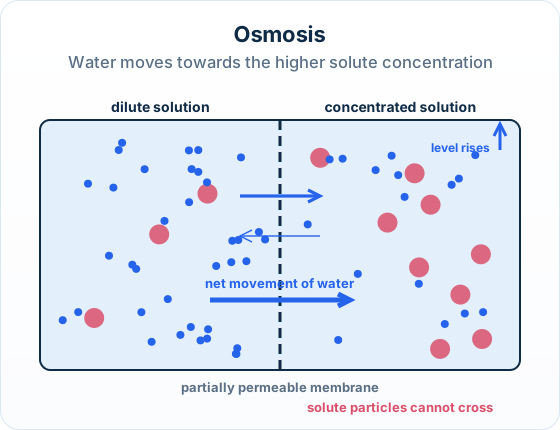
Get the direction right: Water moves towards the more concentrated solution, from hypotonic to hypertonic. Name the solute, not 'the concentration', when you explain it.
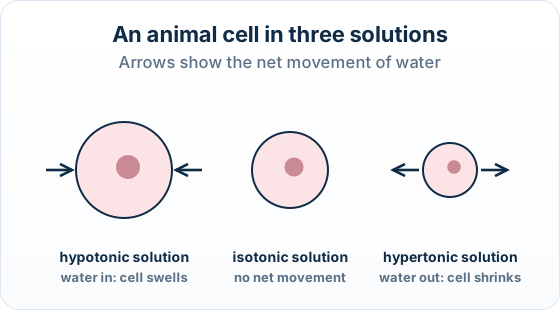
Real example: red blood cells in pure water: Red blood cells placed in pure water take in water by osmosis, swell and burst. In blood plasma, which is isotonic, they keep their shape.
Free preview
This is the free notes preview
You're reading the free notes. Aimnova Pro unlocks the full study experience — and you can try it with your first topic free to keep:
- FlashcardsLock in vocabulary and key terms with spaced repetition.
- Practice questionsAnswer exam-style questions and get instant AI marking.
- Mock exams & past-paper vaultSit full mocks and see exactly how examiners award marks.
- Personalised study planA daily plan built around your exam date and weak areas.
Start Studying Free Full access to Aimnova Pro · cancel anytime
The big idea: Water is polar, so it crosses the bilayer only slowly. Aquaporins are channel proteins that let water through much faster.
The points to remember
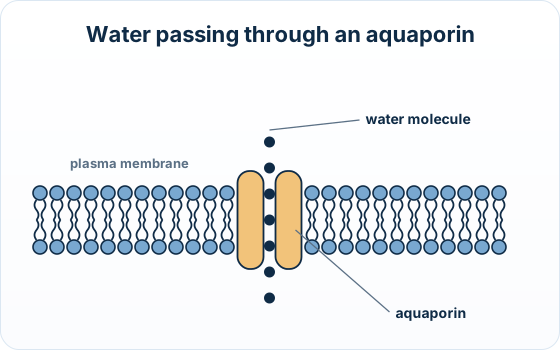
- An aquaporin is an integral channel protein with a narrow pore through the membrane.
- Water molecules pass through the pore in single file; ions are held back.
- Aquaporins increase the permeability of the membrane to water, so osmosis is faster.
- It is still osmosis: passive, no ATP; water follows the difference in solute concentration.
- Each aquaporin carries water quite slowly, so cells that move a lot of water have many: kidney collecting ducts, root cells, gland cells that secrete fluid.
Remember it as: Aquaporin: a water-only door, one molecule at a time.
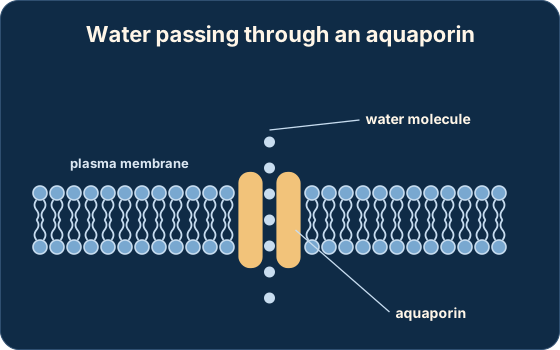
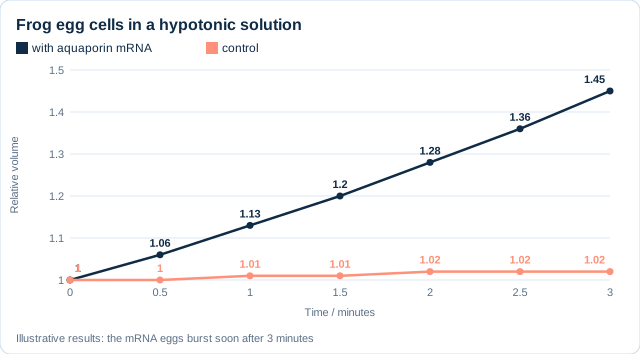
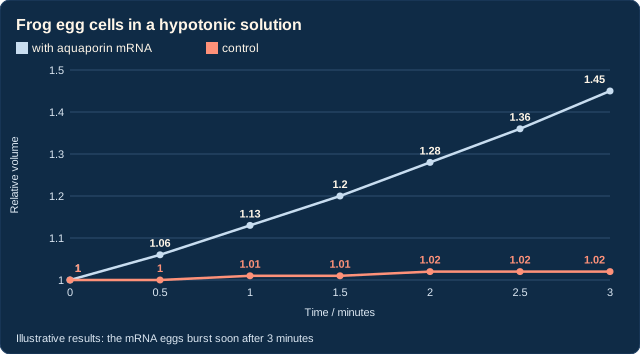
Real example: the discovery: In the early 1990s, Peter Agre's team put the gene message (mRNA) for a membrane protein into frog egg cells, which normally let little water in. In water the eggs swelled and burst: the protein was a water channel. He shared the 2003 Nobel Prize in Chemistry.
Get feedback like a real examiner
Submit your answers and get instant feedback — what you did well, what's missing, and exactly what to write to score full marks.
Try AI Tutor FreeYour first topic is free to keep • No credit card required
The big idea: Data questions on osmosis show a change in volume or mass over time. Read the direction first, then compare the lines, then explain.
How to answer
- Direction: the volume rises, so the net movement of water is into the cells.
- Compare with a comparative word: the mRNA eggs swell faster and more, and burst; the controls hardly change.
- Explain: the solution is hypotonic, so water moves in by osmosis towards the higher solute concentration inside.
- Role of aquaporins: they increase the membrane's permeability to water, so osmosis is faster.
Numbers alone do not compare: Write 'larger' or 'faster', not just the two values. And say 'more permeable' or 'faster', not only 'aquaporins let water in'.
How it is asked: Paper 1B gives a volume or mass graph and asks for the direction and the role of aquaporins. Paper 1A asks what aquaporins are.
IB-style questionExplain[2 marks]
Plant root cells treated with a chemical that blocks aquaporins take up water more slowly. Explain the role of aquaporins in the movement of water across cell membranes.
Model answer plan
See the answer broken into clear points, with guidance on how each point earns marks.