aımnova
DashboardMy LearningCrash CoursesStudy Plan

Aimnova site navigation

Stay in the loop

Get the latest study resources and updates

New features, study tips and exam insights — straight to your inbox.

IB Diploma

  • IB Past Papers
  • IB Study Notes
  • IB Question Bank
  • IB Mock Exams
  • IB Revision

IB Subjects

  • IB Math AA
  • IB Math AI
  • IB Economics
  • IB Business Management
  • IB Physics
  • IB Biology
  • View all IB subjects→

IB Past Papers

  • IB Math AA HL Past Papers
  • IB Math AA SL Past Papers
  • IB Math AI HL Past Papers
  • IB Math AI SL Past Papers
  • IB Economics HL Past Papers
  • IB Economics SL Past Papers
  • IB ESS Past Papers
  • View all past papers→

Study Resources

  • Study Notes
  • Question Bank
  • Mock Exams
  • Crash Courses
  • Flashcards
  • Revision Guide
  • Exam Skills
  • Command Terms
  • Grade Calculator
  • Exam Timetable 2026

Aimnova

  • Features
  • Pricing
  • For Teachers
  • For Schools
  • For Parents
  • About Us
  • Blog
  • Contact
aımnova

IB study, practice and feedback built around the real exam.

TermsPrivacyCookies·© 2026 Aimnova. All rights reserved.c90f7ab

Aimnova is not affiliated with or endorsed by the International Baccalaureate Organization (IB).

NotesBiologyTopic 2.3Lipid bilayers as barriers
Back to Biology Topics
2.3.24 min read

Lipid bilayers as barriers

IB Biology · Unit 2

Your first topic is free to keep

Know exactly what to write for full marks

Practice with exam questions and get AI feedback that shows you the perfect answer — what examiners want to see.

Start Free

Contents

  1. 1A hydrophobic core keeps watery solutions apart
  2. 2Reading permeability data
  3. 3Exam-style question (step by step)
The big idea: The middle of a membrane is oily: hydrophobic hydrocarbon chains. Particles that are large, charged or polar cannot get through it, so the membrane keeps two watery solutions apart.

The points to remember

  • The core of the bilayer is made of the hydrocarbon chains of the fatty acid tails: it is hydrophobic.
  • It has a low permeability to large molecules, such as glucose and proteins.
  • It has a low permeability to hydrophilic particles: ions (Na⁺, K⁺, Cl⁻) and polar molecules.
  • Small, non-polar molecules, such as oxygen and carbon dioxide, pass through easily.
  • So a membrane is an effective barrier between two aqueous (watery) solutions: the cytoplasm and the fluid outside the cell.
Remember it as: Small and non-polar slips through; large, polar or charged is held back.
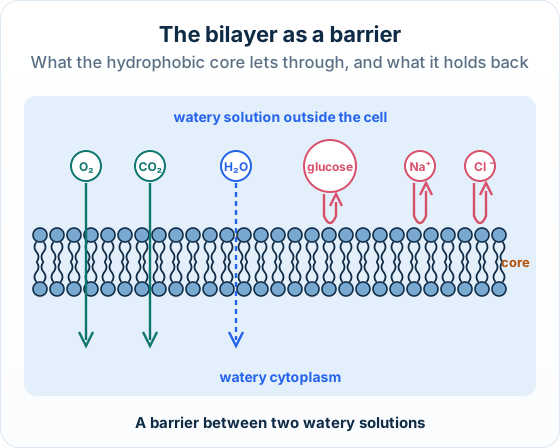
A phospholipid bilayer between two watery solutions; oxygen and carbon dioxide arrows pass straight through, a dashed water arrow passes slowly, glucose and sodium and chloride ions are turned back at the surface
The hydrophobic core lets small non-polar molecules through and holds back the rest.
Real example: red blood cells: A red blood cell holds about 30 times more potassium than the plasma around it. The bilayer stops the charged ions from simply leaking out.

Free preview

This is the free notes preview

You're reading the free notes. Aimnova Pro unlocks the full study experience — and you can try it with your first topic free to keep:

  • FlashcardsLock in vocabulary and key terms with spaced repetition.
  • Practice questionsAnswer exam-style questions and get instant AI marking.
  • Mock exams & past-paper vaultSit full mocks and see exactly how examiners award marks.
  • Personalised study planA daily plan built around your exam date and weak areas.
Start Studying Free Full access to Aimnova Pro · cancel anytime
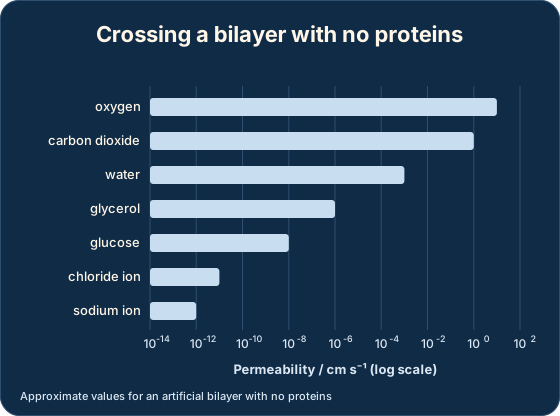
The big idea: Data questions show how fast different substances cross a bilayer with no proteins. Read the pattern: size first, then polarity and charge.
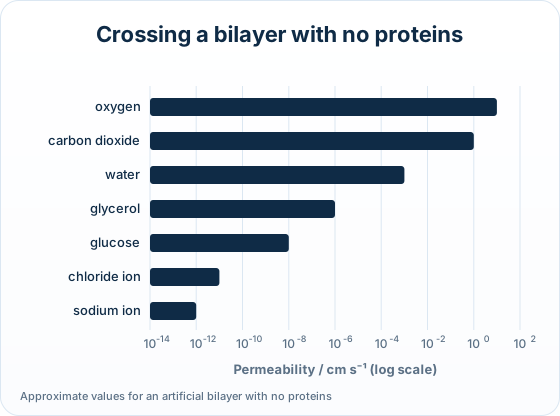
Bar chart on a log scale of how fast seven substances cross a phospholipid bilayer with no proteins: oxygen and carbon dioxide fastest, then water, glycerol, glucose, and chloride and sodium ions slowestBar chart on a log scale of how fast seven substances cross a phospholipid bilayer with no proteins: oxygen and carbon dioxide fastest, then water, glycerol, glucose, and chloride and sodium ions slowest
Approximate values for a bilayer with no proteins: the longer the bar, the faster it crosses.

How to read it

  • The scale is logarithmic: each grid line is 100 times more than the last.
  • Oxygen and carbon dioxide (small, non-polar) cross fastest.
  • Glucose (large, polar) crosses about 100,000 times more slowly than water.
  • Ions (sodium, chloride) are slowest of all: the core is almost a wall to charged particles.
Do not say water cannot cross: Water is polar, but it is very small, so a little does cross the bilayer. Say it crosses slowly.

Get feedback like a real examiner

Submit your answers and get instant feedback — what you did well, what's missing, and exactly what to write to score full marks.

Try AI Tutor FreeYour first topic is free to keep • No credit card required
How it is asked: This idea is the reason behind most transport questions: why a particle needs a protein to cross. It is asked as a short Explain, or with a chart of permeabilities.
IB-style questionExplain[3 marks]

Explain why a cell membrane acts as a barrier between the cytoplasm and the tissue fluid around a cell.

Model answer plan

See the answer broken into clear points, with guidance on how each point earns marks.

Claim your free topic

And a two-mark data question:

IB-style questionExplain[2 marks]

A bilayer with no proteins lets oxygen through about 10 million million times faster than sodium ions. Explain this difference.

Model answer plan

See the answer broken into clear points, with guidance on how each point earns marks.

Claim your free topic

IB Exam Questions on Lipid bilayers as barriers

Practice with IB-style questions filtered to Topic 2.3.2. Get instant AI feedback on every answer.

Practice Topic 2.3.2 QuestionsBrowse All Biology Topics

How Lipid bilayers as barriers Appears in IB Exams

Examiners use specific command terms when asking about this topic. Here's what to expect:

  • Define

    Give the precise meaning of key terms related to Lipid bilayers as barriers.

    AO1
  • Describe

    Give a detailed account of processes or features in Lipid bilayers as barriers.

    AO2
  • Explain

    Give reasons WHY — cause and effect within Lipid bilayers as barriers.

    AO3
  • Evaluate

    Weigh strengths AND limitations of approaches in Lipid bilayers as barriers.

    AO3
  • Discuss

    Present arguments FOR and AGAINST with a balanced conclusion.

    AO3

See the full IB Command Terms guide

Related Biology Topics

Continue learning with these related topics from the same unit:

2.1.1Chemical properties of carbon that allow diverse compounds2.1.2Production of macromolecules by condensation reactions2.1.3Digestion of polymers into monomers by hydrolysis reactions2.1.4Form and function of monosaccharides
View all Biology topics
Improve your exam techniqueCommand terms, paper structure, and mark-scheme tips for Biology
Previous2.3.1Lipid bilayers as the basis of cell membranesNextSimple diffusion across membranes2.3.3

4 exam-style questions ready for you

Students who practice on Aimnova improve their scores by 15% on average. Get instant feedback that shows exactly how to improve your answers.

Practice Now — FreeView All Biology Topics