The big idea: Every cell is wrapped in a cell membrane (plasma membrane) — a thin, flexible barrier that controls what enters and leaves the cell.
What it is made of
- Its basic structure is a phospholipid bilayer: two rows of phospholipid molecules
- Dotted all through this bilayer are proteins, glycoproteins and cholesterol
- These parts can drift around and are scattered like tiles, so the membrane is described as a fluid mosaic
The fluid mosaic model: a phospholipid bilayer (hydrophilic heads facing the water on both sides, hydrophobic tails tucked into the core) with proteins, glycoproteins and cholesterol embedded like tiles in a mosaic.
Interactive diagram
Explore the labelled diagram, charts and maps for this topic in full study mode.
- Cell (plasma) membrane
- The thin barrier surrounding every cell that controls which substances cross into and out of it.
- Phospholipid
- The molecule that makes up most of the membrane: a hydrophilic phosphate head joined to two hydrophobic fatty-acid tails.
- Phospholipid bilayer
- Two rows of phospholipids — heads facing the water on both surfaces, tails facing inward — that form the basic membrane sheet.
- Amphipathic
- Having both a hydrophilic (water-loving) part and a hydrophobic (water-hating) part in the same molecule. Phospholipids are amphipathic.
- Fluid mosaic model
- The accepted model of the membrane: a fluid phospholipid bilayer with proteins and other molecules scattered through it like tiles in a mosaic.
Why 'fluid' and why 'mosaic': Fluid — the phospholipids and many proteins are not fixed; they can drift sideways within the bilayer, so the membrane behaves a bit like a liquid.
Mosaic — many different kinds of molecule (proteins, glycoproteins, cholesterol) are dotted through the bilayer, like the different tiles in a mosaic picture.
Free preview
This is the free notes preview
You're reading the free notes. Aimnova Pro unlocks the full study experience — and you can try it with your first topic free to keep:
- FlashcardsLock in vocabulary and key terms with spaced repetition.
- Practice questionsAnswer exam-style questions and get instant AI marking.
- Mock exams & past-paper vaultSit full mocks and see exactly how examiners award marks.
- Personalised study planA daily plan built around your exam date and weak areas.
The big idea: A drawing of the fluid mosaic model scores when every required part is there, in the right place, and labelled.
What the drawing must show
- Phospholipid bilayer: two rows, heads outwards, tails inwards.
- Integral protein through the bilayer; peripheral protein on one surface.
- Glycoprotein with its carbohydrate chain on the outside.
- Cholesterol between the phospholipid tails.
- Labels for the hydrophilic heads and the hydrophobic core.
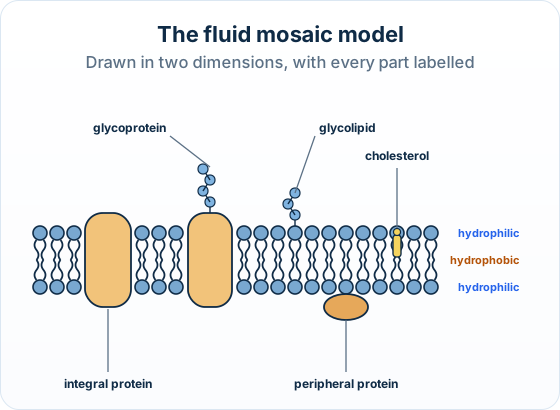
Common slips: Carbohydrate chains drawn on the inside, or peripheral proteins drawn inside the core, lose marks. Use a ruler for label lines and keep them clear of the drawing.
Practice with exam-style questions
Answer exam-style questions and get AI feedback that shows you exactly what examiners want to see in a full-marks response.
The big idea: Fluid: the parts drift sideways. Mosaic: many different molecules are scattered through the bilayer, like tiles.
The points to remember
- Fluid: phospholipids and many proteins are not fixed; they move sideways within the bilayer.
- Mosaic: proteins, glycoproteins, glycolipids and cholesterol are embedded throughout the bilayer; name them, not just 'molecules'.
- Hydrophilic regions: the phosphate heads and the carbohydrate chains, facing water.
- Hydrophobic region: the fatty acid tails of the core.
- Cholesterol sits among the tails and makes the membrane less permeable to small molecules.
Real example: where the model came from: In 1972 Singer and Nicolson proposed the fluid mosaic model. Electron micrographs of membranes split down the middle showed proteins passing right through the core of the bilayer.
How it is asked: Paper 2 asks you to draw the model or to explain the words fluid and mosaic. Paper 1A shows a drawn model and asks which regions are hydrophilic, or which part does a job.
Draw a labelled diagram of the fluid mosaic model of a membrane.
Model answer plan
See the answer broken into clear points, with guidance on how each point earns marks.
And a one-mark Outline:
Outline why the structure of a membrane is described as a mosaic.
Model answer plan
See the answer broken into clear points, with guidance on how each point earns marks.