The big idea: An organism's ecological niche is its role in an ecosystem — not just where it lives, but how it lives.
A niche is described by three things
- The abiotic conditions the species can tolerate (temperature, oxygen, pH and so on)
- Its food source (how it obtains energy)
- Its interactions with other species (predators, prey, competitors, partners)
Address and job: Think of the habitat as an organism's address, and the niche as its job.
- Ecological niche
- The role a species plays in its ecosystem — its abiotic tolerances, the way it obtains food, and its interactions with other species.
- Habitat
- The place where an organism lives. (The habitat is the 'address'; the niche is the 'job'.)
- Abiotic factor
- A non-living physical condition of the environment, such as temperature, oxygen concentration, light or pH.
- Biotic factor
- A living influence on an organism, such as predators, prey, competitors or partner species.
- Tolerance range
- The range of an abiotic factor (for example temperature) within which a species can survive and grow.
Address vs job: Two species can share the same habitat (live in the same pond) but have different niches — one feeds on algae at the surface, the other on insects near the bottom.
So 'where it lives' alone never fully describes a niche; you must also say what it eats and how it interacts with other species.
Free preview
This is the free notes preview
You're reading the free notes. Aimnova Pro unlocks the full study experience — and you can try it with your first topic free to keep:
- FlashcardsLock in vocabulary and key terms with spaced repetition.
- Practice questionsAnswer exam-style questions and get instant AI marking.
- Mock exams & past-paper vaultSit full mocks and see exactly how examiners award marks.
- Personalised study planA daily plan built around your exam date and weak areas.
To describe a species' niche fully you give three kinds of information: the physical conditions it can tolerate, its food source, and its interactions with other species.
Together these define exactly how the species fits into its ecosystem.
| Part of the niche | What it describes | Example for a small lake fish |
|---|---|---|
| Abiotic tolerances | The range of physical conditions the species can survive in (temperature, oxygen, pH, light) | Survives in cool, well-oxygenated, shallow water |
| Food / energy source | How and what the species feeds on (its mode of nutrition) | Eats small invertebrates among the plants |
| Interactions with other species | How it relates to predators, prey, competitors and partners | Shelters among submerged plants to avoid predators |
Abiotic tolerances set the limits: Every species can only survive within a tolerance range for each abiotic factor. A fish that needs cool, well-oxygenated water cannot live in a warm, stagnant pond — the conditions fall outside its tolerance.
Tolerances as data: These tolerance ranges are a big part of the niche, and exams often give them as data (for example a table of preferred temperatures) and ask you to reason about which species could live where.
Fundamental vs realized niche: The fundamental niche is the full range of conditions and resources a species could use if nothing got in its way. The realized niche is the smaller part it actually uses once competitors are present.
Competition shrinks the niche: When two species want the same resources, competition pushes each into a smaller realized niche — this is the start of the competitive exclusion idea you meet in 2.10.4.
A niche is a species' role and its place along a resource gradient. Alone, species A occupies its full fundamental niche; a competitor restricts it to a smaller realized niche.
Interactive diagram
Explore the labelled diagram, charts and maps for this topic in full study mode.
Fundamental niche
- The full range a species could occupy
- Assumes no competitors
- The species' potential
- Larger than the realized niche
Realized niche
- The part it actually occupies
- Takes competitors into account
- What the species really does
- Smaller — restricted by competition
An easy way to remember: Fundamental = the full menu a species could order from. Realized = what's left on the plate after competitors have taken their share.
And for the three parts of a niche: conditions, food, friends-and-foes (abiotic tolerances, food source, interactions).
Feeling unprepared for exams?
Get a clear study plan, practice with real questions, and know exactly where you stand before exam day. No more guessing.
The big idea: A niche is made of interactions: with abiotic conditions and with other organisms. Each one affects the species' growth, survival or reproduction.
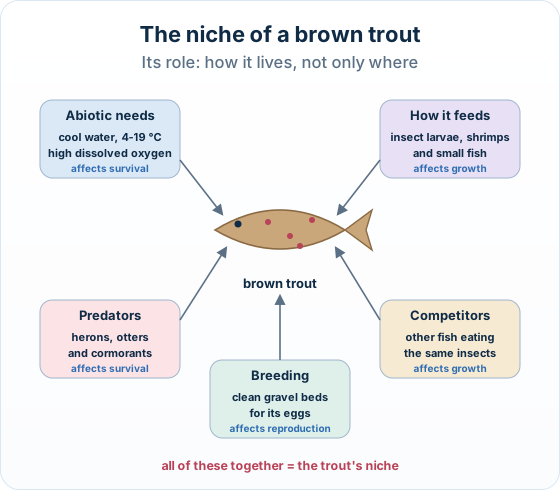
The points to remember
- Abiotic interactions: the conditions it needs, such as temperature, oxygen, light or water.
- How it obtains food: what it eats, or how it makes its own food.
- Biotic interactions: predators, prey, competitors, parasites and partners.
- What it needs to reproduce, such as nest sites or breeding grounds.
Remember it as: Ask: what does it need, what does it eat, who eats it, who competes with it, where does it breed?
Real example: the Atlantic puffin. Puffins feed their chicks on sandeels, nest in burrows on grassy cliff tops and are hunted by great skuas; in years when sandeels are scarce, many chicks starve: food is part of the niche.
Trap: 'It lives in a river' describes the habitat. A niche answer must say how it lives there.
How this is tested: Three question types come up on the niche, each answered in its own way.
| Question | What it asks | How to score |
|---|---|---|
| Short Define or Outline | What an ecological niche is | Give more than just 'where it lives': include the abiotic tolerances, the food source and the interactions with other species |
| Data question (a favourite) | The preferred temperature ranges (or oxygen needs) of several species; deduce which statements about their niches are valid | Read the data, do not rely on memory |
| Suggest | Why an organism is more abundant in one micro-habitat than another | Link your answer to the niche (the shelter, food or conditions that place provides) |
Exam-style question — define an ecological niche
Define the term ecological niche. [3]
How to score all three marks
- Start with the role. A niche is the role a species plays in its ecosystem — how it lives, not only where.
- Name the abiotic part. It includes the range of abiotic conditions (such as temperature and oxygen) that the species can tolerate.
- Add food and interactions. It also includes the species' food/energy source (mode of nutrition) and its interactions with other species (predators, prey, competitors).
Final answer
An ecological niche is the role a species plays in its ecosystem: the range of abiotic conditions it tolerates, the way it obtains food, and its interactions with other species.
Why this works: It does not stop at 'where the organism lives'. It names all three parts — abiotic tolerances, food source and interactions — so each is a separate scoring point.
The single most common error is answering only with the habitat ('it lives in a lake').
| Part of the niche | What it describes | Example for a small lake fish |
|---|---|---|
| Abiotic tolerances | The range of physical conditions the species can survive in (temperature, oxygen, pH, light) | Survives in cool, well-oxygenated, shallow water |
| Food / energy source | How and what the species feeds on (its mode of nutrition) | Eats small invertebrates among the plants |
| Interactions with other species | How it relates to predators, prey, competitors and partners | Shelters among submerged plants to avoid predators |