The big idea: There are far more endangered species than money, land and time to save them all. So conservationists must choose which species to protect first — they prioritise.
The EDGE programme is one way of choosing. It rates each species on two things at once:
The two EDGE scores
- How evolutionarily distinct it is (how unusual its place on the tree of life).
- How globally endangered it is (how close it is to extinction).
| The two letters in 'EDGE' | What it measures |
|---|---|
| ED — Evolutionarily Distinct | Has few close living relatives — a unique, long branch on the tree of life |
| GE — Globally Endangered | At high risk of extinction worldwide (e.g. very few individuals left) |
What 'EDGE' stands for: E·D·G·E = Evolutionarily Distinct and Globally Endangered.
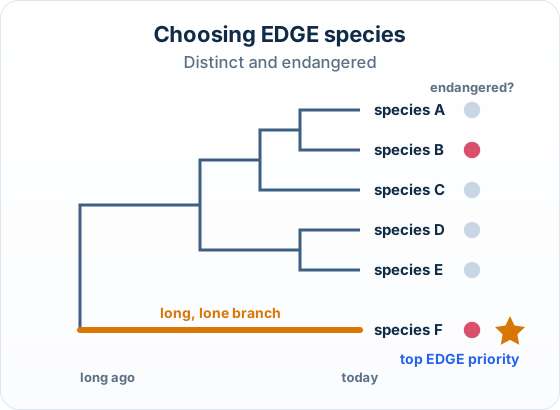
A species scores highly only when it is BOTH — strange on the tree of life AND close to dying out.
Free preview
This is the free notes preview
You're reading the free notes. Aimnova Pro unlocks the full study experience — and you can try it with your first topic free to keep:
- FlashcardsLock in vocabulary and key terms with spaced repetition.
- Practice questionsAnswer exam-style questions and get instant AI marking.
- Mock exams & past-paper vaultSit full mocks and see exactly how examiners award marks.
- Personalised study planA daily plan built around your exam date and weak areas.
An evolutionarily distinct species has very few close living relatives.
Why that matters
- Its branch on the evolutionary tree is long and lonely.
- So it carries a large share of unique evolutionary history and unique genes.
- If that species goes extinct, that whole branch — and everything special about it — is lost forever.
- This is because no similar species can replace it.
- Biodiversity
- The variety of life — the range of different species (and of genes and ecosystems) in an area.
- Conservation
- Protecting species and habitats so that biodiversity is maintained for the future.
- Evolutionarily distinct
- Having very few close living relatives — a long, separate branch on the tree of life, carrying unique evolutionary history.
- Globally endangered
- At high risk of extinction across the whole world (e.g. very small or fast-falling population).
- EDGE species
- A species that is BOTH highly evolutionarily distinct AND globally endangered — so it is given high priority for conservation.
EDGE combines the two scores.
Lower priority
- Distinct but common — not urgent, it is not about to disappear
- Endangered but has many close relatives — a smaller loss to the tree of life, because similar species remain
Top priority
- A species that is high on both — distinct AND endangered
- Saving it protects the most unique, irreplaceable part of biodiversity
| Example species | Evolutionarily distinct? | Globally endangered? | EDGE priority |
|---|---|---|---|
| A lone-branch reptile near extinction | Yes — few relatives | Yes — very rare | HIGH |
| A common bird with many close relatives | No — many relatives | No — abundant | LOW |
| A rare frog with many similar species | No — many relatives | Yes — rare | MEDIUM |
Why distinctness matters: Saving an evolutionarily distinct species protects a unique branch of the tree of life and its unique genes.
If it dies out, no other species can replace what is lost — so its disappearance costs biodiversity far more than losing a species with many close relatives.
An evolutionarily distinct species sits alone on a long branch — a high EDGE score.
Interactive diagram
Explore the labelled diagram, charts and maps for this topic in full study mode.
Never wonder what to study next
Get a personalized daily plan based on your exam date, progress, and weak areas. We'll tell you exactly what to review each day.
The big idea: EDGE scores come from evidence: DNA shows how distinct a species is, and the Red List how endangered. Deciding which species come first is still a choice that people debate.
The points to remember
- Evolutionary distinctness is worked out from DNA base sequences: they show how long ago a species split from its closest relatives.
- Global endangerment comes from the IUCN Red List, which grades how close each species is to extinction.
- A species near the top of an EDGE list scores high on both.
- The aim: save as much unique evolutionary history as possible with limited money and time.
- Choosing has ethical, environmental, political, social, cultural and economic effects, so it is debated.
- For example, a little-known EDGE species may get money that a famous animal does not.
Remember it as: Long branch, short time left.
Real example: Attenborough's long-beaked echidna: This spiny, egg-laying mammal lives only in the mountains of one island in Indonesia. It is one of just five egg-laying mammals alive and is critically endangered: a top EDGE mammal.
Explain the programme, do not just spell it out:
More than the letters: Writing out what E, D, G and E stand for is not enough. Say what EDGE does: it ranks species so that limited effort saves the most evolutionary history.
How this is tested: On Paper 1A (multiple choice) you are asked to identify why a species is prioritised by EDGE — the answer is that it is both evolutionarily distinct AND globally endangered.
Paper 2: On Paper 2 a short Describe question (about 2 marks) asks you to describe the purpose of the EDGE of Existence programme.
Exam-style question — the purpose of EDGE
Describe the purpose of the EDGE of Existence conservation programme. [2]
How to score both marks
- Say what EDGE chooses between. It is a way of prioritising which species to conserve when resources are limited — it ranks species rather than treating them all the same.
- Give the two criteria it uses. It targets species that are evolutionarily distinct (few close relatives / a unique branch of the tree of life) and globally endangered (at high risk of extinction).
- Answer the command term ('describe'). Purpose: to direct conservation effort to the species whose loss would remove the most unique, irreplaceable evolutionary history — those that are both distinct and endangered.
Final answer
The purpose of EDGE is to prioritise conservation: it ranks and targets species that are both evolutionarily distinct (few close relatives, a unique branch of the tree of life) and globally endangered (at high risk of extinction), so that limited effort protects the most irreplaceable biodiversity.
Where the two marks come from: Mark 1: EDGE is for prioritising / choosing which species to conserve.
Mark 2: it targets species that are evolutionarily distinct AND globally endangered.
A common mistake is naming only one of the two criteria — you need both.