The big idea: Whole genome sequencing reads every base of a genome, and it has become very fast and very cheap.
- Whole genome sequencing
- Determining the full order of bases (A, T, C, G) across an organism's entire genome.
The points to remember
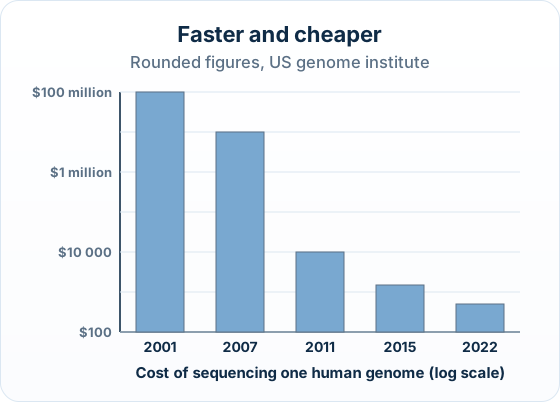
- The first human genome (2003) took 13 years and cost about $2.7 billion in all.
- Today a human genome can be read in about a day for a few hundred dollars.
- Faster and cheaper sequencing means any species, and many individuals, can be sequenced.
Remember it as: Thirteen years then; about a day now.
Free preview
This is the free notes preview
You're reading the free notes. Aimnova Pro unlocks the full study experience — and you can try it with your first topic free to keep:
- FlashcardsLock in vocabulary and key terms with spaced repetition.
- Practice questionsAnswer exam-style questions and get instant AI marking.
- Mock exams & past-paper vaultSit full mocks and see exactly how examiners award marks.
- Personalised study planA daily plan built around your exam date and weak areas.
The big idea: Comparing whole genomes shows how species are related now; reading each patient's genome may guide medicine in future.
The points to remember
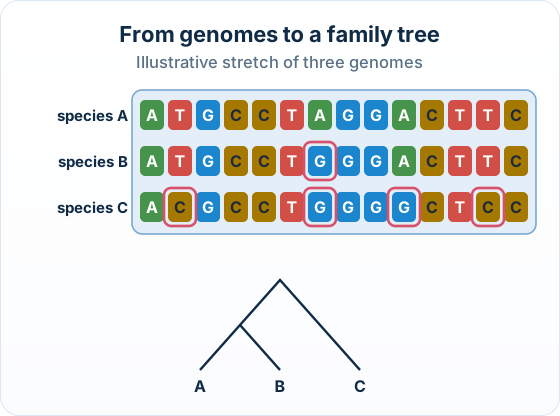
- Current: research into evolutionary relationships: genomes are aligned and differences counted.
- Fewer differences mean a more recent common ancestor; differences can date splits (molecular clock) and build cladograms.
- Current: identifying the cause of genetic diseases, and helping to conserve endangered species.
- Future: personalized medicine, for example the right drug and dose for each person.
Real example: the 100 000 Genomes Project: From 2012 to 2018 the UK sequenced the whole genomes of about 100 000 patients with rare diseases or cancer. For about a quarter of the rare-disease patients it found the cause.
Some uses are not credited as uses of whole genome sequencing:
Say whose genome, and what for: Personalized medicine must mention the individual patient. Paternity tests, forensics and cloning do not count as answers here.
Get feedback like a real examiner
Submit your answers and get instant feedback — what you did well, what's missing, and exactly what to write to score full marks.
How this is tested: This topic is tested on Paper 1A and on Paper 1B / Paper 2.
What you may be asked
- On Paper 1A you may be asked which is a current use of whole genome sequencing.
- At Higher Level, Paper 2 can ask how sequencing reveals evolutionary relationships.
- On Paper 1B / Paper 2 the headline question is a Discuss task on the present and future applications of whole genome sequencing — worth several marks.
Exam-style question — applications of whole genome sequencing
Whole genome sequencing is now fast and affordable. Discuss the present and possible future applications of whole genome sequencing. [3]
How to build a full-mark 'Discuss'
- Give a present-day use. Sequencing a patient's genome can diagnose inherited diseases or identify mutations, so treatment can be tailored to the individual (personalised medicine).
- Give a second, different use. Comparing genomes lets biologists work out how species are related and build accurate evolutionary (phylogenetic) trees.
- Add a future possibility AND a balancing point. In future, cheap sequencing could screen newborns for risk of many diseases — but this raises concerns about privacy and how genetic data is used. (A 'Discuss' answer needs benefits and a limitation/concern.)
- Answer the command term. State a clear overall judgement: whole genome sequencing already supports diagnosis and evolutionary studies, and will likely expand into prediction and prevention, provided ethical safeguards keep pace.
Final answer
Present uses include diagnosing genetic disease and personalising treatment, and comparing genomes to map evolutionary relationships; future uses include predictive screening — balanced against privacy and ethical concerns about genetic data.
What 'Discuss' is looking for: Two or more distinct applications, at least one future use, and a limitation or ethical concern — finishing with a clear overall judgement. Listing three benefits with no balancing point usually caps the marks.
Discuss the current and potential future uses of whole genome sequencing.
Model answer plan
See the answer broken into clear points, with guidance on how each point earns marks.