The big idea: Cell theory is one of the foundations of biology. It says three things.
The three parts of cell theory
- All living things are made of one or more cells.
- The cell is the basic unit of structure and function in life.
- New cells only come from existing cells (by cell division).
So: There is no smaller living unit than a cell — and a cell never appears from non-living material.
The functions of life
- Homeostasis: keeping conditions inside the cell steady, such as its water content
- Metabolism: all the chemical reactions inside the cell
- Nutrition: taking in (or making) the food and nutrients it needs
- Movement: moving itself, or moving things around inside the cell
- Excretion: removing the waste products of metabolism
- Growth: getting larger or making more living material
- Response to stimuli: reacting to changes in the surroundings
- Reproduction: making new cells / new organisms
A single-celled Paramecium: each visible structure is labelled with the function of life it carries out — one cell carries out every function of life by itself.
Interactive diagram
Explore the labelled diagram, charts and maps for this topic in full study mode.
Why this matters: Because a cell is the smallest living thing, every cell must carry out all the jobs needed to stay alive by itself.
Those jobs are the functions of life above.
Free preview
This is the free notes preview
You're reading the free notes. Aimnova Pro unlocks the full study experience — and you can try it with your first topic free to keep:
- FlashcardsLock in vocabulary and key terms with spaced repetition.
- Practice questionsAnswer exam-style questions and get instant AI marking.
- Mock exams & past-paper vaultSit full mocks and see exactly how examiners award marks.
- Personalised study planA daily plan built around your exam date and weak areas.
For a long time people believed in spontaneous generation — the idea that living things could appear from non-living matter (for example, maggots simply forming on meat).
How Louis Pasteur disproved it
- He boiled broth in swan-neck flasks.
- The broth stayed clear because microbes from the air were trapped in the bend.
- When the neck was broken off, microbes reached the broth and it turned cloudy.
- This showed that cells (microbes) only come from other cells, not from the broth itself.
- Cell theory
- Living things are made of cells; the cell is the basic unit of life; cells come only from pre-existing cells.
- Spontaneous generation
- The disproved idea that living organisms can arise from non-living material.
- Functions of life
- The processes every living organism carries out: homeostasis, metabolism, nutrition, movement, excretion, growth, response to stimuli and reproduction.
- Unicellular organism
- An organism made of a single cell that carries out all the functions of life by itself.
- Excretion
- The removal of the waste products of metabolism from the cell or organism.
A single cell must do it all: A unicellular organism — such as Paramecium or a yeast cell — is one cell that is a whole organism.
It has no other cells to help it, so that one cell must perform every function of life: it feeds, respires, grows, responds, reproduces, and removes its own waste.
Stop wasting time on topics you know
Our AI identifies your weak areas and focuses your study time where it matters. No more overstudying easy topics.
The big idea: Cell theory lets us predict before we look: any newly discovered organism will be made of one or more cells. That is deductive reasoning.
The points to remember
- A theory explains many observations; cell theory says all living things are made of one or more cells.
- Deductive reasoning goes from a general theory to a prediction about a particular case.
- Deduced from cell theory: a newly discovered organism will consist of one or more cells.
- A prediction can be tested, for example by looking at the organism under a microscope.
- Each time a prediction is supported, confidence in the theory grows; one clear failure would challenge it.
Remember it as: Theory first, prediction next, then look.
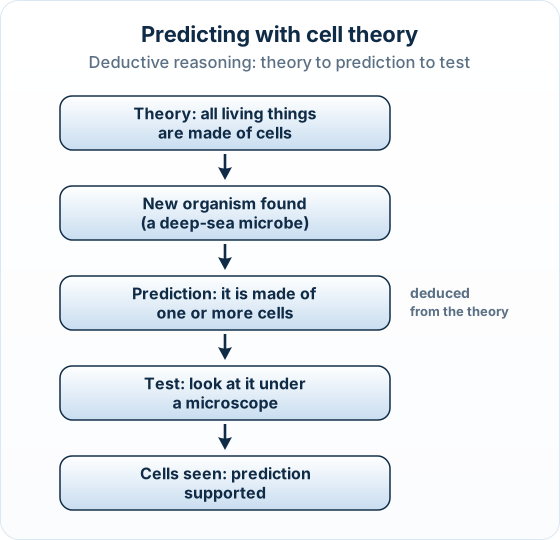
Real example: a microbe found by its DNA: Scientists first found DNA of a new group of archaea in deep-sea mud. Cell theory predicted it came from cells. In 2020, after 12 years of trying, a Japanese team grew one: tiny round cells with long branches.
Keep the direction of the reasoning right:
Deduction starts from the theory: Deductive reasoning goes from the general theory to a prediction about one organism. Going from many observations to a general rule is induction.
How this is tested: This sub-topic comes up as a quick identify question and as a short Explain question.
Where it comes up
- Paper 1A (multiple choice): identify a function of life from a description (e.g. a Paramecium ingesting algae = nutrition).
- Paper 1A: recognise the evidence that disproved spontaneous generation.
- Paper 2: a short Explain question on why a single cell that performs all the functions of life must also carry out one named function — such as excretion.
IB-style question — why a single cell must excrete
A unicellular alga lives in pond water and carries out all the functions of life. Explain why this single cell must also carry out excretion. [2]
How to score both marks
- Start from metabolism. The cell's chemical reactions (metabolism), such as respiration, produce waste products — for example carbon dioxide (CO₂).
- Say why the waste is a problem. If these waste products are not removed, they build up and become toxic / harmful, which would damage or kill the cell.
- Answer the command term — explain. So the cell must carry out excretion (removing metabolic waste) to stay alive, because no other cell can do it for a single-celled organism.
Final answer
Metabolism (e.g. respiration) makes waste products such as CO₂; if not removed they build up and become toxic, so the cell must excrete to survive.
What earns the marks: A full answer needs both ideas: (1) metabolism produces waste (name one, e.g. CO₂), and (2) the waste would build up and harm the cell if it were not excreted.
Just writing 'to remove waste' on its own is usually only worth one mark.