The menstrual cycle at Higher Level: The same statement as SL. At HL the same hormones return in puberty (4.7.13), IVF (4.7.7) and pregnancy (4.7.19).
Practise this as you read
- Outline the roles of FSH, LH, oestradiol and progesterone.
- Identify positive and negative feedback on a hormone graph.
Free preview
This is the free notes preview
You're reading the free notes. Aimnova Pro unlocks the full study experience — and you can try it with your first topic free to keep:
- FlashcardsLock in vocabulary and key terms with spaced repetition.
- Practice questionsAnswer exam-style questions and get instant AI marking.
- Mock exams & past-paper vaultSit full mocks and see exactly how examiners award marks.
- Personalised study planA daily plan built around your exam date and weak areas.
The big idea: The menstrual cycle is the roughly 28-day sequence that prepares the body for a possible pregnancy each month. It is run by four hormones working in a set order.
Pituitary gland (in the brain)
- FSH
- LH
Ovary
- Oestrogen
- Progesterone
Feedback: Each hormone has its own job, and they switch each other on and off through feedback — that timed teamwork is what the exam tests.
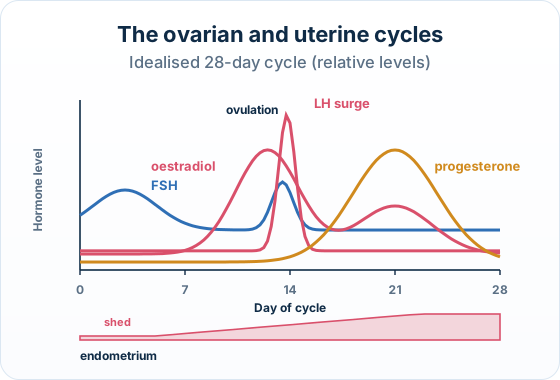
- Menstrual cycle
- The roughly 28-day cycle in which the uterus lining is built up and the ovary releases an egg, ready for a possible pregnancy.
- FSH (follicle-stimulating hormone)
- A hormone from the pituitary gland that stimulates a follicle in the ovary to grow and mature.
- Follicle
- A fluid-filled sac in the ovary that holds and protects a developing egg; the growing follicle makes oestrogen.
- Oestrogen
- A hormone made by the growing follicle. It repairs and thickens the uterus lining and, at high levels, triggers the LH surge.
- LH (luteinising hormone)
- A hormone from the pituitary gland. A sharp surge of LH around day 14 causes ovulation.
- Ovulation
- The release of a mature egg from the ovary, caused by the LH surge around day 14.
- Corpus luteum
- What the empty follicle becomes after ovulation. It secretes progesterone.
- Progesterone
- A hormone from the corpus luteum that maintains the thick uterus lining in the second half of the cycle.
Pituitary vs ovary — a quick sort: Two hormones come from the brain (pituitary) and two from the ovary.
Pituitary: FSH and LH (the two with the short letter names).
Ovary: oestrogen and progesterone.
Exam questions love to ask you to name one pituitary AND one ovarian hormone — keep the two groups straight.
Get feedback like a real examiner
Submit your answers and get instant feedback — what you did well, what's missing, and exactly what to write to score full marks.
Follow the cycle in order and each hormone's job — and the moment it acts — makes sense.
Read it as cause and effect: Read it as a chain of cause and effect: one hormone rises, that triggers the next event, which switches the next hormone on or off.
The cycle, step by step
- FSH rises and stimulates a follicle to grow in the ovary.
- The growing follicle releases oestrogen, which repairs and thickens the uterus lining.
- Oestrogen climbs high and, by positive feedback, triggers a sudden LH surge (~day 14).
- The LH surge causes ovulation — the mature egg is released from the ovary.
- The empty follicle becomes the corpus luteum, which releases progesterone.
- Progesterone maintains the thick lining and inhibits FSH and LH, so no new follicle starts.
- If there is no pregnancy, the corpus luteum breaks down, progesterone falls, and the lining is shed — this is menstruation, and a new cycle begins.
Two kinds of feedback: The cycle is timed by feedback — hormones controlling the hormones that made them.
Negative feedback (most of the cycle)
- Oestrogen and progesterone inhibit FSH and LH
- This stops extra follicles ripening
- It keeps the lining stable
Positive feedback (just before ovulation)
- A high level of oestrogen stimulates a big release of LH
- This is the LH surge that causes ovulation
One hormone, two kinds of feedback: The same hormone (oestrogen) acts by negative feedback when low and positive feedback when high — this switch is the clever part of the cycle.
| Feedback | When | What happens |
|---|---|---|
| Negative feedback | Most of the cycle | Oestrogen and progesterone INHIBIT FSH and LH — this stops more than one follicle ripening at a time |
| Positive feedback | Just before ovulation (~day 12-14) | A high level of oestrogen STIMULATES a big release of LH (the LH surge) → ovulation |
| Negative feedback (luteal) | Second half of the cycle | Progesterone from the corpus luteum INHIBITS FSH and LH, keeping the lining stable |
The role of progesterone (a 4-mark favourite): Progesterone is the second-half hormone, and the exam asks about it directly.
What progesterone does
- It is secreted by the corpus luteum.
- It maintains and thickens the uterus lining, ready to receive an embryo.
- It inhibits FSH and LH (negative feedback), so no new follicle develops.
- If there is no pregnancy, progesterone falls — this lets the lining break down (menstruation) and lets FSH rise again to start the next cycle.
First half (before ovulation)
- FSH grows a follicle
- Oestrogen rises → thickens the lining
- High oestrogen → positive feedback → LH surge
- Ends with ovulation (~day 14)
Second half (after ovulation)
- Corpus luteum makes progesterone
- Progesterone maintains the lining
- Progesterone + oestrogen → negative feedback → FSH and LH stay low
- No pregnancy → progesterone falls → menstruation
An easy way to remember: FSH = Follicle grows. LH = Launches the egg (ovulation). Oestrogen = builds the lining. Progesterone = protects/maintains the lining.
The big idea: The ovarian cycle (follicle, ovulation, corpus luteum) and the uterine cycle (endometrium shed, rebuilt, maintained) run together as the menstrual cycle, timed by four hormones.
See it drawn, step by step
In My Learning, handwritten diagrams build one step at a time. Play, pause and replay each explanation until it clicks. Create your free account to try it.
The points to remember
- FSH (pituitary): a follicle develops.
- Oestradiol (follicle): endometrium thickens; high levels give the LH surge (positive feedback).
- LH (pituitary): the surge causes ovulation around day 14.
- Progesterone (corpus luteum): maintains the endometrium; with oestradiol it inhibits FSH and LH (negative feedback). When it falls, menstruation starts.
Names. The guide calls the main oestrogen oestradiol: write 'oestradiol' in answers.
Remember it as: FSH grows it, LH launches it, progesterone keeps the lining.
Learn what examiners really want
See exactly what to write to score full marks. Our AI shows you model answers and the key phrases examiners look for.
How this is tested: The cycle is tested on Paper 2 with Outline and naming questions, and on Paper 1 with a hormone-level graph.
| Paper | Question | How to score |
|---|---|---|
| Paper 2, 4-mark Outline (the classic) | Outline the roles of progesterone in the cycle | Score separate points: made by the corpus luteum; maintains the lining; inhibits FSH and LH; falls if no pregnancy → menstruation |
| Paper 2 | Name one pituitary and one ovarian hormone and describe each one's role | Pick FSH or LH for the pituitary, oestrogen or progesterone for the ovary |
| Paper 1, 1 mark | A hormone-level graph: what happens around day 14-15? | Read the sharp LH spike and answer ovulation |
Exam-style question — outline the roles of progesterone
Outline what progesterone does during the menstrual cycle. [4]
How to score all four marks
- Where it comes from. Progesterone is secreted by the corpus luteum (the empty follicle after ovulation).
- What it does to the uterus. It maintains and thickens the uterus lining, keeping it ready to receive a fertilised egg.
- Its feedback role. It inhibits FSH and LH (negative feedback), so no new follicle develops during the second half of the cycle.
- What happens when it falls. If there is no pregnancy, progesterone falls, the lining breaks down (menstruation), and FSH can rise to begin a new cycle. (Award 1 mark for each distinct point, up to 4.)
Final answer
Progesterone is made by the corpus luteum; it maintains/thickens the uterus lining; it inhibits FSH and LH (negative feedback); and when it falls (no pregnancy) the lining is shed (menstruation) and a new cycle starts.
Why this scores full marks: Each sentence is a separate, distinct role — source, effect on the lining, feedback effect, and what its fall causes.
An 'Outline' worth 4 marks needs four scoring points, not one idea ('it maintains the lining') written four ways.
| Hormone | Where it is made | Its main role in the cycle |
|---|---|---|
| FSH (follicle-stimulating hormone) | Pituitary gland | Stimulates a follicle in the ovary to grow and mature; the follicle then makes oestrogen |
| Oestrogen | Growing follicle (ovary) | Repairs and thickens the uterus lining; high oestrogen triggers the LH surge |
| LH (luteinising hormone) | Pituitary gland | A sharp surge (~day 14) causes ovulation; turns the empty follicle into the corpus luteum |
| Progesterone | Corpus luteum (ovary) | Maintains the thick uterus lining; inhibits FSH and LH so no new follicle starts |