aımnova
DashboardMy LearningCrash CoursesStudy Plan

Aimnova site navigation

Stay in the loop

Get the latest study resources and updates

New features, study tips and exam insights — straight to your inbox.

IB Diploma

  • IB Past Papers
  • IB Study Notes
  • IB Question Bank
  • IB Mock Exams
  • IB Revision

IB Subjects

  • IB Math AA
  • IB Math AI
  • IB Economics
  • IB Business Management
  • IB Physics
  • IB Biology
  • View all IB subjects→

IB Past Papers

  • IB Math AA HL Past Papers
  • IB Math AA SL Past Papers
  • IB Math AI HL Past Papers
  • IB Math AI SL Past Papers
  • IB Economics HL Past Papers
  • IB Economics SL Past Papers
  • IB ESS Past Papers
  • View all past papers→

Study Resources

  • Study Notes
  • Question Bank
  • Mock Exams
  • Crash Courses
  • Flashcards
  • Revision Guide
  • Exam Skills
  • Command Terms
  • Grade Calculator
  • Exam Timetable 2026

Aimnova

  • Features
  • Pricing
  • For Teachers
  • For Schools
  • For Parents
  • About Us
  • Blog
  • Contact
aımnova

IB study, practice and feedback built around the real exam.

TermsPrivacyCookies·© 2026 Aimnova. All rights reserved.06bfe1b

Aimnova is not affiliated with or endorsed by the International Baccalaureate Organization (IB).

NotesBiology HLTopic 4.6Solvation with water as the solvent
Back to Biology HL Topics
4.6.13 min read

Solvation with water as the solvent (Biology HL)

IB Biology · Unit 4

Smart study tools

Turn reading into results

Move beyond passive notes. Answer exam-style questions, get AI feedback, and build the skills that earn top marks.

Get Started Free

Contents

  1. 1Solvation at Higher Level
  2. 2How water dissolves things
  3. 3What solvation allows
  4. 4Exam-style question (step by step)
Solvation at Higher Level: The same statement as SL. At HL it underpins solute potential: dissolved particles lower the water potential (4.6.8 and 4.6.10).

Practise this as you read

  • Explain how ions and polar molecules dissolve in water.
  • State which end of a water molecule faces a positive ion.

Free preview

This is the free notes preview

You're reading the free notes. Aimnova Pro unlocks the full study experience — and you can try it with your first topic free to keep:

  • FlashcardsLock in vocabulary and key terms with spaced repetition.
  • Practice questionsAnswer exam-style questions and get instant AI marking.
  • Mock exams & past-paper vaultSit full mocks and see exactly how examiners award marks.
  • Personalised study planA daily plan built around your exam date and weak areas.
Start Studying Free Full access to Aimnova Pro · cancel anytime
The big idea: Solvation is water molecules surrounding each particle of a dissolved substance. It happens because water is polar.
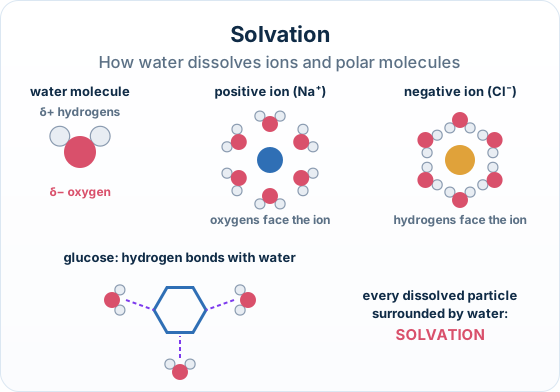
A polar water molecule; water molecules around a sodium ion and a chloride ion; hydrogen bonds between water and glucose
Water surrounds each dissolved particle.

The points to remember

  • In a water molecule the oxygen is slightly negative and the hydrogens are slightly positive.
  • Positive ions attract the oxygen ends of water molecules.
  • Negative ions attract the hydrogen ends of water molecules.
  • Polar molecules such as glucose form hydrogen bonds with water.
  • Each dissolved particle ends up in a shell of water: it is solvated.
Remember it as: Opposite charges face each other.

Real example: sugar in phloem sap. Plants move sucrose from leaves to roots and fruits dissolved in phloem sap. Sucrose is polar, so it forms hydrogen bonds with water and stays in solution.

Know your predicted grade

Take timed mock exams and get detailed feedback on every answer. See exactly where you're losing marks.

Try Mock Exams FreeYour first topic is free to keep • No credit card required
What solvation allows: Because so many substances dissolve in water, water is the medium of life.
Dissolves in water?ExamplesWhy
Yes: ionsSodium, potassium, chlorideAttracted to the charged ends of water molecules
Yes: polar moleculesGlucose, amino acids, sucroseForm hydrogen bonds with water
No: non-polar moleculesFats and oilsNo charges, so water is not attracted to them
Why it matters: Dissolved substances can be transported in blood plasma and phloem sap, and can react with each other in the cytoplasm.
How it is asked: Short answers on why ions and polar molecules dissolve in water, and 1A items on which end of a water molecule faces an ion.
IB-style questionExplain[3 marks]

Explain how sodium chloride and glucose dissolve in water.

Model answer plan

See the answer broken into clear points, with guidance on how each point earns marks.

Claim your free topic

Try an IB Exam Question — Free AI Feedback

Test yourself on Solvation with water as the solvent. Write your answer and get instant AI feedback — just like a real IB examiner.

what is meant by solvation. [1 mark]

Related Biology HL Topics

Continue learning with these related topics from the same unit:

4.1.1DNA replication as production of exact copies of DNA with identical base sequences4.1.2Semi-conservative nature of DNA replication and role of complementary base pairing4.1.3Role of helicase and DNA polymerase in DNA replication4.1.4Polymerase chain reaction and gel electrophoresis as tools for amplifying and separating DNA
View all Biology HL topics
Improve your exam techniqueCommand terms, paper structure, and mark-scheme tips for Biology HL
Previous4.5.11External factors impacting the pattern of gene expressionNextWater movement from less concentrated to more concentrated solutions4.6.2

5 practice questions on Solvation with water as the solvent

Students who practiced this topic on Aimnova scored 82% on average. Try free practice questions and get instant AI feedback.

Try 3 Free QuestionsView All Biology HL Topics