Meiosis as a reduction division at Higher Level: The same statement as SL. At HL meiosis also links to non-disjunction (4.4.10), variation (4.4.11) and inheritance.
Practise this as you read
- Outline the two rounds of segregation.
- Distinguish between the cells produced by mitosis and by meiosis.
Free preview
This is the free notes preview
You're reading the free notes. Aimnova Pro unlocks the full study experience — and you can try it with your first topic free to keep:
- FlashcardsLock in vocabulary and key terms with spaced repetition.
- Practice questionsAnswer exam-style questions and get instant AI marking.
- Mock exams & past-paper vaultSit full mocks and see exactly how examiners award marks.
- Personalised study planA daily plan built around your exam date and weak areas.
The big idea: Meiosis is the special cell division that makes gametes (sex cells — sperm and egg).
How meiosis works
- It takes one diploid (2n) cell and divides it twice to make four haploid (n) cells.
- Because the chromosome number is halved, meiosis is called a reduction division.
- The four gametes it makes are all genetically different from each other.
One diploid cell (2n) divides twice: meiosis I separates the homologous chromosomes, meiosis II separates the sister chromatids, giving four haploid (n) gametes. Crossing over and independent assortment make the four gametes genetically different.
Interactive diagram
Explore the labelled diagram, charts and maps for this topic in full study mode.
- Meiosis
- A division that makes gametes: one diploid cell divides twice to form four haploid cells that are genetically different.
- Diploid (2n)
- A cell that has two copies of each chromosome — one set from each parent (in humans, 46 chromosomes = 23 pairs).
- Haploid (n)
- A cell that has only one copy of each chromosome — half the diploid number (in humans, 23 chromosomes). Gametes are haploid.
- Gamete
- A sex cell (sperm or egg) — haploid, so that two gametes can join at fertilisation to restore the diploid number.
- Homologous chromosomes
- A matching pair of chromosomes — the same size and carrying the same genes, one inherited from each parent (though the versions of the genes may differ).
- Reduction division
- A division that halves the chromosome number, turning a diploid cell into haploid cells. Meiosis is a reduction division.
Why halving matters: If gametes had the full diploid number, fertilisation would double the chromosome number every generation.
By halving it to haploid, meiosis makes sure that when a sperm and egg join, the offspring gets back the correct diploid number — and keeps it stable from one generation to the next.
Memorize terms 3x faster
Smart flashcards show you cards right before you forget them. Perfect for definitions and key concepts.
Meiosis is two divisions in a row, not one.
Meiosis I
- The homologous chromosomes (the matching pairs) are separated
- This is where the chromosome number halves, so meiosis I is the reduction division
Meiosis II
- The sister chromatids are separated, much like mitosis
- This finishes the job, giving four haploid gametes
| Feature | Meiosis I (first division) | Meiosis II (second division) |
|---|---|---|
| What is separated | Homologous chromosomes are pulled apart | Sister chromatids are pulled apart |
| Chromosome number | Halves: diploid (2n) → haploid (n) | Stays haploid (n) |
| This is the… | Reduction division (the number halves here) | Division that finishes splitting the chromatids |
| Cells made | Two haploid cells | Four haploid cells (the gametes) |
| Variation added | Crossing over (prophase I) + independent assortment (metaphase I) | Chromatids that crossed over are shared out |
Where meiosis happens: In animals, meiosis happens in the gonads — the testes (making sperm) and the ovaries (making eggs).
In a flowering plant, meiosis happens in the anthers (making pollen, the male gametes) and in the ovules inside the ovary (making the female gametes / egg cells).
Source 1 — crossing over (prophase I): Early in meiosis I (prophase I), the homologous chromosomes pair up and lie alongside each other.
Where they touch, they swap matching sections — this is crossing over.
Swapping sections mixes the alleles on each chromosome, so a chromosome ends up with a new combination it did not have before.
Source 2 — independent assortment (metaphase I): At metaphase I, each pair of homologous chromosomes lines up at the middle of the cell, and which one of each pair goes to which pole is decided at random.
This is independent assortment: every pair is sorted independently of the others, so the gametes get a fresh mix of maternal and paternal chromosomes.
Why the four gametes differ: crossing over (prophase I) swaps sections between homologous chromosomes, and independent assortment (metaphase I) shuffles which chromosome of each pair goes to each pole.
Interactive diagram
Explore the labelled diagram, charts and maps for this topic in full study mode.
Crossing over
- Happens in prophase I
- Homologous chromosomes pair up and swap sections
- Mixes the alleles along a chromosome
- Creates new combinations on each chromosome
Independent assortment
- Happens in metaphase I
- Each homologous pair lines up and sorts at random
- Shuffles whole maternal vs paternal chromosomes
- Every gamete gets a different mix of chromosomes
An easy way to remember: Crossing over crosses sections within a pair (prophase I).
Independent assortment sorts whole chromosomes between the poles (metaphase I).
Together they make every one of the four gametes genetically unique.
Meiosis vs mitosis: Don't confuse the two divisions. Mitosis makes two genetically identical body cells (no change in chromosome number). Meiosis makes four genetically different gametes and halves the chromosome number.
| Feature | Mitosis | Meiosis |
|---|---|---|
| Number of divisions | One | Two (meiosis I then meiosis II) |
| Daughter cells made | Two | Four |
| Chromosome number | Stays the same (2n → 2n) | Halves (2n → n) — reduction division |
| Genetically… | Identical to the parent cell | Different from the parent and from each other |
| Makes | Body (somatic) cells for growth and repair | Gametes (sex cells) for reproduction |
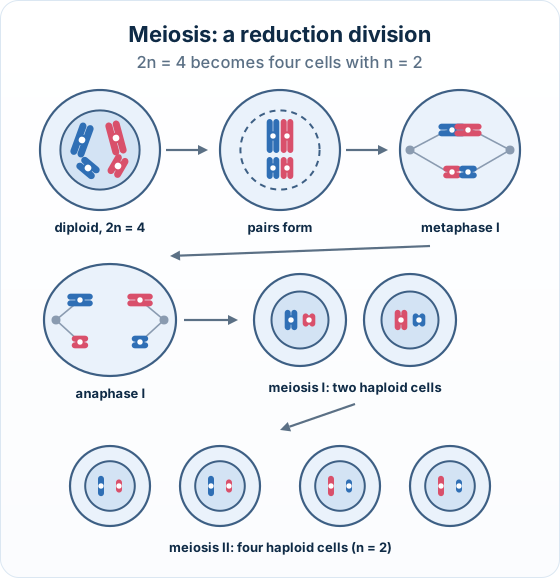
The big idea: Meiosis has two rounds of segregation: first the homologous chromosomes separate, then the sister chromatids. One diploid nucleus becomes four haploid nuclei.
The points to remember
- Diploid (2n): two of each chromosome, in homologous pairs. Haploid (n): one of each.
- Meiosis I: homologous chromosomes pair up and then separate: the number is halved.
- Meiosis II: sister chromatids separate, as in mitosis.
- Result: four haploid nuclei from one diploid nucleus.
- A sexual life cycle needs meiosis: fertilisation joins two haploid gametes, restoring 2n.
Remember it as: First the pairs part, then the chromatids.
Real example: a lily anther. Lily anthers have large cells and large chromosomes, so slides of them are a classic way to see the stages of meiosis, including the two separate divisions.
Know your predicted grade
Take timed mock exams and get detailed feedback on every answer. See exactly where you're losing marks.
How it is asked: 1A items on what happens in the first division (the number halves; homologues separate) or on the order of events; 1B items distinguishing the cells made by mitosis and meiosis; diagrams to classify as haploid or diploid.
Distinguish between the cells produced by mitosis and the cells produced by meiosis.
Model answer plan
See the answer broken into clear points, with guidance on how each point earns marks.
Which division halves the number?: The first division of meiosis halves the chromosome number. The second separates chromatids and does not change the number.