Phases of mitosis at Higher Level: The same statement as SL. At HL the long answers add the spindle, microtubule motors and cytokinesis, and compare plant and animal cells.
Practise this as you read
- Describe each phase of mitosis.
- Compare and contrast mitosis and cytokinesis in animal and plant cells.
Free preview
This is the free notes preview
You're reading the free notes. Aimnova Pro unlocks the full study experience — and you can try it with your first topic free to keep:
- FlashcardsLock in vocabulary and key terms with spaced repetition.
- Practice questionsAnswer exam-style questions and get instant AI marking.
- Mock exams & past-paper vaultSit full mocks and see exactly how examiners award marks.
- Personalised study planA daily plan built around your exam date and weak areas.
The big idea: Mitosis is the division of one nucleus into two new nuclei that are genetically identical to each other and to the original cell.
Key facts about mitosis
- It happens in one division and always produces two daughter nuclei.
- The daughters have the same number of chromosomes as the parent (they stay diploid).
- It is used for growth, repair of damaged tissue, and asexual reproduction — any time a body needs more cells that are exact copies.
- Mitosis
- The division of a nucleus into two genetically identical daughter nuclei, each with the same number of chromosomes as the parent.
- Chromosome
- A length of DNA carrying genes. Before mitosis it has been copied, so it is made of two identical sister chromatids joined at a centromere.
- Sister chromatids
- The two identical copies of a chromosome, produced by DNA replication and joined together at the centromere until anaphase.
- Centromere
- The point where the two sister chromatids are joined; spindle fibres attach here.
- Diploid
- Having the full (two of each) set of chromosomes. Mitosis keeps daughter cells diploid — the chromosome number does not change.
- Spindle
- A framework of protein fibres that attaches to chromosomes and pulls them to opposite ends of the cell.
Copied first, then shared out: Before mitosis even starts, the cell copies all of its DNA (this happens in interphase, the busy stage before division).
So each chromosome arrives at mitosis as two identical sister chromatids. Mitosis then simply shares one copy out to each daughter — which is exactly why the two daughters end up identical.
Feeling unprepared for exams?
Get a clear study plan, practice with real questions, and know exactly where you stand before exam day. No more guessing.
Mitosis runs through four phases, always in the same order: prophase, metaphase, anaphase, telophase.
A common way to remember the order is PMAT — or the phrase People Meet And Talk.
The four phases — PMAT: Prophase — chromosomes condense (coil up) and become visible; the spindle starts to form and the nuclear membrane breaks down.
Metaphase — chromosomes line up single file along the middle of the cell.
Anaphase — sister chromatids are pulled apart to opposite poles.
Telophase — two new nuclear membranes form, giving two nuclei.
| Phase (in order) | What the chromosomes do | Way to remember |
|---|---|---|
| Prophase | Chromosomes condense (coil up) and become visible; each is two identical sister chromatids joined at a centromere. The spindle begins to form and the nuclear membrane breaks down. | Prophase = Prepare / Appear |
| Metaphase | Chromosomes line up single file along the middle (equator) of the cell, attached to spindle fibres. | Metaphase = Middle |
| Anaphase | The centromeres split and the sister chromatids are pulled Apart to opposite poles by the spindle fibres. | Anaphase = Apart |
| Telophase | Two new nuclear membranes form around the two groups of chromosomes, which then uncoil. Two nuclei now exist. | Telophase = Two nuclei |
Before anaphase
- Each chromosome = two identical sister chromatids
- Chromatids are joined at the centromere
- Prophase: chromosomes condense and appear
- Metaphase: chromosomes line up at the middle
Anaphase onwards
- Centromeres split
- Sister chromatids are pulled apart
- One copy of every chromosome goes to each pole
- Telophase: two identical nuclei form
Why the two daughters are genetically identical: This is the headline exam point for this topic. Two facts work together to guarantee it.
Two facts, one result
- 1) The DNA was replicated once beforehand, so the two sister chromatids of each chromosome are exact copies (same genes).
- 2) In anaphase those chromatids separate, with one copy going to each pole.
- The result: each daughter receives one complete, identical set of chromosomes — same genes, same chromosome number (still diploid).
| Step in mitosis | What it guarantees | Why this keeps the daughters identical |
|---|---|---|
| DNA is replicated once before mitosis (in interphase) | Each chromosome becomes two identical sister chromatids | The two copies carry exactly the same genes |
| Sister chromatids stay joined until anaphase | The identical copies are kept paired up | One full copy is ready for each daughter cell |
| In anaphase, sister chromatids separate — one to each pole | Each pole receives one of every chromosome | Each daughter gets the same complete set of chromosomes |
| Two nuclei form (telophase), then the cell divides | Two cells, each with a full diploid set | Both daughters have the same genes AND the same chromosome number as the parent |
An easy way to remember the phases: Prophase = Prepare (chromosomes appear). Metaphase = Middle (they line up). Anaphase = Apart (chromatids separate). Telophase = Two nuclei.
PMAT — People Meet And Talk.
The big idea: Mitosis has four phases, always in the same order. Follow the chromosomes: each daughter cell ends up with one copy of every chromosome.
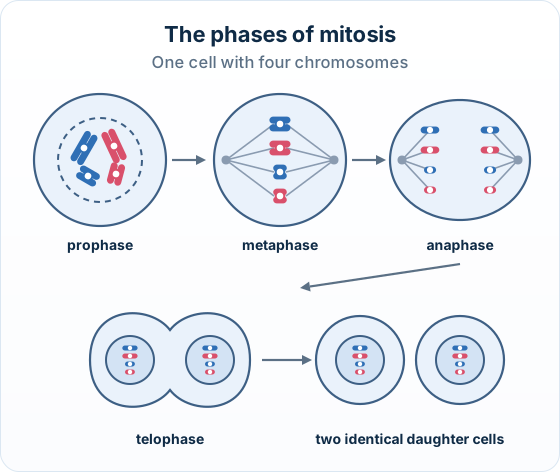
The points to remember
- Prophase: chromosomes condense; the nuclear membrane breaks down; the spindle forms.
- Metaphase: chromosomes line up across the equator, attached to spindle microtubules.
- Anaphase: centromeres divide; sister chromatids move to opposite poles.
- Telophase: nuclear membranes re-form; chromosomes uncoil; two nuclei.
- Each nucleus gets the same chromosomes, so the daughter cells are genetically identical.
Remember it as: Prophase, metaphase, anaphase, telophase: PMAT.
Real example: whitefish embryos. Slides of early whitefish embryos are used to show animal mitosis: the cells divide quickly and their spindles and chromosomes are easy to see.
Memorize terms 3x faster
Smart flashcards show you cards right before you forget them. Perfect for definitions and key concepts.
How it is asked: A 1A item on what marks a phase, a Paper 2 'outline how mitosis gives identical cells' worth 3 or 4 marks, or at HL a long compare-and-contrast of mitosis and cytokinesis in plant and animal cells.
Describe what happens to the chromosomes in each phase of mitosis.
Model answer plan
See the answer broken into clear points, with guidance on how each point earns marks.
A chain, not a list: Each mark is a separate step: replication, then condensing, lining up and separating. Saying 'the cells are copied' four ways scores once.