aımnova
DashboardMy LearningCrash CoursesStudy Plan

Aimnova site navigation

Stay in the loop

Get the latest study resources and updates

New features, study tips and exam insights — straight to your inbox.

IB Diploma

  • IB Past Papers
  • IB Study Notes
  • IB Question Bank
  • IB Mock Exams
  • IB Revision

IB Subjects

  • IB Math AA
  • IB Math AI
  • IB Economics
  • IB Business Management
  • IB Physics
  • IB Biology
  • View all IB subjects→

IB Past Papers

  • IB Math AA HL Past Papers
  • IB Math AA SL Past Papers
  • IB Math AI HL Past Papers
  • IB Math AI SL Past Papers
  • IB Economics HL Past Papers
  • IB Economics SL Past Papers
  • IB ESS Past Papers
  • View all past papers→

Study Resources

  • Study Notes
  • Question Bank
  • Mock Exams
  • Crash Courses
  • Flashcards
  • Revision Guide
  • Exam Skills
  • Command Terms
  • Grade Calculator
  • Exam Timetable 2026

Aimnova

  • Features
  • Pricing
  • For Teachers
  • For Schools
  • For Parents
  • About Us
  • Blog
  • Contact
aımnova

IB study, practice and feedback built around the real exam.

TermsPrivacyCookies·© 2026 Aimnova. All rights reserved.06bfe1b

Aimnova is not affiliated with or endorsed by the International Baccalaureate Organization (IB).

NotesBiology HLTopic 4.4Consequences of mutations in genes that control the cell cycle
Back to Biology HL Topics
4.4.163 min read

Consequences of mutations in genes that control the cell cycle (Biology HL)

IB Biology · Unit 4

Exam preparation

Practice the questions examiners actually ask

Our question bank mirrors real IB exam papers. Practice under timed conditions and track your progress across topics.

Start Practicing

Contents

  1. 1The accelerator and the brake
  2. 2How mutations add up
  3. 3Exam-style question (step by step)
The big idea: Cell division is controlled by genes. Mutations that turn proto-oncogenes into oncogenes, or that disable tumour suppressor genes, can lead to uncontrolled cell division.
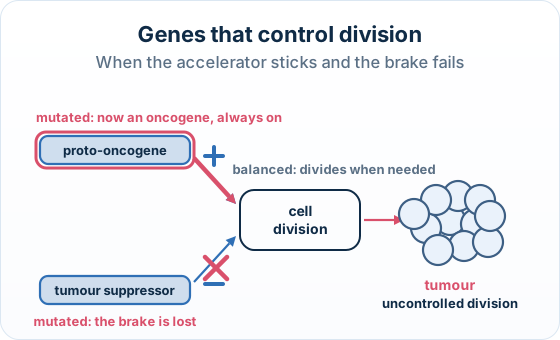
A proto-oncogene stimulating and a tumour suppressor gene slowing cell division; a mutation makes the oncogene always on and another disables the suppressor, giving a tumour
Oncogene on, suppressor off: uncontrolled division.

The points to remember

  • Proto-oncogenes code for proteins that stimulate the cell cycle when division is needed.
  • A mutation can turn a proto-oncogene into an oncogene, which stimulates division all the time.
  • Tumour suppressor genes code for proteins that slow or stop the cell cycle, for example when DNA is damaged.
  • A mutation can stop a tumour suppressor gene working, so division is no longer held back.
  • Uncontrolled division forms a tumour; this can lead to cancer.
Remember it as: Accelerator stuck on, brake cut: no control.

Real example: TP53. The tumour suppressor gene TP53 codes for the protein p53, which can stop the cycle when DNA is damaged. TP53 is mutated in about half of all human cancers.

Free preview

This is the free notes preview

You're reading the free notes. Aimnova Pro unlocks the full study experience — and you can try it with your first topic free to keep:

  • FlashcardsLock in vocabulary and key terms with spaced repetition.
  • Practice questionsAnswer exam-style questions and get instant AI marking.
  • Mock exams & past-paper vaultSit full mocks and see exactly how examiners award marks.
  • Personalised study planA daily plan built around your exam date and weak areas.
Start Studying Free Full access to Aimnova Pro · cancel anytime
How mutations add up: One mutation is rarely enough. Cancer usually needs several mutations in genes that control the cell cycle, all in the same line of cells.
GeneNormal roleAfter mutation
Proto-oncogeneStimulates division when neededOncogene: stimulates division all the time
Tumour suppressor geneSlows or stops divisionNot working: division not held back
Mutagens raise the risk: Mutagens, such as chemicals in tobacco smoke and UV radiation, increase the chance of these mutations. Mutations also build up over a lifetime, which is why cancer is more common in older people.

Learn what examiners really want

See exactly what to write to score full marks. Our AI shows you model answers and the key phrases examiners look for.

Try AI Feedback FreeYour first topic is free to keep • No credit card required
How it is asked: A short Paper 2 'explain how chemicals (or radiation) can cause cancer', or 1A items on what oncogenes and tumour suppressor genes do.
IB-style questionExplain[2 marks]

Explain how a chemical in the diet could cause cancer.

Model answer plan

See the answer broken into clear points, with guidance on how each point earns marks.

Claim your free topic

Try an IB Exam Question — Free AI Feedback

Test yourself on Consequences of mutations in genes that control the cell cycle. Write your answer and get instant AI feedback — just like a real IB examiner.

the name given to a proto-oncogene after a mutation makes it stimulate cell division all the time. [1 mark]

Related Biology HL Topics

Continue learning with these related topics from the same unit:

4.1.1DNA replication as production of exact copies of DNA with identical base sequences4.1.2Semi-conservative nature of DNA replication and role of complementary base pairing4.1.3Role of helicase and DNA polymerase in DNA replication4.1.4Polymerase chain reaction and gel electrophoresis as tools for amplifying and separating DNA
View all Biology HL topics
Improve your exam techniqueCommand terms, paper structure, and mark-scheme tips for Biology HL
Previous4.4.15Control of the cell cycle using cyclinsNextDifferences between tumours in rates of cell division and growth and in the capacity for metastasis and invasion of neighbouring tissue4.4.17

6 exam-style questions ready for you

Students who practice on Aimnova improve their scores by 15% on average. Get instant feedback that shows exactly how to improve your answers.

Practice Now — FreeView All Biology HL Topics