Gene mutations at Higher Level: The same statement as SL. At HL the same three types return when gene knockout and CRISPR are used to change genes on purpose.
Practise this as you read
- Classify a mutation from two base sequences.
- Distinguish between insertion and deletion mutations.
Free preview
This is the free notes preview
You're reading the free notes. Aimnova Pro unlocks the full study experience — and you can try it with your first topic free to keep:
- FlashcardsLock in vocabulary and key terms with spaced repetition.
- Practice questionsAnswer exam-style questions and get instant AI marking.
- Mock exams & past-paper vaultSit full mocks and see exactly how examiners award marks.
- Personalised study planA daily plan built around your exam date and weak areas.
The big idea: A mutation is a random change to the base sequence of DNA.
What that means
- DNA is a code spelled out in four bases (A, T, C and G).
- If that spelling is changed — even by a single base — the gene now carries different information.
- Mutations are random: they are not made on purpose and cannot be aimed at a useful result.
Why mutations matter: Mutations are the original source of all new alleles (new versions of a gene), which is why they matter so much for variation and evolution.
- Mutation
- A random change in the base sequence of DNA (the genetic material).
- Gene
- A length of DNA that carries the code for a particular characteristic.
- Allele
- A particular version of a gene. A new allele is produced when a mutation changes the base sequence of an existing gene.
- Base sequence
- The order of the four bases (A, T, C, G) along a strand of DNA — this order is the genetic code.
- Mutagen
- Anything that increases the rate of mutation, such as ultraviolet (UV) light, X-rays or certain chemicals.
Mutations make new alleles: Where do the different versions of a gene come from in the first place?
They come from mutation. A change to the base sequence of an existing gene creates a new allele — a slightly different version of that gene.
So mutation is the ultimate source of all the genetic variation in living things.
Learn what examiners really want
See exactly what to write to score full marks. Our AI shows you model answers and the key phrases examiners look for.
Most gene mutations you need at SL involve a change to a single base. There are three kinds.
The key to telling them apart: They differ in what happens to the bases: is a base swapped, added or removed?
- Substitution
- One base is swapped for a different base. The total number of bases stays the same.
- Insertion
- One (or more) extra base is added into the sequence, increasing the total number of bases.
- Deletion
- One (or more) base is removed from the sequence, decreasing the total number of bases.
- Frameshift
- The shift in the reading frame caused by an insertion or a deletion, so that every codon after the change is read differently.
Why insertion and deletion hit harder: DNA is read in triplets (groups of three bases called codons).
Substitution
- Changes only the one base it touches.
- Usually just one codon is affected.
Insertion or deletion
- Changes the total number of bases, so the cell reads every triplet after the change out of step.
- This is a frameshift: it usually changes all of the codons downstream — a much bigger effect from a single base change.
| Mutation type | What changes in the DNA | Effect on the reading frame |
|---|---|---|
| Substitution | One base is swapped for a different base (e.g. A becomes G) | No shift — only the one codon containing that base can change |
| Insertion | One (or more) extra base is added into the sequence | Shifts the reading frame from that point on (a frameshift) |
| Deletion | One (or more) base is removed from the sequence | Shifts the reading frame from that point on (a frameshift) |
Substitution
- One base is swapped for another
- Total number of bases stays the same
- Reading frame is not shifted
- Usually affects one codon only
Insertion / Deletion
- A base is added (insertion) or removed (deletion)
- Total number of bases changes
- Reading frame is shifted (a frameshift)
- Usually affects every codon downstream
Mutagens can cause these changes: Mutations happen by chance, but their rate goes up when DNA is exposed to a mutagen.
Ultraviolet (UV) light, X-rays and some chemicals can damage DNA and cause mutations such as a substitution (or an insertion/deletion).
If asked to name a mutation type a mutagen could cause, any of substitution, insertion or deletion is a valid answer.
An easy way to remember: Sub = substitute (swap one for another). Insertion = put one in. Deletion = take one out.
Only insertion and deletion change the number of bases — and changing the number is what causes a frameshift.
The big idea: A gene mutation is a change in the base sequence: a base is swapped, added or removed.
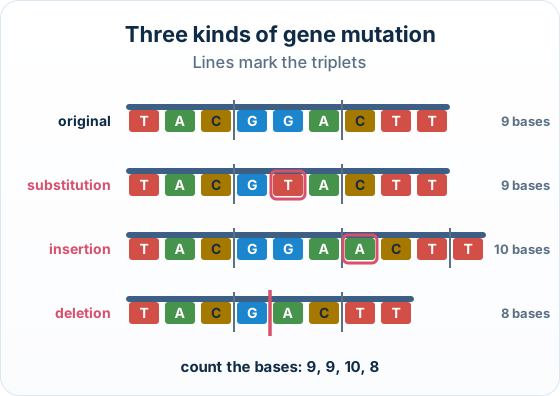
The points to remember
- Substitution: one base replaced by another; the number of bases stays the same.
- Insertion: one or more bases added; the number of bases goes up.
- Deletion: one or more bases removed; the number of bases goes down.
- To classify from data, line up the sequences and count the bases.
Remember it as: Swap, add, remove: count before and after.
Real example: cystic fibrosis. The commonest cystic fibrosis mutation is a deletion of three bases in the CFTR gene. Exactly one codon is lost, so the protein lacks one amino acid, phenylalanine, and folds wrongly.
Never wonder what to study next
Get a personalized daily plan based on your exam date, progress, and weak areas. We'll tell you exactly what to review each day.
How this is tested: Mutation questions appear on Paper 1A and Paper 1B, in three common forms.
Three common tasks
- Paper 1B — classify: you get a DNA base sequence before and after a change. Read the two sequences, then decide whether a base was swapped (substitution), added (insertion) or removed (deletion).
- Paper 1A — multiple choice: identify a true general feature of mutations (random; a change to the base sequence; the source of new alleles), or name a mutation type a mutagen such as UV light can cause.
- Paper 1B — 2-mark Compare and contrast: give a similarity and a difference between two named types — one of each, clearly labelled.
Exam-style question — classify the mutation from two base sequences
A short length of DNA normally reads T A C G G A C T T (shown in triplets). After a mutation it reads T A C G T A C T T. Classify the type of mutation that has occurred, and justify your answer. [2]
How to score both marks
- Compare the two sequences base by base. The first triplet (T A C) and the last (C T T) are unchanged. In the middle triplet, the original G G A has become G T A — the second base G has become T.
- Decide what happened to the bases. One base has been swapped for a different base, and the total number of bases is unchanged (still 9). No base was added or removed.
- Classify and justify. This is a substitution mutation, because one base (G) has been replaced by another base (T) while the number of bases stays the same.
Final answer
Substitution — one base (G) has been replaced by another base (T); the total number of bases is unchanged, so the reading frame is not shifted.
How to tell the types apart in data: Count the bases before and after.
Same number of bases, one letter different → substitution.
One more base → insertion. One fewer base → deletion — and in both of these, every triplet after the change is read differently (a frameshift).
| DNA base sequence | What happened | Mutation type |
|---|---|---|
| Original: T A C G G A C T T | the reference sequence (read in triplets) | (none) |
| T A C G T A C T T | the middle G was swapped for a T | Substitution |
| T A C G A G A C T T | an extra A was added — every triplet after it changes | Insertion (frameshift) |
| T A C G A C T T | a base (G) was removed — every triplet after it changes | Deletion (frameshift) |