aımnova
DashboardMy LearningCrash CoursesStudy Plan

Aimnova site navigation

Stay in the loop

Get the latest study resources and updates

New features, study tips and exam insights — straight to your inbox.

IB Diploma

  • IB Past Papers
  • IB Study Notes
  • IB Question Bank
  • IB Mock Exams
  • IB Revision

IB Subjects

  • IB Math AA
  • IB Math AI
  • IB Economics
  • IB Business Management
  • IB Physics
  • IB Biology
  • View all IB subjects→

IB Past Papers

  • IB Math AA HL Past Papers
  • IB Math AA SL Past Papers
  • IB Math AI HL Past Papers
  • IB Math AI SL Past Papers
  • IB Economics HL Past Papers
  • IB Economics SL Past Papers
  • IB ESS Past Papers
  • View all past papers→

Study Resources

  • Study Notes
  • Question Bank
  • Mock Exams
  • Crash Courses
  • Flashcards
  • Revision Guide
  • Exam Skills
  • Command Terms
  • Grade Calculator
  • Exam Timetable 2027

Aimnova

  • Features
  • Pricing
  • For Teachers
  • For Schools
  • For Parents
  • About Us
  • Blog
  • Contact
aımnova

IB study, practice and feedback built around the real exam.

TermsPrivacyCookies·© 2026 Aimnova. All rights reserved.d9e1c61

Aimnova is not affiliated with or endorsed by the International Baccalaureate Organization (IB).

NotesBiology HLTopic 4.12Threats to coral reefs as an example of potential ecosystem collapse
Back to Biology HL Topics
4.12.74 min read

Threats to coral reefs as an example of potential ecosystem collapse (Biology HL)

IB Biology · Unit 4

AI-powered feedback

Stop guessing — know where you lost marks

Get instant, examiner-style feedback on every answer. See exactly how to improve and what the markscheme expects.

Try It Free

Contents

  1. 1Threats to coral reefs at Higher Level
  2. 2Two threats to corals
  3. 3From dead corals to a collapsed reef
  4. 4Exam-style question (step by step)
Threats to coral reefs at Higher Level: The same statement as SL. HL Paper 2 has used it as a data question on the chemistry of sea water and on reef species in 2100.

Practise this as you read

  • State the relationship between two forms of dissolved carbon from a graph.
  • Predict how rising carbon dioxide will affect reef species.

Free preview

This is the free notes preview

You're reading the free notes. Aimnova Pro unlocks the full study experience — and you can try it with your first topic free to keep:

  • FlashcardsLock in vocabulary and key terms with spaced repetition.
  • Practice questionsAnswer exam-style questions and get instant AI marking.
  • Mock exams & past-paper vaultSit full mocks and see exactly how examiners award marks.
  • Personalised study planA daily plan built around your exam date and weak areas.
Start Studying Free Full access to Aimnova Pro · cancel anytime
The big idea: Coral reefs face two threats from rising carbon dioxide. Ocean acidification suppresses calcification, so corals build their skeletons more slowly. Warmer water causes coral bleaching. Loss of corals can cause the collapse of the whole reef ecosystem.

See it drawn, step by step

In My Learning, handwritten diagrams build one step at a time. Play, pause and replay each explanation until it clicks. Create your free account to try it.
Claim your free topic
Ocean acidification
The fall in the pH of sea water as it absorbs more carbon dioxide, which forms carbonic acid.
Calcification
The building of calcium carbonate skeletons and shells, using carbonate ions from sea water.
Zooxanthellae
Photosynthetic algae that live inside coral tissues and supply the coral with most of its food.
Coral bleaching
The loss of zooxanthellae from stressed corals, which turn white.

The points to remember

  • The sea is still slightly alkaline. 'Acidification' means its pH is falling.
  • Acidification and bleaching have different causes: carbon dioxide dissolving v higher temperature.
  • Bleached corals can recover if the heat ends quickly; long heatwaves kill them.
Remember it as: Carbon dioxide in: carbonate down.

Feeling unprepared for exams?

Get a clear study plan, practice with real questions, and know exactly where you stand before exam day. No more guessing.

Get Exam Ready FreeYour first topic is free to keep • No credit card required

See it drawn, step by step

In My Learning, handwritten diagrams build one step at a time. Play, pause and replay each explanation until it clicks. Create your free account to try it.

Claim your free topic
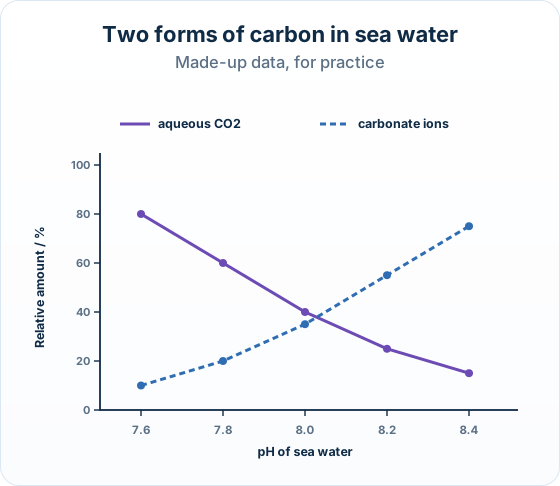
Line graph against pH from 7.6 to 8.4. Aqueous carbon dioxide falls from 80 to 15 per cent as pH rises; carbonate ions rise from 10 to 75 per centLine graph against pH from 7.6 to 8.4. Aqueous carbon dioxide falls from 80 to 15 per cent as pH rises; carbonate ions rise from 10 to 75 per cent
Two forms of carbon in sea water (made-up data). As pH falls, carbonate ions fall.
Real data: Surface ocean pH has fallen by about 0.1, from 8.2 to 8.1, since the industrial revolution (Garcia-Soto and others, 2021). The Great Barrier Reef had mass bleaching in 1998, 2002, 2016, 2017, 2020, 2022 and 2024 (Great Barrier Reef Marine Park Authority).

The points to remember

  • Natural factors also change the pH of sea water: temperature, upwelling, photosynthesis, respiration, run-off from rivers.
  • Corals are the foundation of the reef: when they die the whole ecosystem can collapse.
  • Calcifying animals such as molluscs are also harmed by acidification.
Remember it as: Acid weakens, heat bleaches, the reef falls.
How it is asked: Paper 2 asks you to explain the effect of warmer water on corals [3], to describe how rising carbon dioxide alters reefs [4], or to read graphs of ocean chemistry and predict effects on reef species.
IB-style questionExplain[3 marks]

Explain the effect of an increase in water temperature on corals.

Model answer plan

See the answer broken into clear points, with guidance on how each point earns marks.

Claim your free topic

Try an IB Exam Question — Free AI Feedback

Test yourself on Threats to coral reefs as an example of potential ecosystem collapse. Write your answer and get instant AI feedback — just like a real IB examiner.

the acid that forms when carbon dioxide dissolves in seawater. [1 mark]

Related Biology HL Topics

Continue learning with these related topics from the same unit:

4.1.1DNA replication as production of exact copies of DNA with identical base sequences4.1.2Semi-conservative nature of DNA replication and role of complementary base pairing4.1.3Role of helicase and DNA polymerase in DNA replication4.1.4Polymerase chain reaction and gel electrophoresis as tools for amplifying and separating DNA
View all Biology HL topics
Improve your exam techniqueCommand terms, paper structure, and mark-scheme tips for Biology HL
Previous4.12.6Poleward and upslope range shifts of temperate speciesNextAfforestation, forest regeneration and restoration of peat-forming wetlands as approaches to carbon sequestration4.12.8

26 questions to test your understanding

Reading is just the start. Students who tested themselves scored 82% on average — try IB-style questions with AI feedback.

Start FreeView All Biology HL Topics