Anthropogenic causes at Higher Level: The same statement as SL. HL Paper 2 often asks for it in two short marks inside a longer question on carbon or on farming.
Practise this as you read
- State two human causes of the rise in carbon dioxide.
- Explain how a greenhouse gas leads to warming of the Earth.
Free preview
This is the free notes preview
You're reading the free notes. Aimnova Pro unlocks the full study experience — and you can try it with your first topic free to keep:
- FlashcardsLock in vocabulary and key terms with spaced repetition.
- Practice questionsAnswer exam-style questions and get instant AI marking.
- Mock exams & past-paper vaultSit full mocks and see exactly how examiners award marks.
- Personalised study planA daily plan built around your exam date and weak areas.
The big idea: Anthropogenic means caused by humans. Human activities have raised the concentrations of carbon dioxide and methane in the atmosphere. Both are greenhouse gases: they absorb long-wave radiation given out by the Earth, so more heat is retained.
See it drawn, step by step
In My Learning, handwritten diagrams build one step at a time. Play, pause and replay each explanation until it clicks. Create your free account to try it.
- Greenhouse gas
- A gas in the atmosphere that absorbs long-wave (infrared) radiation given out by the Earth, so that heat is retained.
- Enhanced greenhouse effect
- The extra warming caused by the greenhouse gases that human activity has added to the atmosphere.
- Anthropogenic
- Caused by human activity, not by natural processes.
From the Sun
- Short-wave radiation (mostly light)
- Passes through the atmosphere
- Warms the surface
From the Earth
- Long-wave radiation (infrared, heat)
- Absorbed by carbon dioxide and methane
- Heat is retained in the atmosphere
The points to remember
- The greenhouse effect is natural: without it the Earth would be too cold for life.
- The problem is the extra carbon dioxide and methane from human activity.
- Methane is at a much lower concentration, but each molecule absorbs more.
Remember it as: Light in, heat out, heat absorbed.
See how examiners mark answers
Answer exam-style questions with model answers. Learn exactly what earns marks and what doesn't.
See it drawn, step by step
In My Learning, handwritten diagrams build one step at a time. Play, pause and replay each explanation until it clicks. Create your free account to try it.
| Human activity | Effect on the atmosphere |
|---|---|
| Burning fossil fuels (coal, oil, natural gas) | Releases carbon dioxide: the main cause of the rise |
| Deforestation | Less photosynthesis, so less carbon dioxide is taken up; a carbon sink is lost |
| Burning of forests and peat | Releases carbon dioxide |
| Raising cattle and sheep | The animals give out methane |
| Rice fields, landfill sites, leaks of natural gas | Release methane |
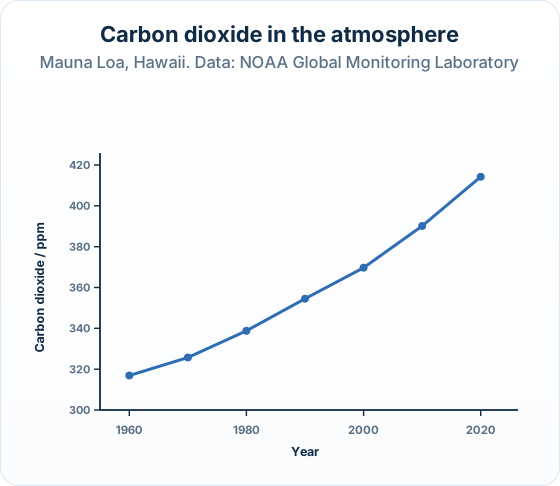
- Carbon sink
- A store or process that removes carbon dioxide from the air, for example a forest that photosynthesises.
- Carbon source
- A store or process that adds carbon dioxide to the air, for example the burning of fossil fuels.
The points to remember
- The main driver of climate change today is the burning of fossil fuels.
- For deforestation, say what it does: less carbon dioxide is taken up by photosynthesis.
- Farm animals such as cattle and sheep matter because of methane.
Remember it as: Fossil fuels and forests for carbon dioxide. Cattle for methane.
How it is asked: Paper 1A asks for the main driver of climate change, the radiation absorbed, or a reading from a graph. Paper 2 asks for two human causes [2], for the effect of cattle or sheep farming [2], or for the chain from burning fossil fuels to warming [2 to 3].
A country burns large amounts of coal in its power stations. Explain how this contributes to global warming.
Model answer plan
See the answer broken into clear points, with guidance on how each point earns marks.