aımnova
DashboardMy LearningCrash CoursesStudy Plan

Aimnova site navigation

Stay in the loop

Get the latest study resources and updates

New features, study tips and exam insights — straight to your inbox.

IB Diploma

  • IB Past Papers
  • IB Study Notes
  • IB Question Bank
  • IB Mock Exams
  • IB Revision

IB Subjects

  • IB Math AA
  • IB Math AI
  • IB Economics
  • IB Business Management
  • IB Physics
  • IB Biology
  • View all IB subjects→

IB Past Papers

  • IB Math AA HL Past Papers
  • IB Math AA SL Past Papers
  • IB Math AI HL Past Papers
  • IB Math AI SL Past Papers
  • IB Economics HL Past Papers
  • IB Economics SL Past Papers
  • IB ESS Past Papers
  • View all past papers→

Study Resources

  • Study Notes
  • Question Bank
  • Mock Exams
  • Crash Courses
  • Flashcards
  • Revision Guide
  • Exam Skills
  • Command Terms
  • Grade Calculator
  • Exam Timetable 2027

Aimnova

  • Features
  • Pricing
  • For Teachers
  • For Schools
  • For Parents
  • About Us
  • Blog
  • Contact
aımnova

IB study, practice and feedback built around the real exam.

TermsPrivacyCookies·© 2026 Aimnova. All rights reserved.d9e1c61

Aimnova is not affiliated with or endorsed by the International Baccalaureate Organization (IB).

NotesBiology HLTopic 4.10Modelling of sexual and natural selection based on experimental control of selection pressures
Back to Biology HL Topics
4.10.84 min read

Modelling of sexual and natural selection based on experimental control of selection pressures (Biology HL)

IB Biology · Unit 4

IB exam ready

Study like the top scorers do

Access a smart study planner, AI tutor, and exam vault — everything you need to hit your target grade.

Start Free

Contents

  1. 1Modelling selection at Higher Level
  2. 2Endler's ponds
  3. 3Reading the results
  4. 4Exam-style question (step by step)
Modelling selection at Higher Level: The same statement as SL. HL data questions add experimental design (measurement, controlled variables) and ask whether a population is in genetic equilibrium, which is taught later in this topic.

Practise this as you read

  • Interpret the results of Endler's experiments.
  • Explain a change in a trait from the selection pressure applied.

Free preview

This is the free notes preview

You're reading the free notes. Aimnova Pro unlocks the full study experience — and you can try it with your first topic free to keep:

  • FlashcardsLock in vocabulary and key terms with spaced repetition.
  • Practice questionsAnswer exam-style questions and get instant AI marking.
  • Mock exams & past-paper vaultSit full mocks and see exactly how examiners award marks.
  • Personalised study planA daily plan built around your exam date and weak areas.
Start Studying Free Full access to Aimnova Pro · cancel anytime
The big idea: John Endler tested selection by experiment. He kept guppies in ponds that differed only in their predators. Within a few generations the males' spots changed, in the direction that each selection pressure predicts.

See it drawn, step by step

In My Learning, handwritten diagrams build one step at a time. Play, pause and replay each explanation until it clicks. Create your free account to try it.

Claim your free topic

The points to remember

  • Spots make a male attractive to females and visible to predators.
  • The result is a balance between sexual selection and natural selection.
  • The change took only months, because guppies breed fast.
Remember it as: Change the predator, change the fish.

Stop wasting time on topics you know

Our AI identifies your weak areas and focuses your study time where it matters. No more overstudying easy topics.

Try Smart Study FreeYour first topic is free to keep • No credit card required
One variable changed: Endler controlled the selection pressure: the only planned difference between the ponds was the predator. So a difference in the guppies can be put down to selection.
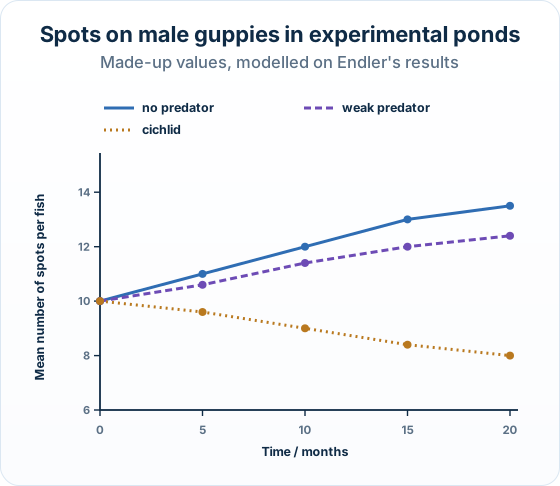
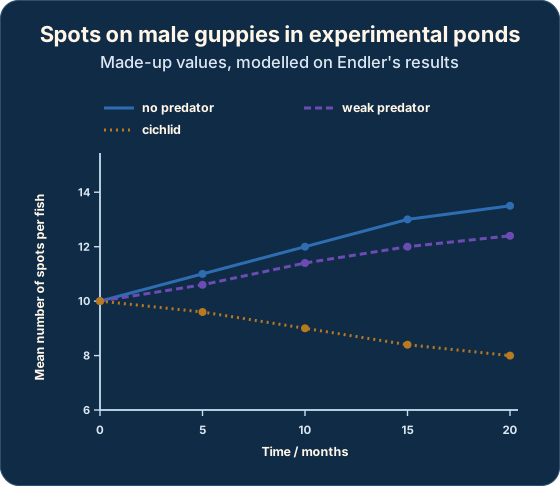
Line graph of mean spots per male guppy over 20 months: rising with no predator and with a weak predator, falling with a cichlid predatorLine graph of mean spots per male guppy over 20 months: rising with no predator and with a weak predator, falling with a cichlid predator
Made-up values with the same pattern as Endler's results.
PondResultWhy
No predatorSpots increaseSexual selection: females prefer males with more spots
Weak predator (eats small young)Spots increase or stayAdult males are not hunted, so female choice still wins
Dangerous predator (cichlid)Spots decreaseNatural selection: conspicuous males are eaten

The points to remember

  • Independent variable: the kind of predator in the pond.
  • Dependent variable: the mean number of spots per fish.
  • Controlled: starting population, pond size, gravel, food, temperature.
Remember it as: Predators dull the males. Females brighten them.
How it is asked: A whole data question in Paper 1B (read the graph, name the variables, explain and justify the results) and Paper 1A items on what the experiments showed.
IB-style questionExplain[3 marks]

In Endler's experiments, the mean number of spots on male guppies rose in ponds with no predators and fell in ponds with a predator that hunts adult guppies by sight. Explain these two results.

Model answer plan

See the answer broken into clear points, with guidance on how each point earns marks.

Claim your free topic

Try an IB Exam Question — Free AI Feedback

Test yourself on Modelling of sexual and natural selection based on experimental control of selection pressures. Write your answer and get instant AI feedback — just like a real IB examiner.

what Endler's experiments on guppy populations demonstrated about natural selection. [1 mark]

Related Biology HL Topics

Continue learning with these related topics from the same unit:

4.1.1DNA replication as production of exact copies of DNA with identical base sequences4.1.2Semi-conservative nature of DNA replication and role of complementary base pairing4.1.3Role of helicase and DNA polymerase in DNA replication4.1.4Polymerase chain reaction and gel electrophoresis as tools for amplifying and separating DNA
View all Biology HL topics
Improve your exam techniqueCommand terms, paper structure, and mark-scheme tips for Biology HL
Previous4.10.7Sexual selection as a selection pressure in animal speciesNextConcept of the gene pool4.10.9

14 practice questions on Modelling of sexual and natural selection based on experimental control of selection pressures

Students who practiced this topic on Aimnova scored 82% on average. Try free practice questions and get instant AI feedback.

Try 3 Free QuestionsView All Biology HL Topics