aımnova
DashboardMy LearningCrash CoursesStudy Plan

Aimnova site navigation

Stay in the loop

Get the latest study resources and updates

New features, study tips and exam insights — straight to your inbox.

IB Diploma

  • IB Past Papers
  • IB Study Notes
  • IB Question Bank
  • IB Mock Exams
  • IB Revision

IB Subjects

  • IB Math AA
  • IB Math AI
  • IB Economics
  • IB Business Management
  • IB Physics
  • IB Biology
  • View all IB subjects→

IB Past Papers

  • IB Math AA HL Past Papers
  • IB Math AA SL Past Papers
  • IB Math AI HL Past Papers
  • IB Math AI SL Past Papers
  • IB Economics HL Past Papers
  • IB Economics SL Past Papers
  • IB ESS Past Papers
  • View all past papers→

Study Resources

  • Study Notes
  • Question Bank
  • Mock Exams
  • Crash Courses
  • Flashcards
  • Revision Guide
  • Exam Skills
  • Command Terms
  • Grade Calculator
  • Exam Timetable 2027

Aimnova

  • Features
  • Pricing
  • For Teachers
  • For Schools
  • For Parents
  • About Us
  • Blog
  • Contact
aımnova

IB study, practice and feedback built around the real exam.

TermsPrivacyCookies·© 2026 Aimnova. All rights reserved.d9e1c61

Aimnova is not affiliated with or endorsed by the International Baccalaureate Organization (IB).

NotesBiology HLTopic 3.9Classification of organisms into trophic levels
Back to Biology HL Topics
3.9.104 min read

Classification of organisms into trophic levels (Biology HL)

IB Biology · Unit 3

Smart study tools

Turn reading into results

Move beyond passive notes. Answer exam-style questions, get AI feedback, and build the skills that earn top marks.

Get Started Free

Contents

  1. 1Trophic levels at Higher Level
  2. 2What are the trophic levels called?
  3. 3Exam-style question (step by step)
Trophic levels at Higher Level: Same content as SL: C4.2 has no additional Higher Level content. HL Paper 2 asks for the trophic level of one organism in the same way as SL.

Practise this as you read

  • State the trophic level of an organism in a food chain.
  • Identify the tertiary consumers in a food web.

Free preview

This is the free notes preview

You're reading the free notes. Aimnova Pro unlocks the full study experience — and you can try it with your first topic free to keep:

  • FlashcardsLock in vocabulary and key terms with spaced repetition.
  • Practice questionsAnswer exam-style questions and get instant AI marking.
  • Mock exams & past-paper vaultSit full mocks and see exactly how examiners award marks.
  • Personalised study planA daily plan built around your exam date and weak areas.
Start Studying Free Full access to Aimnova Pro · cancel anytime
The big idea: A trophic level is the position of an organism in a food chain. The four names to use are producer, primary consumer, secondary consumer and tertiary consumer.

See it drawn, step by step

In My Learning, handwritten diagrams build one step at a time. Play, pause and replay each explanation until it clicks. Create your free account to try it.

Claim your free topic

The points to remember

  • Producer: makes its own carbon compounds. Always first.
  • Primary consumer: eats producers.
  • Secondary consumer: eats primary consumers.
  • Tertiary consumer: eats secondary consumers.
  • An organism with a varied diet has a different level in different food chains.
Remember it as: Find the producer, then count: primary, secondary, tertiary.

A chain from the sea. Phytoplankton are eaten by krill, krill by herring and herring by cod. Phytoplankton are the producers, krill the primary consumers, herring the secondary consumers and cod the tertiary consumers.

Trap: When a question asks for a trophic level, write the name: 'primary consumer'. 'Herbivore' or 'second trophic level' may not be accepted.
Trophic levelNameWhat it doesExample
1stProducerMakes its own food by photosynthesis (an autotroph)Grass, algae, a tree
2ndPrimary consumerA herbivore — eats producersRabbit, grasshopper, locust
3rdSecondary consumerA carnivore — eats primary consumersFox, frog, small fish
4thTertiary consumerA carnivore — eats secondary consumersHawk, large fish, eagle
One organism, more than one level: In a real food web, an organism can sit at more than one trophic level at the same time.

This is normal in webs and is a favourite exam point.
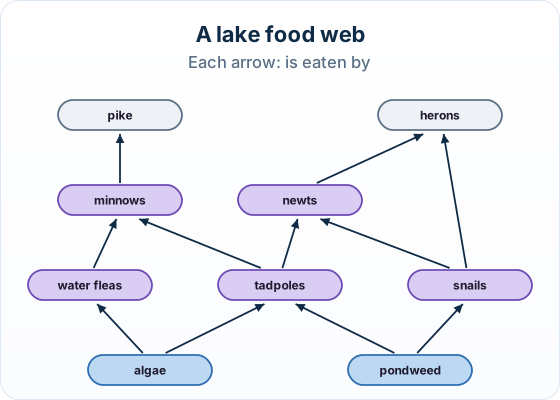
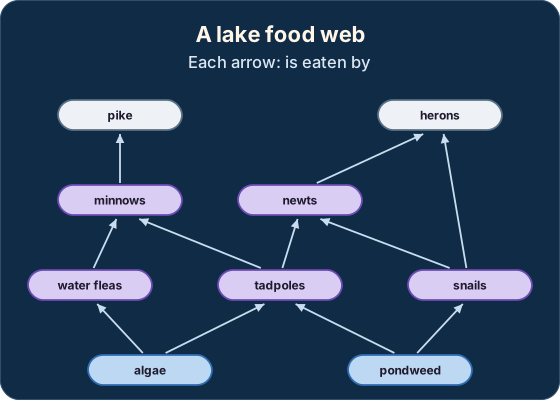
Food web of a lake: algae and pondweed at the bottom; water fleas, tadpoles and snails above them; minnows and newts above those; pike and herons at the top. Herons eat newts and also eat snailsFood web of a lake: algae and pondweed at the bottom; water fleas, tadpoles and snails above them; minnows and newts above those; pike and herons at the top. Herons eat newts and also eat snails
Herons eat snails and newts, so they feed at two trophic levels.

Herons in the lake. Follow pondweed → snails → herons: the herons are secondary consumers. Now follow pondweed → snails → newts → herons: the herons are tertiary consumers. Both are true.

Study smarter, not longer

Most students waste 40% of study time on topics they already know. Our AI tracks your progress and optimizes every minute.

Try Smart Study FreeYour first topic is free to keep • No credit card required
How it is asked: Paper 2 asks you to state the trophic level of one organism for 1 mark. Paper 1A shows a food web and asks how many species are only primary consumers, which organisms are tertiary consumers, or which organism feeds at two levels.
IB-style questionState[2 marks]

In a lake, herons eat snails, and the snails eat pondweed. The herons also eat newts, and the newts eat snails. State the two trophic levels of the herons.

Model answer plan

See the answer broken into clear points, with guidance on how each point earns marks.

Claim your free topic

Try an IB Exam Question — Free AI Feedback

Test yourself on Classification of organisms into trophic levels. Write your answer and get instant AI feedback — just like a real IB examiner.

In the food chain oak tree → caterpillar → blue tit → sparrowhawk, state the trophic level of the blue tit. [1 mark]

Related Biology HL Topics

Continue learning with these related topics from the same unit:

3.1.1Enzymes as catalysts3.1.2Role of enzymes in metabolism3.1.3Anabolic and catabolic reactions3.1.4Enzymes as globular proteins with an active site for catalysis
View all Biology HL topics
Improve your exam techniqueCommand terms, paper structure, and mark-scheme tips for Biology HL
Previous3.9.9Release of energy in both autotrophs and heterotrophs by oxidation of carbon compounds in cell respirationNextConstruction of energy pyramids3.9.11

28 practice questions on Classification of organisms into trophic levels

Students who practiced this topic on Aimnova scored 82% on average. Try free practice questions and get instant AI feedback.

Try 3 Free QuestionsView All Biology HL Topics