HIV and AIDS at Higher Level: Same content as SL: C3.2 has no additional Higher Level content. HL Paper 2 has asked for a 4-mark Discuss on the consequences of HIV infection.
Practise this as you read
- Discuss the consequences of HIV infection.
- Explain a symptom from a graph of helper T-cell count.
Free preview
This is the free notes preview
You're reading the free notes. Aimnova Pro unlocks the full study experience — and you can try it with your first topic free to keep:
- FlashcardsLock in vocabulary and key terms with spaced repetition.
- Practice questionsAnswer exam-style questions and get instant AI marking.
- Mock exams & past-paper vaultSit full mocks and see exactly how examiners award marks.
- Personalised study planA daily plan built around your exam date and weak areas.
The big idea: HIV is a virus that attacks the immune system itself. Seeing how it does the opposite of a vaccine makes both easier to remember.
HIV
- A virus that attacks the immune system itself
- It destroys the helper T-cells that normally switch on your defences
- After years, so many are gone that the immune system collapses; this stage is called AIDS
A vaccine
- Does the reverse: it strengthens the immune system in advance
- It teaches the immune system to remember a pathogen
- So the pathogen can be destroyed quickly if you ever meet it for real
- Pathogen
- A microorganism that causes disease — for example a bacterium or a virus.
- Antigen
- A molecule (often on the surface of a pathogen) that the immune system recognises as foreign and responds to.
- Antibody
- A Y-shaped protein made by the immune system that binds to one specific antigen, marking the pathogen for destruction.
- Helper T-cell
- A type of lymphocyte that activates other immune cells, including the B-cells that make antibodies. HIV destroys these cells.
- HIV
- Human Immunodeficiency Virus — a virus that infects and destroys helper T-cells, gradually weakening the immune system.
- AIDS
- Acquired Immune Deficiency Syndrome — the late stage of HIV infection, when helper T-cell numbers are so low that the immune system can no longer fight infection.
- Vaccine
- A harmless preparation of a pathogen's antigens that triggers immunity (memory) without causing the disease.
- Immunological memory
- The ability of the immune system to respond faster and more strongly the second time it meets the same antigen, thanks to memory cells.
An antibody is a Y-shaped protein whose tips fit one specific antigen, like a lock and key. Vaccination builds memory cells that can make these antibodies fast — and it is the helper T-cells (destroyed by HIV) that switch on the cells producing them.
Interactive diagram
Explore the labelled diagram, charts and maps for this topic in full study mode.
Why these two belong together: Both topics turn on the helper T-cell.
A vaccine works because helper T-cells help build memory against an antigen.
HIV is so dangerous because it kills those same helper T-cells — removing the very cell a vaccine relies on.
Feeling unprepared for exams?
Get a clear study plan, practice with real questions, and know exactly where you stand before exam day. No more guessing.
Most pathogens are dealt with by the immune system. HIV is different — it infects the immune system itself.
HIV enters helper T-cells and uses them to make new virus particles, destroying the cells in the process. Because helper T-cells are the 'switch' that activates other immune cells, losing them cripples the whole defence.
Only certain lymphocytes: HIV does not infect every white blood cell. It infects and kills only certain lymphocytes, mainly helper T-cells. B-cells are not infected, but with too few helper T-cells they are not activated, so they cannot make antibodies.
| Step | What happens | Why it matters |
|---|---|---|
| HIV infects helper T-cells | The virus enters and uses helper T-cells to make copies of itself, destroying them | Helper T-cells are the 'switch' that activates other immune cells |
| Helper T-cell count falls | Over months and years the number of helper T-cells in the blood drops | The longer the infection, the weaker the immune response becomes |
| Antibody production fails | Without helper T-cells, B-cells are not activated, so few antibodies are made | The body can no longer fight off pathogens effectively |
| AIDS develops | Helper T-cells fall so low that the immune system collapses | The person catches opportunistic infections and rare cancers — this stage is AIDS |
See it drawn, step by step
In My Learning, handwritten diagrams build one step at a time. Play, pause and replay each explanation until it clicks. Create your free account to try it.
Why losing helper T-cells is catastrophic: Helper T-cells activate B-cells, and B-cells make antibodies.
So as HIV destroys helper T-cells, antibody production falls and the body can no longer fight infection.
The points to remember
- HIV infects and kills helper T-cells (only certain lymphocytes).
- Fewer helper T-cells: fewer B-cells activated.
- So antibody production falls.
- Opportunistic infections can no longer be fought: AIDS.
When the immune system fails: AIDS: When helper T-cell numbers drop low enough, the immune system effectively fails. This late stage is AIDS.
The person then suffers opportunistic infections and cancers that a healthy immune system would normally prevent. These usually cause death, not the virus directly.
How this is tested: Paper 1 shows a graph of helper T-cells over the years after infection and asks you to explain a symptom. Paper 2 asks you to discuss the consequences of HIV infection (4 marks): T-cells lost, B-cells not activated, antibodies not made, opportunistic infections, AIDS.
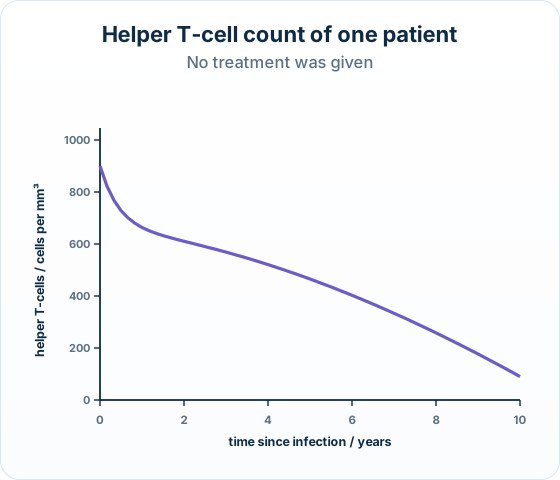
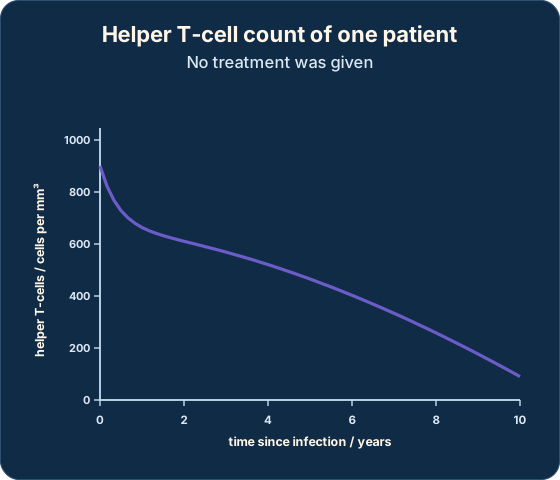
The graph shows the number of helper T-cells in the blood of an untreated patient in the years after infection with HIV. Explain a symptom the patient is likely to have nine years after infection.
Model answer plan
See the answer broken into clear points, with guidance on how each point earns marks.