Pain reflex arcs at Higher Level: Shared with SL; at HL the free nerve endings that start the arc are the pain receptors of 3.5.15.
Practise this as you read
- Identify the receptor and the effector.
- Describe the pathway of the arc.
Free preview
This is the free notes preview
You're reading the free notes. Aimnova Pro unlocks the full study experience — and you can try it with your first topic free to keep:
- FlashcardsLock in vocabulary and key terms with spaced repetition.
- Practice questionsAnswer exam-style questions and get instant AI marking.
- Mock exams & past-paper vaultSit full mocks and see exactly how examiners award marks.
- Personalised study planA daily plan built around your exam date and weak areas.
The big idea: A reflex is a fast, automatic response to a stimulus that happens without conscious thought.
For example: When you touch something sharp, your hand pulls back before you even feel the pain.
How it is so fast: This is possible because the signal travels along a fixed nerve pathway called a reflex arc, which routes the message through the spinal cord instead of waiting for the brain to decide.
Reflexes protect the body from harm and keep it working smoothly.
The reflex arc: a stimulus is detected by a receptor, the signal travels along a sensory neuron into the CNS, a relay neuron passes it to a motor neuron, and the effector carries out the response — all without waiting for the brain.
Interactive diagram
Explore the labelled diagram, charts and maps for this topic in full study mode.
- Reflex
- A fast, automatic response to a stimulus that does not need conscious thought.
- Reflex arc
- The fixed nerve pathway a reflex follows: stimulus -> receptor -> sensory neuron -> relay neuron (CNS) -> motor neuron -> effector -> response.
- Stimulus
- A change in the environment that is detected by the body (e.g. a pin prick, bright light, heat).
- Receptor
- A sensory cell or sensory nerve ending that detects a stimulus and starts a nerve impulse.
- Effector
- A muscle or gland that carries out the response (e.g. a muscle that contracts to move the body).
- Relay neuron (interneuron)
- A short neuron inside the CNS that connects the sensory neuron to the motor neuron.
Why reflexes are fast: A reflex is quick because the signal takes a short cut through the spinal cord and does not have to travel up to the brain and back.
Skipping the brain means the response happens in a fraction of a second — exactly what you need to pull away from danger.
Never wonder what to study next
Get a personalized daily plan based on your exam date, progress, and weak areas. We'll tell you exactly what to review each day.
Every reflex follows the same ordered pathway. Learn the seven steps in order and you can answer almost any reflex-arc question.
The trick: The signal goes IN to the CNS along a sensory neuron and OUT from the CNS along a motor neuron — the relay neuron is the bridge between them, inside the spinal cord.
| Part of the arc | What it is | What it does |
|---|---|---|
| Stimulus | A change detected by the body (e.g. a sharp pin, bright light, heat) | Starts the reflex off |
| Receptor | A sensory cell or sensory nerve ending (e.g. in the skin) | Detects the stimulus and starts a nerve impulse |
| Sensory neuron | A neuron carrying the impulse toward the CNS | Brings the signal IN to the spinal cord |
| Relay neuron (interneuron) | A short neuron inside the CNS (spinal cord) | Connects the sensory neuron to the motor neuron |
| Motor neuron | A neuron carrying the impulse away from the CNS | Sends the command OUT to the effector |
| Effector | A muscle or a gland | Carries out the response (e.g. contracts to pull the hand away) |
Where the synapses are: The neurons of a reflex arc do not touch — they meet at synapses.
The synapse between the sensory neuron and the relay neuron, and the one between the relay neuron and the motor neuron, both sit inside the CNS (in the grey matter of the spinal cord).
Where the synapses sit: Synapses in a reflex arc are located in the central nervous system, not out in the skin or the muscle.
Signal going IN
- Starts at the receptor (detects the stimulus)
- Travels along the sensory neuron
- Heads toward the CNS (spinal cord)
- Synapses onto the relay neuron inside the CNS
Signal coming OUT
- Leaves along the motor neuron
- Travels away from the CNS
- Reaches the effector (a muscle or gland)
- The effector carries out the response
An easy way to remember: Sensory = Sending in; Motor = Moving out.
And for the order of the arc: 'Some Run Slowly, Running Mostly Empty, Resting' — Stimulus, Receptor, Sensory, Relay, Motor, Effector, Response.
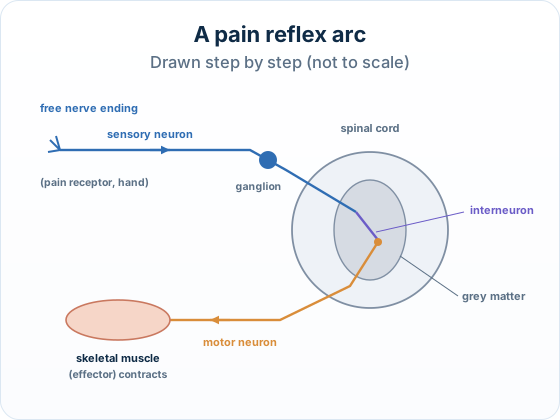
The big idea: A pain reflex arc is an involuntary response: a free sensory nerve ending in the hand detects pain, a sensory neuron carries the impulse into the grey matter of the spinal cord, one interneuron passes it to a motor neuron, and a skeletal muscle, the effector, contracts to pull the hand away.
The points to remember
- Receptor: a free sensory nerve ending in the skin of the hand.
- Sensory neuron: into the spinal cord (cell body in a ganglion).
- One interneuron in the grey matter: two synapses, both in the CNS.
- Motor neuron: out to the effector.
- Effector: a skeletal muscle, which contracts. No conscious decision.
Remember it as: Ending, sensory, inter, motor, muscle.
Real example: a pin in the finger. Your hand is already moving away before you feel the pain: the arc through the spinal cord is complete first, and the impulses that reach the brain arrive a moment later.
Trap: The receptor is the nerve ending of the sensory neuron, not the pin or the skin; the effector is the muscle, not the hand.
Stop wasting time on topics you know
Our AI identifies your weak areas and focuses your study time where it matters. No more overstudying easy topics.
How it is asked: Expect MCQs that name the receptor, the effector or where the synapses are, a Describe question on the pathway, or a Draw question on a reflex arc (follow the step drawing above).
Describe the pathway of a pain reflex arc, from the stimulus to the response.
Model answer plan
See the answer broken into clear points, with guidance on how each point earns marks.