aımnova
DashboardMy LearningCrash CoursesStudy Plan

Aimnova site navigation

Stay in the loop

Get the latest study resources and updates

New features, study tips and exam insights — straight to your inbox.

IB Diploma

  • IB Past Papers
  • IB Study Notes
  • IB Question Bank
  • IB Mock Exams
  • IB Revision

IB Subjects

  • IB Math AA
  • IB Math AI
  • IB Economics
  • IB Business Management
  • IB Physics
  • IB Biology
  • View all IB subjects→

IB Past Papers

  • IB Math AA HL Past Papers
  • IB Math AA SL Past Papers
  • IB Math AI HL Past Papers
  • IB Math AI SL Past Papers
  • IB Economics HL Past Papers
  • IB Economics SL Past Papers
  • IB ESS Past Papers
  • View all past papers→

Study Resources

  • Study Notes
  • Question Bank
  • Mock Exams
  • Crash Courses
  • Flashcards
  • Revision Guide
  • Exam Skills
  • Command Terms
  • Grade Calculator
  • Exam Timetable 2026

Aimnova

  • Features
  • Pricing
  • For Teachers
  • For Schools
  • For Parents
  • About Us
  • Blog
  • Contact
aımnova

IB study, practice and feedback built around the real exam.

TermsPrivacyCookies·© 2026 Aimnova. All rights reserved.06bfe1b

Aimnova is not affiliated with or endorsed by the International Baccalaureate Organization (IB).

NotesBiology HLTopic 3.6The spinal cord as an integrating centre for unconscious processes
Back to Biology HL Topics
3.6.53 min read

The spinal cord as an integrating centre for unconscious processes (Biology HL)

IB Biology · Unit 3

Your first topic is free to keep

Know exactly what to write for full marks

Practice with exam questions and get AI feedback that shows you the perfect answer — what examiners want to see.

Start Free

Contents

  1. 1The spinal cord at Higher Level
  2. 2The spinal cord at work, step by step
  3. 3Exam-style question (step by step)
The spinal cord at Higher Level: Shared with SL: conscious and unconscious processes.

Practise this as you read

  • Distinguish conscious and unconscious processes.
  • State where each is integrated.

Free preview

This is the free notes preview

You're reading the free notes. Aimnova Pro unlocks the full study experience — and you can try it with your first topic free to keep:

  • FlashcardsLock in vocabulary and key terms with spaced repetition.
  • Practice questionsAnswer exam-style questions and get instant AI marking.
  • Mock exams & past-paper vaultSit full mocks and see exactly how examiners award marks.
  • Personalised study planA daily plan built around your exam date and weak areas.
Start Studying Free Full access to Aimnova Pro · cancel anytime
The big idea: The spinal cord is an integrating centre of its own. It receives impulses from receptors and can send a response straight back to the effectors, with no awareness: an unconscious process. Conscious processes, the ones we are aware of and can decide about, happen in the cerebral hemispheres of the brain.
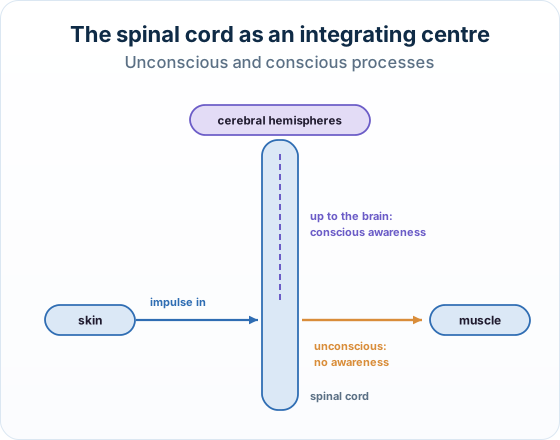
A diagram drawn step by step: the spinal cord below the cerebral hemispheres; an impulse from the skin enters it; a response leaves it straight to a muscle, unconsciously; impulses also go up to the brain for conscious awareness
The spinal cord at work, step by step.

The points to remember

  • The spinal cord links the brain with the body, and integrates too.
  • It can respond to an input on its own, without the brain.
  • These responses are unconscious: we are not aware of them as they happen.
  • Conscious processes happen in the cerebral hemispheres: awareness and decisions.
  • Unconscious responses are automatic and fast.
Remember it as: Cord acts; brain knows.

Real example: the knee-jerk. When a doctor taps just below your kneecap, your leg kicks forward before you decide anything. The spinal cord makes this response on its own; you only become aware of it a moment later, when the impulses reach your brain.

Trap: Unconscious does not mean the brain is never told: impulses still reach the brain, but the response has already happened without a conscious decision.

Stop wasting time on topics you know

Our AI identifies your weak areas and focuses your study time where it matters. No more overstudying easy topics.

Try Smart Study FreeYour first topic is free to keep • No credit card required
How it is asked: Expect a question that distinguishes conscious and unconscious processes, or asks where each is integrated.
IB-style questionDistinguish[2 marks]

Distinguish between conscious and unconscious processes in the nervous system.

Model answer plan

See the answer broken into clear points, with guidance on how each point earns marks.

Claim your free topic

Try an IB Exam Question — Free AI Feedback

Test yourself on The spinal cord as an integrating centre for unconscious processes. Write your answer and get instant AI feedback — just like a real IB examiner.

one advantage to an animal of some responses being integrated by the spinal cord rather than by the brain. [2 marks]

Related Biology HL Topics

Continue learning with these related topics from the same unit:

3.1.1Enzymes as catalysts3.1.2Role of enzymes in metabolism3.1.3Anabolic and catabolic reactions3.1.4Enzymes as globular proteins with an active site for catalysis
View all Biology HL topics
Improve your exam techniqueCommand terms, paper structure, and mark-scheme tips for Biology HL
Previous3.6.4The brain as a central information integration organNextInput to the spinal cord and cerebral hemispheres through sensory neurons3.6.6

6 exam-style questions ready for you

Students who practice on Aimnova improve their scores by 15% on average. Get instant feedback that shows exactly how to improve your answers.

Practice Now — FreeView All Biology HL Topics