Integration of organs at Higher Level: Shared with SL; at HL the same signals reappear as chemical signalling pathways (3.4) and synapses (3.5).
Practise this as you read
- Distinguish nervous and hormonal signalling.
- Outline the role of the blood.
Free preview
This is the free notes preview
You're reading the free notes. Aimnova Pro unlocks the full study experience — and you can try it with your first topic free to keep:
- FlashcardsLock in vocabulary and key terms with spaced repetition.
- Practice questionsAnswer exam-style questions and get instant AI marking.
- Mock exams & past-paper vaultSit full mocks and see exactly how examiners award marks.
- Personalised study planA daily plan built around your exam date and weak areas.
The big idea: Your body has two systems for sending signals and coordinating its parts. Together they make the body behave as one integrated whole.
The two systems
- The nervous system sends fast electrical signals along neurons.
- The endocrine system sends slower chemical signals — hormones — through the blood.
- These two systems do not work in isolation: the brain links them together.
- Nervous system
- The system of neurons (nerve cells) that carries fast electrical impulses to coordinate the body. It includes the brain, spinal cord and nerves.
- Endocrine system
- The system of glands that release hormones into the blood to coordinate the body more slowly and over a longer time.
- Hormone
- A chemical messenger released by an endocrine gland into the blood. It travels to target cells anywhere in the body and changes how they behave.
- Endocrine gland
- An organ that makes and releases a hormone directly into the blood (for example the pancreas, adrenal gland, thyroid or a testis).
- Target cell
- A cell that has the matching receptor for a particular hormone, so only those cells respond to it.
- Central nervous system (CNS)
- The brain and spinal cord — the control centre that receives information and decides on a response.
Why two systems?: The two systems are built for different jobs. Together they cover both the quick and the sustained demands of the body.
React right now
- Example: snatching your hand off a hot pan
- The nervous system is fast and precise
Maintain a change
- Example: keeping blood glucose steady all day
- The endocrine system is slower but longer-lasting
Never wonder what to study next
Get a personalized daily plan based on your exam date, progress, and weak areas. We'll tell you exactly what to review each day.
The easiest way to keep the two systems straight is to compare them side by side.
Think about what carries the signal, how fast it travels, how far it spreads, and how long the effect lasts.
| Feature | Nervous system | Endocrine system |
|---|---|---|
| Signal carried by | Electrical impulses along neurons | Chemical hormones in the blood |
| Speed of response | Very fast (a fraction of a second) | Slower (seconds to minutes) |
| How far it reaches | A precise target — one muscle or gland | Widespread — any cell with the right receptor |
| How long it lasts | Short-lived — stops almost at once | Longer-lasting — minutes, hours or longer |
| Example | Pulling your hand off a hot pan | Adrenaline preparing the whole body for action |
Nervous system
- Signal is electrical (an impulse along a neuron)
- Fast — acts in a fraction of a second
- Precise target — one muscle or gland
- Effect is short-lived
Endocrine system
- Signal is chemical (a hormone in the blood)
- Slower — acts over seconds to minutes
- Widespread — reaches any cell with the receptor
- Effect is longer-lasting
The link between them — the brain: The two systems are joined by the brain. So the nervous system can control the endocrine system.
From the brain to the glands
Hypothalamus
Part of the brain called the hypothalamus monitors the body and signals the pituitary gland (an endocrine gland just below it).
Pituitary
The pituitary then releases hormones that switch other endocrine glands on or off.
Nerves carry the signal
The signal that travels from the CNS to an endocrine gland is carried by neurons (nerves), often routed through the hypothalamus and pituitary.
Hypothalamus → pituitary → other glands
Keeping things steady — negative feedback: Both systems hold internal conditions steady using negative feedback. This same loop is used whether the control is nervous, hormonal, or both together.
The negative-feedback loop
Change
A change moves a level away from its normal value (its set point).
Detect
Receptors detect the change.
Respond
A control centre signals effectors, and the response opposes the original change.
Back to normal
Because the response always reverses the change, the level is pushed back and held close to normal.
Change → detect → oppose → normal
Negative feedback: a change moves a level away from its set point, receptors detect it, the control centre signals effectors, and the response opposes the change — returning the level to normal. This is how the nervous and endocrine systems keep the body stable.
Interactive diagram
Explore the labelled diagram, charts and maps for this topic in full study mode.
An easy way to remember: Nervous = Now (fast, electrical, brief). Endocrine = Enduring (slower, hormonal, long-lasting).
And negative feedback always does the opposite of the change — that is the whole point of the word negative.
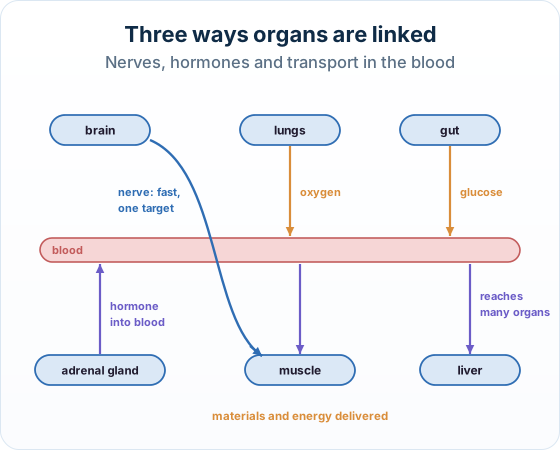
The big idea: Organs are integrated in three ways: nervous signalling (fast impulses to one target), hormonal signalling (hormones in the blood reach many targets), and transport of materials and energy by the blood between the organs that supply them and the organs that use them.
The points to remember
- Nerves: impulses, fast, to one target, brief.
- Hormones: carried in the blood, slower, to many targets, longer-lasting.
- The blood also transports materials: oxygen, glucose, carbon dioxide, urea.
- It moves energy too: in glucose, and as heat.
- All three link the organs into one body.
Remember it as: Wire, broadcast, delivery.
Real example: during a sprint. Nerves make the leg muscles contract at once; epinephrine from the adrenal glands raises the heart rate for minutes; the blood brings oxygen from the lungs and glucose from the liver to the muscles and carries carbon dioxide and heat away.
Trap: The blood is not only a route for hormones: it transports materials such as oxygen and glucose between organs, which is also part of integration.
Stop wasting time on topics you know
Our AI identifies your weak areas and focuses your study time where it matters. No more overstudying easy topics.
How this is tested: This topic is tested with short matching and recall questions.
The three question types
- Multiple choice: a table where you pick the row that correctly matches an endocrine gland, the hormone it releases, and that hormone's action. Read each row and reject the wrong ones.
- Short State: give one body effect of a named hormone such as testosterone or epinephrine (adrenaline). One clear effect per hormone.
- Identify what carries signals from the CNS to an endocrine gland. The answer is neurons / nerves.
Exam-style question — match the gland, hormone and action
A table lists four endocrine glands with a hormone and an action. Which row is correct?
W: Pancreas — insulin — raises blood glucose.
X: Adrenal gland — epinephrine (adrenaline) — raises heart rate.
Y: Thyroid gland — insulin — lowers heart rate.
Z: Testis — adrenaline — drives male development. [1]
How to read the rows
- Check each gland makes that hormone. The pancreas makes insulin (row W is right so far), the adrenal gland makes epinephrine / adrenaline (row X is right so far), the thyroid does NOT make insulin (row Y is already wrong), and the testis makes testosterone, not adrenaline (row Z is wrong).
- Check the action matches the hormone. Insulin lowers blood glucose, not raises it — so row W is wrong. Epinephrine (adrenaline) raises heart rate — so row X matches on all three columns.
- Choose the fully correct row. Only row X is correct in all three columns: adrenal gland → epinephrine → raises heart rate. (Reject any row with even one wrong column.)
Final answer
Row X — adrenal gland releases epinephrine (adrenaline), which raises heart rate.
How to read it: A matching question is only correct if all three columns agree — gland, hormone and action.
The trap rows look right in one column (e.g. insulin really is a pancreas hormone) but get the action wrong (insulin lowers, not raises, glucose). Always check every column before you commit.
| Endocrine gland | Hormone it releases | One action of the hormone |
|---|---|---|
| Pancreas | Insulin | Lowers blood glucose (cells take up glucose) |
| Adrenal gland | Epinephrine (adrenaline) | Raises heart rate and breathing rate (the 'fight-or-flight' response) |
| Testis | Testosterone | Drives male sexual development (e.g. sperm production, body changes at puberty) |
| Thyroid gland | Thyroxin | Raises the metabolic rate of body cells |
Another question in the papers' style:
Outline the role of the blood in integrating the organs of the body, using one example.
Model answer plan
See the answer broken into clear points, with guidance on how each point earns marks.