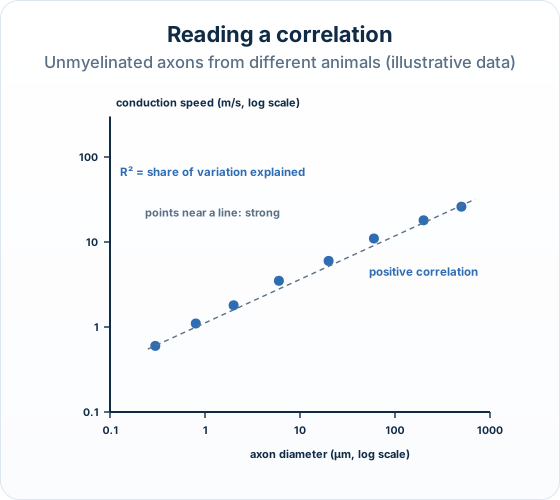
Nerve impulse speed at Higher Level: Shared with SL; at HL the speed of myelinated fibres is explained by saltatory conduction (3.5.11).
Practise this as you read
- Explain differences in conduction speed.
- Analyse data on axon diameter and speed.
Free preview
This is the free notes preview
You're reading the free notes. Aimnova Pro unlocks the full study experience — and you can try it with your first topic free to keep:
- FlashcardsLock in vocabulary and key terms with spaced repetition.
- Practice questionsAnswer exam-style questions and get instant AI marking.
- Mock exams & past-paper vaultSit full mocks and see exactly how examiners award marks.
- Personalised study planA daily plan built around your exam date and weak areas.
The big idea: A nerve impulse (action potential) does not travel at the same speed in every neuron.
Its speed depends mainly on three things
- Whether the axon is wrapped in a myelin sheath
- Whether the impulse can use saltatory conduction (jumping between gaps)
- The diameter of the axon
Fast vs slow: A thick, myelinated axon carries an impulse much faster than a thin, bare one.
A myelinated motor neuron. The fatty myelin sheath insulates the axon, and the impulse jumps between the bare gaps — the nodes of Ranvier — which is why a myelinated axon conducts so fast.
Interactive diagram
Explore the labelled diagram, charts and maps for this topic in full study mode.
- Myelin sheath
- A fatty layer that wraps around the axon of some neurons and acts as electrical insulation. It is made by special supporting cells.
- Node of Ranvier
- A small gap in the myelin sheath where the axon membrane is exposed. The action potential is regenerated only at these gaps.
- Saltatory conduction
- Conduction in which the impulse 'jumps' from one node of Ranvier to the next, instead of moving continuously along the whole membrane. ('Saltare' is Latin for 'to jump'.)
- Axon diameter
- How wide the axon is. A wider axon conducts a nerve impulse faster than a narrow one.
- Myelinated / unmyelinated
- A myelinated axon has a myelin sheath; an unmyelinated axon does not. Myelinated axons conduct faster.
Why insulation matters: The myelin sheath works like the plastic coating around an electrical wire — it insulates the axon.
Because the impulse can only form at the bare gaps (the nodes of Ranvier), it skips the insulated stretches and leaps from node to node, saving a huge amount of time.
Memorize terms 3x faster
Smart flashcards show you cards right before you forget them. Perfect for definitions and key concepts.
How fast an impulse travels depends on how often along the axon it has to be re-made.
Unmyelinated axon
- The action potential has to be re-made at every single point along the membrane
- So it creeps along continuously and slowly
Myelinated axon
- Insulated almost everywhere — the impulse can only be re-made at the nodes of Ranvier
- So it effectively jumps from one node to the next
- This jumping is called saltatory conduction, and it is far faster
Saltatory conduction — jumping the gaps: Because the myelin insulates the axon, the action potential cannot form under the sheath.
Instead it is regenerated only at the nodes of Ranvier, so the impulse 'jumps' from node to node down the axon.
Skipping the insulated stretches means the impulse covers the same distance in far less time — this is why myelinated neurons are so fast.
Depolarization (the action potential) only happens at the nodes of Ranvier — the gaps in the myelin. The impulse 'jumps' from one node to the next, so it travels much faster than along a bare axon.
Interactive diagram
Explore the labelled diagram, charts and maps for this topic in full study mode.
Axon diameter — wider is faster: The width (diameter) of the axon also matters.
A wider axon has less internal resistance to the flow of charge along it, so the impulse moves through it faster.
A narrow axon resists the flow more, so the same impulse travels more slowly. This is why some animals have giant, extra-wide axons for their fastest escape reflexes.
| Factor | Faster conduction when… | Why it speeds the impulse |
|---|---|---|
| Myelination | the axon IS myelinated | The fatty sheath insulates the axon, so the impulse jumps between nodes instead of moving along every part of the membrane |
| Saltatory conduction | there are nodes of Ranvier (gaps) | The action potential is only regenerated at the nodes, so it 'leaps' node to node rather than creeping continuously |
| Axon diameter | the axon is WIDER (thicker) | A wider axon offers less resistance to the flow of charge inside it, so the impulse moves along faster |
Fast conduction
- Axon IS myelinated (insulated)
- Uses saltatory conduction (jumps node to node)
- Axon is wide (low internal resistance)
- Impulse reaches the end quickly
Slow conduction
- Axon is unmyelinated (bare)
- Conduction is continuous along the whole membrane
- Axon is narrow (high internal resistance)
- Impulse reaches the end slowly
Putting the three together: To decide which of two axons is faster, weigh up all three clues:
myelinated beats unmyelinated, wider beats narrower.
So the fastest axon is the one that is myelinated AND wide; the slowest is the one that is unmyelinated AND thin. This is exactly the comparison a data question on axon cross-sections is testing.
Remember it as: Saltatory = salto = a jump. The impulse does a series of jumps between the gaps.
And for diameter: a wide motorway moves traffic faster than a narrow lane — a wide axon moves the impulse faster than a narrow one.
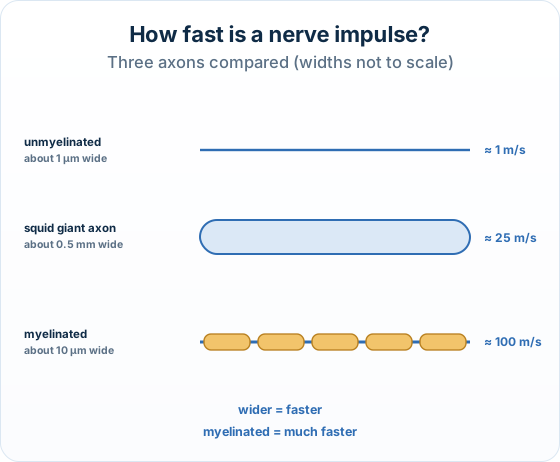
The big idea: Impulses travel at different speeds. Wider axons conduct faster: the unmyelinated squid giant axon is about 0.5 mm wide and fast. Myelinated axons conduct much faster still, even when they are thin.
The points to remember
- Thin unmyelinated fibre: slow (about 1 m/s).
- Squid giant axon: unmyelinated but very wide: about 25 m/s.
- Thin myelinated mammal axon: up to about 100 m/s.
- Speed is positively correlated with axon diameter.
- Myelin lets thin axons be fast, so many fit in one nerve.
Remember it as: Go wide, or wrap it up.
Real example: the squid's escape. The giant axons of a squid carry the signal that makes its mantle contract, so it can jet away from a predator in a fraction of a second.
Trap: A correlation shows that two variables change together; it does not by itself show that one causes the other.
Know your predicted grade
Take timed mock exams and get detailed feedback on every answer. See exactly where you're losing marks.
How this is tested: Three question types come up: an Outline, a short Identify, and a multiple-choice data-reasoning item.
What each one needs
- Outline: how saltatory conduction transmits a nerve impulse — say the impulse is regenerated only at the nodes of Ranvier and so jumps from node to node
- Identify: a myelinated neuron is shown and you say where depolarization occurs — at the nodes (the gaps in the myelin), not under the sheath
- Data reasoning: cross-sections of different axons — say which conducts most slowly (the thin, unmyelinated one), or propose why one fibre is faster (thicker / more myelin)
Exam-style question — outline saltatory conduction
Outline how saltatory conduction transmits a nerve impulse along a myelinated axon. [2]
Step by step
- Where the impulse forms. The myelin sheath insulates the axon, so the action potential (depolarization) can only be regenerated at the nodes of Ranvier — the gaps in the sheath.
- How it moves. Because of this, the impulse 'jumps' from one node to the next rather than moving continuously, which makes conduction much faster.
Final answer
The myelin insulates the axon, so the action potential is regenerated only at the nodes of Ranvier; the impulse therefore jumps from node to node, which is faster than continuous conduction.
Why this works: Both key ideas are present: the impulse is only at the nodes of Ranvier, and it jumps between them.
An answer that just says 'it goes fast' without naming the nodes and the jumping would not be a full outline.
Exam-style question — draw and label a myelinated neuron
Draw a labelled diagram of a myelinated motor neuron and show where depolarization occurs during an action potential. [3]
Step by step
- Draw the axon and its sheath. Show the long axon carrying the impulse, wrapped in segments of myelin sheath with gaps between them.
- Label the gaps. Label those gaps as the nodes of Ranvier, and label the fatty myelin sheath segments.
- Show depolarization. Show that depolarization (the action potential) occurs at the nodes of Ranvier, not under the myelin.
Final answer
A myelinated axon with the myelin sheath labelled, the gaps labelled as nodes of Ranvier, and depolarization shown occurring at those nodes.
Depolarization (the action potential) only happens at the nodes of Ranvier — the gaps in the myelin. The impulse 'jumps' from one node to the next, so it travels much faster than along a bare axon.
Interactive diagram
Explore the labelled diagram, charts and maps for this topic in full study mode.
| Feature | Myelinated axon | Unmyelinated axon |
|---|---|---|
| Myelin sheath | present (fatty, insulating) | absent |
| Where the impulse forms | only at the nodes of Ranvier (gaps) | continuously, all along the membrane |
| Type of conduction | saltatory ('jumping' node to node) | continuous |
| Speed of impulse | fast | slow |
Another question in the papers' style:
A myelinated axon 10 µm wide conducts impulses faster than the squid giant axon, which is about 500 µm wide. Explain how this is possible.
Model answer plan
See the answer broken into clear points, with guidance on how each point earns marks.
Data questions. Graphs of axon diameter and speed often use log scales and ask you to describe the correlation: