Resting potential at Higher Level: Shared with SL; at HL the resting potential is the starting point of depolarization and repolarization (3.5.8) and of the oscilloscope traces (3.5.10).
Practise this as you read
- Describe how the resting potential is set up.
- Outline the role of ATP.
Free preview
This is the free notes preview
You're reading the free notes. Aimnova Pro unlocks the full study experience — and you can try it with your first topic free to keep:
- FlashcardsLock in vocabulary and key terms with spaced repetition.
- Practice questionsAnswer exam-style questions and get instant AI marking.
- Mock exams & past-paper vaultSit full mocks and see exactly how examiners award marks.
- Personalised study planA daily plan built around your exam date and weak areas.
The big idea: A neuron that is not carrying a signal is not 'switched off' — it is held ready.
The resting potential
- Across the neuron's membrane there is a small voltage called the resting potential
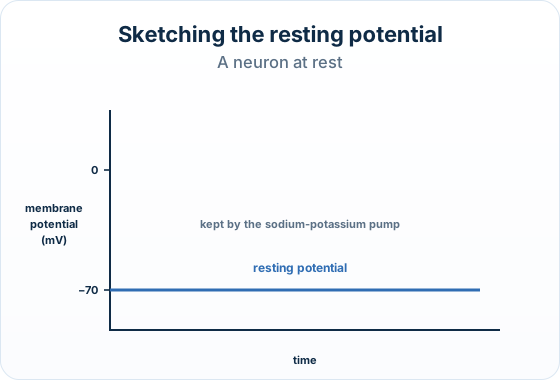
- The inside of the neuron is negative compared with the outside — about −70 mV
- This negative inside is set up and maintained by actively pumping ions across the membrane, which costs the cell energy (ATP)
- It is the starting point from which a nerve impulse can later fire
Before any signal, the membrane sits at its resting potential of about −70 mV (the flat baseline on the left). The sodium-potassium pump uses ATP to hold the inside negative relative to the outside; only later does a stimulus trigger depolarisation.
Interactive diagram
Explore the labelled diagram, charts and maps for this topic in full study mode.
- Resting potential
- The voltage (potential difference) across the membrane of a neuron that is NOT conducting an impulse — the inside is about −70 mV relative to the outside.
- Membrane potential
- Any voltage across a cell membrane, caused by an uneven distribution of charged ions on the two sides.
- Sodium-potassium pump
- A membrane protein that uses ATP to move sodium ions (Na⁺) out of the neuron and potassium ions (K⁺) into it, against their concentration gradients.
- Active transport
- Movement of substances across a membrane AGAINST their concentration gradient, which requires energy from ATP.
- Concentration gradient
- A difference in the concentration of a substance between two regions — here, the difference in Na⁺ and K⁺ either side of the membrane.
Negative inside, ready to fire: The key fact to lock in: at rest, the inside of the neuron is negative (≈ −70 mV) relative to the outside.
This is not an accident — the cell spends ATP to keep it that way, so that a signal can be triggered the instant it is needed.
Get feedback like a real examiner
Submit your answers and get instant feedback — what you did well, what's missing, and exactly what to write to score full marks.
The resting potential does not happen by itself. It is built and held by the sodium-potassium pump, a protein in the neuron's membrane.
Follow the cause and effect
The pump moves ions
The sodium-potassium pump moves ions across the membrane.
Ions become uneven
The ions become unevenly spread.
Charge becomes voltage
That uneven spread of charge is the voltage.
Pump → uneven ions → voltage
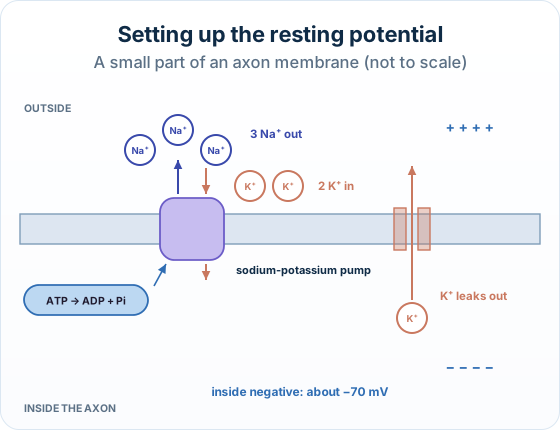
The pump moves 3 out, 2 in: Each cycle, the sodium-potassium pump moves 3 sodium ions (Na⁺) OUT of the neuron and 2 potassium ions (K⁺) IN.
What that does
- More positive ions leave than enter (3 out vs 2 in)
- So the inside of the cell is left with less positive charge — it becomes negative relative to the outside
- Both ions are moved against their concentration gradients
- So the pump must spend ATP to do it — this is active transport
| Step | What the sodium-potassium pump does | Why it matters |
|---|---|---|
| Pump sodium out | Moves 3 sodium ions (Na⁺) OUT of the neuron | Removes positive charge from inside the cell |
| Pump potassium in | Moves 2 potassium ions (K⁺) IN to the neuron | Fewer positive ions enter than left, so the inside loses charge overall |
| Uses energy | Each pumping cycle uses one molecule of ATP | The ions are moved AGAINST their concentration gradients — this needs energy (active transport) |
| Potassium leaks back out | K⁺ slowly leaks back out through K⁺ channels | Leaves even fewer positive ions inside, making the inside more negative |
Then potassium leaks back out: The pump builds a high concentration of K⁺ inside the neuron. Because K⁺ is now more concentrated inside, some of it leaks back out down its concentration gradient through potassium channels.
Why the leak matters: Every K⁺ that leaks out takes a positive charge with it, making the inside even more negative.
Together, the pump and this potassium leak settle the membrane at its resting value of about −70 mV.
Where the ATP comes from: The pump cannot run for free — it needs a constant supply of ATP.
That ATP is made by cell respiration (in the neuron's mitochondria). This is why a neuron starved of oxygen or glucose quickly loses its resting potential: no respiration → no ATP → the pump stops → the gradients run down.
| Feature | Sodium-potassium pump | Potassium leak |
|---|---|---|
| Direction of ions | Na⁺ out, K⁺ in | K⁺ out |
| With or against gradient | Against the concentration gradient | Down the concentration gradient |
| Energy needed | Yes — uses ATP (active transport) | No — passive (facilitated diffusion) |
| Effect on the inside | Sets up the gradient (3 out, 2 in → net loss of +) | Makes the inside more negative still |
Sodium-potassium pump
- Moves Na⁺ OUT and K⁺ IN
- Works against the concentration gradients
- Uses ATP (active transport)
- Sets up the ion difference across the membrane
Potassium leak
- K⁺ leaks back OUT of the neuron
- Moves down its concentration gradient
- No ATP needed (passive diffusion)
- Makes the inside more negative → helps reach −70 mV
Remember it as: 3 out, 2 in — more positive ions leave than enter, so the inside goes negative.
Pump = ATP (active, against the gradient); leak = free (passive, down the gradient). Together they give −70 mV.
The big idea: Energy from ATP drives the sodium-potassium pump, which moves sodium ions out and potassium ions in, in opposite directions. The membrane becomes polarized: the inside is negative compared with the outside. This voltage is the resting potential, about −70 mV.
The points to remember
- ATP powers the pump: active transport.
- 3 Na⁺ out, 2 K⁺ in each cycle, against their gradients.
- K⁺ leaks back out through channels.
- Inside negative: the membrane is polarized.
- Resting potential: about −70 mV.
Remember it as: Three out, two in, then some potassium leaks.
Real example: the brain's energy bill. The brain is about 2% of body mass but uses about 20% of the body's energy at rest, much of it to run sodium-potassium pumps.
Trap: The resting potential is negative because more positive ions end up outside; it is not caused by negative ions being pumped in.
Learn what examiners really want
See exactly what to write to score full marks. Our AI shows you model answers and the key phrases examiners look for.
How this is tested: Three kinds of question come up: a short written answer, a multiple-choice item, and a short data twist.
Short written answer: A favourite asks you to outline how ATP from respiration is used to establish the resting potential. The two key points are usually the active transport by the sodium-potassium pump (Na⁺ out, K⁺ in) and that this needs ATP because the ions move against their gradients.
Multiple choice: It often asks you to identify how sodium and potassium ion movements set up the resting potential. The answer is the pump moving Na⁺ out and K⁺ in, leaving the inside negative.
The data twist: Because this is a membrane / ion topic, a short data twist is common: a table of ion concentrations inside vs outside the axon, asking you to deduce what the pump is doing.
Exam-style question — outline how ATP establishes the resting potential
Outline how ATP produced in respiration is used to establish the resting potential of a neuron. [2]
Step by step
- Name the active-transport step. ATP powers the sodium-potassium pump, which actively transports 3 sodium ions (Na⁺) out of the neuron and 2 potassium ions (K⁺) in per cycle.
- Link it to the negative inside. Because the ions are pumped against their concentration gradients (which needs the ATP), more positive ions leave than enter, so the inside becomes negative relative to the outside — the resting potential of about −70 mV.
Final answer
ATP from respiration powers the sodium-potassium pump, which actively transports Na⁺ out and K⁺ in against their concentration gradients; more positive ions leave than enter, so the inside becomes negative (≈ −70 mV) — the resting potential.
Why this works: The answer has two distinct ideas: (1) ATP runs the pump that moves Na⁺ and K⁺ by active transport, and (2) moving them against the gradient leaves the inside negative.
Saying only 'ATP is used to make the resting potential' without naming the pump and the negative inside would leave out half the answer.
| Ion | Concentration inside the axon | Concentration outside the axon | Kept this way by |
|---|---|---|---|
| Sodium (Na⁺) | Low | High | The pump constantly moving Na⁺ out |
| Potassium (K⁺) | High | Low | The pump constantly moving K⁺ in |
| Overall charge | More NEGATIVE (≈ −70 mV) | More positive (set as 0 mV) | The pump + K⁺ leaking back out |
Another question in the papers' style:
Describe how the sodium-potassium pump and potassium channels together set up the resting potential of a neuron.
Model answer plan
See the answer broken into clear points, with guidance on how each point earns marks.
Sketching the resting potential. A question may ask you to draw it: