Summation at Higher Level: An AHL statement: how many inputs together decide whether a neuron fires.
Practise this as you read
- Explain why one input may not be enough.
- Explain the effect of inhibitory inputs.
Free preview
This is the free notes preview
You're reading the free notes. Aimnova Pro unlocks the full study experience — and you can try it with your first topic free to keep:
- FlashcardsLock in vocabulary and key terms with spaced repetition.
- Practice questionsAnswer exam-style questions and get instant AI marking.
- Mock exams & past-paper vaultSit full mocks and see exactly how examiners award marks.
- Personalised study planA daily plan built around your exam date and weak areas.
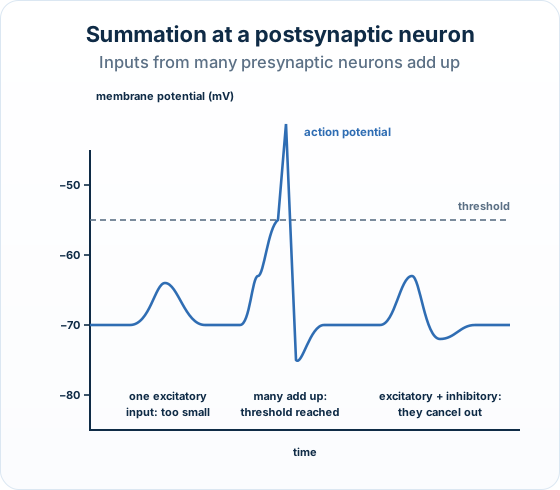
The big idea: One postsynaptic neuron receives synapses from many presynaptic neurons. Their excitatory and inhibitory effects add up: this is summation. If the total depolarization reaches the threshold, a full action potential follows; if not, nothing does. The result is all or nothing.
The points to remember
- A postsynaptic neuron has synapses from many presynaptic neurons.
- Excitatory inputs depolarize it a little; inhibitory inputs hyperpolarize it.
- Their effects add up: summation.
- Total reaches the threshold: an action potential follows.
- Below the threshold: no action potential. It is all or nothing.
Remember it as: Add up the votes: past the threshold, it fires.
Real example: motor neurons in the spinal cord. A single motor neuron in the spinal cord receives thousands of synapses. Whether it fires, and so whether its muscle fibres contract, depends on the sum of all the excitatory and inhibitory inputs at that moment.
Trap: A bigger total does not give a bigger action potential: once the threshold is reached, every action potential is the same size.
Feeling unprepared for exams?
Get a clear study plan, practice with real questions, and know exactly where you stand before exam day. No more guessing.
How it is asked: Expect a question on why one presynaptic neuron may not be enough, or how excitatory and inhibitory inputs decide whether the postsynaptic neuron fires.
Explain why an impulse in one excitatory presynaptic neuron may not produce an action potential in the postsynaptic neuron.
Model answer plan
See the answer broken into clear points, with guidance on how each point earns marks.