Oscilloscope traces at Higher Level: An AHL statement: reading what a trace shows about the axon.
Practise this as you read
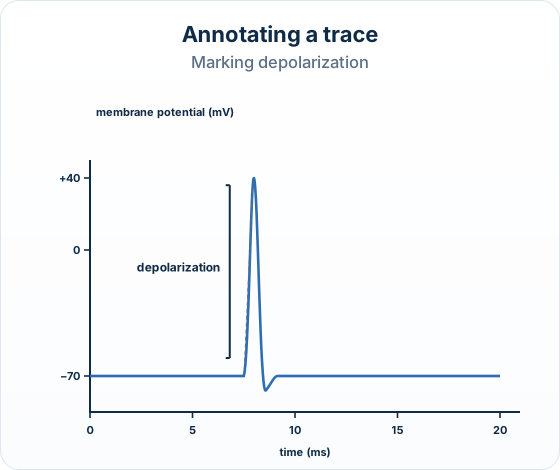
- Annotate depolarization on a trace.
- Calculate impulses per second.
Free preview
This is the free notes preview
You're reading the free notes. Aimnova Pro unlocks the full study experience — and you can try it with your first topic free to keep:
- FlashcardsLock in vocabulary and key terms with spaced repetition.
- Practice questionsAnswer exam-style questions and get instant AI marking.
- Mock exams & past-paper vaultSit full mocks and see exactly how examiners award marks.
- Personalised study planA daily plan built around your exam date and weak areas.
Start Studying Free Full access to Aimnova Pro · cancel anytime
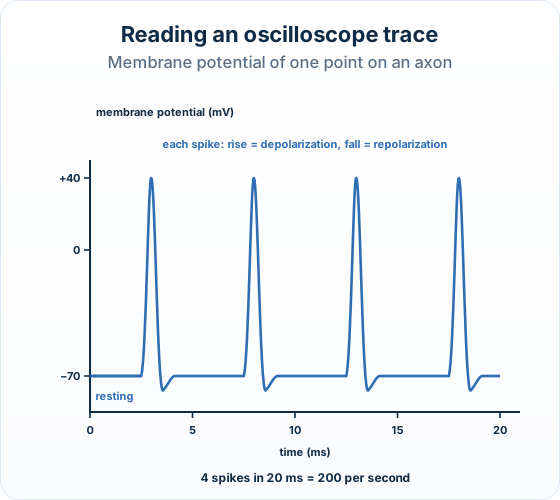
The big idea: An oscilloscope shows the membrane potential of an axon against time. A flat line at about −70 mV is the resting potential; each spike is one action potential, its rise depolarization and its fall repolarization. Counting spikes in a time gives the number of impulses per second.
The points to remember
- Oscilloscope: membrane potential (mV) against time (ms).
- Flat at −70 mV: resting potential.
- Steep rise: depolarization (Na⁺ in); fall: repolarization (K⁺ out).
- Dip below −70 mV: the short undershoot.
- Impulses per second = number of spikes ÷ time in seconds.
Remember it as: Flat, spike, flat; count the spikes.
Real example: a stronger stimulus. A touch receptor pressed harder does not make bigger spikes on the oscilloscope; it makes more of them each second.
Trap: Convert milliseconds to seconds before dividing: 4 spikes in 20 ms is 4 ÷ 0.020 s = 200 per second, not 0.2.
Annotating a trace. A question may ask you to show depolarization on a trace:
Memorize terms 3x faster
Smart flashcards show you cards right before you forget them. Perfect for definitions and key concepts.
Try Flashcards FreeYour first topic is free to keep • No credit card required
How it is asked: Expect an MCQ on what is happening at a labelled point, a State question naming the oscilloscope, an Annotate question on the trace, or a calculation of impulses per second.
IB-style questionCalculate[2 marks]
An oscilloscope trace shows 6 action potentials in 40 ms. Calculate the number of impulses per second.
Model answer plan
See the answer broken into clear points, with guidance on how each point earns marks.