aımnova
DashboardMy LearningCrash CoursesStudy Plan

Aimnova site navigation

Stay in the loop

Get the latest study resources and updates

New features, study tips and exam insights — straight to your inbox.

IB Diploma

  • IB Past Papers
  • IB Study Notes
  • IB Question Bank
  • IB Mock Exams
  • IB Revision

IB Subjects

  • IB Math AA
  • IB Math AI
  • IB Economics
  • IB Business Management
  • IB Physics
  • IB Biology
  • View all IB subjects→

IB Past Papers

  • IB Math AA HL Past Papers
  • IB Math AA SL Past Papers
  • IB Math AI HL Past Papers
  • IB Math AI SL Past Papers
  • IB Economics HL Past Papers
  • IB Economics SL Past Papers
  • IB ESS Past Papers
  • View all past papers→

Study Resources

  • Study Notes
  • Question Bank
  • Mock Exams
  • Crash Courses
  • Flashcards
  • Revision Guide
  • Exam Skills
  • Command Terms
  • Grade Calculator
  • Exam Timetable 2026

Aimnova

  • Features
  • Pricing
  • For Teachers
  • For Schools
  • For Parents
  • About Us
  • Blog
  • Contact
aımnova

IB study, practice and feedback built around the real exam.

TermsPrivacyCookies·© 2026 Aimnova. All rights reserved.06bfe1b

Aimnova is not affiliated with or endorsed by the International Baccalaureate Organization (IB).

NotesBiology HLTopic 3.4Hormones, neurotransmitters, cytokines and calcium ions as examples of functional categories of signalling chemicals in animals
Back to Biology HL Topics
3.4.33 min read

Hormones, neurotransmitters, cytokines and calcium ions as examples of functional categories of signalling chemicals in animals (Biology HL)

IB Biology · Unit 3

Your first topic is free to keep

Know exactly what to write for full marks

Practice with exam questions and get AI feedback that shows you the perfect answer — what examiners want to see.

Start Free

Contents

  1. 1Kinds of signal at Higher Level
  2. 2Four kinds of signal, step by step
  3. 3Exam-style question (step by step)
Kinds of signal at Higher Level: An AHL statement: sorting animal signalling chemicals by what they do.

Practise this as you read

  • Identify which substances act as signals.
  • Outline the role of calcium ions.
  • Distinguish hormones from neurotransmitters.

Free preview

This is the free notes preview

You're reading the free notes. Aimnova Pro unlocks the full study experience — and you can try it with your first topic free to keep:

  • FlashcardsLock in vocabulary and key terms with spaced repetition.
  • Practice questionsAnswer exam-style questions and get instant AI marking.
  • Mock exams & past-paper vaultSit full mocks and see exactly how examiners award marks.
  • Personalised study planA daily plan built around your exam date and weak areas.
Start Studying Free Full access to Aimnova Pro · cancel anytime
The big idea: Animals use four functional categories of signalling chemical. Hormones travel in the blood to distant cells. Neurotransmitters cross a synapse to the next cell. Cytokines act on nearby cells, mainly in immunity. Calcium ions enter a cell and trigger a response inside it.
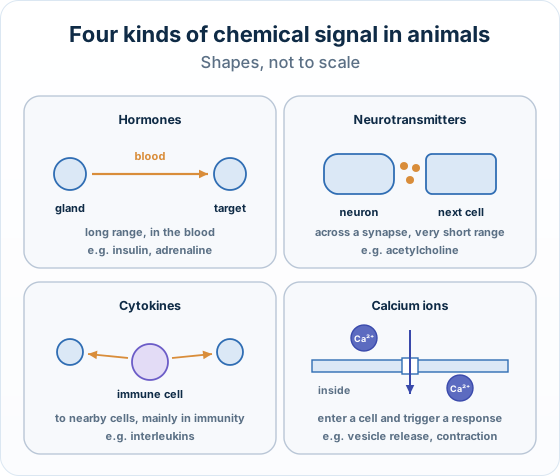
Four cards drawn one by one: a gland sending a hormone through the blood to a target cell; a neuron releasing neurotransmitter across a synapse; an immune cell sending cytokines to nearby cells; calcium ions entering a cell through a channel
Four kinds of signal, step by step.

The points to remember

  • Hormones: gland to blood to target cells anywhere in the body.
  • Neurotransmitters: neuron to the next cell, across a synapse.
  • Cytokines: to nearby cells, mainly between immune cells.
  • Calcium ions: flow into a cell and trigger vesicle release or contraction.
  • The categories are about what the signal does, not its chemistry.
Remember it as: Blood, gap, neighbour, inside.

Real examples. Adrenaline from the adrenal glands reaches the heart through the blood. Acetylcholine crosses the gap between a motor neuron and a muscle fibre. Interleukin-2, a cytokine from helper T cells, makes nearby lymphocytes divide. Calcium ions entering the end of a neuron make vesicles release neurotransmitter.

Trap: Calcium ions are not made by cells, yet they still act as a signal: the categories are functional.

Feeling unprepared for exams?

Get a clear study plan, practice with real questions, and know exactly where you stand before exam day. No more guessing.

Get Exam Ready FreeYour first topic is free to keep • No credit card required
How it is asked: Expect an MCQ asking which substances act as signals, an Outline question on calcium ions, or a Distinguish question on hormones and neurotransmitters.
IB-style questionDistinguish[4 marks]

Distinguish between hormones and neurotransmitters as signalling chemicals.

Model answer plan

See the answer broken into clear points, with guidance on how each point earns marks.

Claim your free topic

Try an IB Exam Question — Free AI Feedback

Test yourself on Hormones, neurotransmitters, cytokines and calcium ions as examples of functional categories of signalling chemicals in animals. Write your answer and get instant AI feedback — just like a real IB examiner.

Cells do not make calcium ions.

why calcium ions are still classed as a signalling chemical.
[2 marks]

Related Biology HL Topics

Continue learning with these related topics from the same unit:

3.1.1Enzymes as catalysts3.1.2Role of enzymes in metabolism3.1.3Anabolic and catabolic reactions3.1.4Enzymes as globular proteins with an active site for catalysis
View all Biology HL topics
Improve your exam techniqueCommand terms, paper structure, and mark-scheme tips for Biology HL
Previous3.4.2Cell signalling by bacteria in quorum sensingNextChemical diversity of hormones and neurotransmitters3.4.4

8 questions to test your understanding

Reading is just the start. Students who tested themselves scored 82% on average — try IB-style questions with AI feedback.

Start FreeView All Biology HL Topics