Receptors at Higher Level: C2.1 is all AHL: it opens chemical signalling, the topic that links hormones, neurotransmitters and cell responses.
Practise this as you read
- Explain why a receptor binds only its ligand.
- Identify the ligand in a signalling example.
Free preview
This is the free notes preview
You're reading the free notes. Aimnova Pro unlocks the full study experience — and you can try it with your first topic free to keep:
- FlashcardsLock in vocabulary and key terms with spaced repetition.
- Practice questionsAnswer exam-style questions and get instant AI marking.
- Mock exams & past-paper vaultSit full mocks and see exactly how examiners award marks.
- Personalised study planA daily plan built around your exam date and weak areas.
The big idea: A body is trillions of cells that have to coordinate. They can't shout, so they send each other chemical messages.
How a chemical message works
Release
A cell releases a signalling molecule (a chemical signal).
Travel and fit
It travels to another cell and fits into a receptor on that cell.
Respond
The receptor recognising the signal is what triggers a response.
Two words run this whole topic
- A ligand is the signalling molecule that binds a receptor.
- A receptor is the protein that the ligand binds to — it receives the message.
A signalling molecule (the LIGAND) binds a RECEPTOR protein on the target cell. The binding site is complementary to that one ligand, and binding triggers a RESPONSE inside the cell — the signal is passed on without the ligand having to enter the cell.
Interactive diagram
Explore the labelled diagram, charts and maps for this topic in full study mode.
- Chemical signal (signalling molecule)
- A molecule released by one cell to carry a message to another cell.
- Ligand
- Any signalling molecule that binds to a receptor. (If it binds a receptor, it is acting as a ligand.)
- Receptor
- A protein with a binding site that a specific ligand fits into. Binding the ligand starts a response in the cell.
- Target cell
- A cell that carries the receptor for a given signal — so it is the cell that actually responds to it.
- Response
- The change a target cell makes when the ligand binds — e.g. switching an enzyme or a gene on or off.
Ligand vs receptor — don't swap them: Ligand = the message (the molecule that travels and binds).
Receptor = the mailbox (the protein that receives it).
Remember it as: a ligand is the molecule that lands on the receptor.
Practice with exam-style questions
Answer exam-style questions and get AI feedback that shows you exactly what examiners want to see in a full-marks response.
A cell is bathed in many different molecules at once. So how does it respond to the right signal and ignore the rest? The answer is the shape and chemistry of the receptor's binding site.
Read it as a chain of cause and effect
A protein
The receptor is a protein.
A precise site
It folds into a precise binding site.
Complementary
That site is complementary to one particular ligand.
One ligand
So only that ligand binds.
Some cells
Which means only cells with that receptor respond.
Complementary = matches in shape AND chemistry: The binding site doesn't just match the ligand's shape — it also matches its chemistry (the position of charges and polar/non-polar groups).
Why that matters
- This is exactly like a key fitting one lock.
- A molecule of the wrong shape or wrong chemistry simply doesn't fit, so it can't trigger the receptor.
- Because the fit is so precise, the signal is specific — this is the single most important idea in the topic.
| Feature | Why it matters |
|---|---|
| The receptor is a PROTEIN | Proteins can fold into precise 3-D shapes, so a receptor can have a binding site shaped for one particular ligand. |
| Binding site is COMPLEMENTARY | The site matches the ligand in both SHAPE and CHEMISTRY (charges, polar/non-polar groups) — like a key fitting one lock. |
| This gives SPECIFICITY | Only a ligand with the matching shape/chemistry binds; other molecules drifting past do not fit and are ignored. |
| Only TARGET cells respond | A cell responds only if it carries the matching receptor. Cells without that receptor cannot bind the ligand, so the signal passes them by. |
| Binding is REVERSIBLE | The ligand attaches, triggers a response, then detaches — so the signal can be switched off and the response is temporary. |
From signal to response — the core sequence
- A cell releases a signalling molecule (the ligand).
- The ligand reaches a cell and binds a receptor whose site is complementary to it.
- Because the fit is specific, only cells that carry that receptor can bind it — the target cells.
- Binding triggers a response inside the target cell (e.g. an enzyme or gene is switched on or off).
- Binding is reversible: the ligand detaches again, so the response is temporary and can be switched off.
Same signal, different cells, different jobs: The same signal can make different cells do different things — because the response depends on each cell's own receptor and internal machinery, not on the signal itself.
Adrenaline in 'fight-or-flight'
The same hormone reaches the whole body, but heart cells speed up while liver cells release glucose. One message, different responses — set by the receiving cell.
And a cell with no matching receptor for that signal simply doesn't respond at all.
| Cell type A | Cell type B | |
|---|---|---|
| Same ligand arrives? | Yes — the identical signalling molecule reaches both | Yes — the identical signalling molecule reaches both |
| Has the matching receptor? | Yes — so it can bind the ligand and respond | Depends — if it lacks the receptor it does NOT respond at all |
| What the response is | Set by THIS cell's receptor + internal machinery | If it does respond, the effect can be DIFFERENT from cell A |
| Result | One signal, but each cell type does its own thing | Specificity lives in the cell, not in the signal |
The big idea: Receptors are proteins. Folding gives each one a binding site whose shape and chemistry match one signalling chemical, its ligand: that is why signalling is specific.
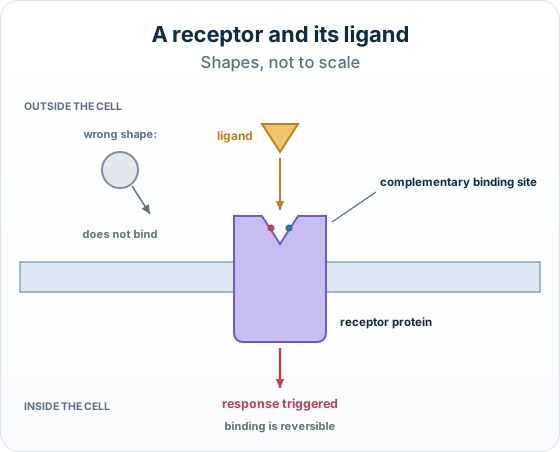
The points to remember
- Receptors are proteins: folding gives a precise binding site.
- The site is complementary to the ligand in shape and chemistry (charges, polar groups).
- Only the ligand binds: specificity.
- Binding changes the receptor and triggers a response inside the cell.
- Binding is reversible: the ligand can detach.
Remember it as: One site, one ligand, one response.
Real example: beta blockers. Drugs such as propranolol bind the receptors for adrenaline on heart cells without triggering them, so adrenaline cannot bind and the heart rate stays lower.
Trap: The ligand is the signalling chemical; the receptor is the protein. Do not swap them.
Feeling unprepared for exams?
Get a clear study plan, practice with real questions, and know exactly where you stand before exam day. No more guessing.
How this is tested: The key word is specificity. Questions ask what makes a signal reach only some cells, and why one signal can cause different responses.
| Paper | What you may be asked | What to write |
|---|---|---|
| Multiple choice | Identify what a ligand is, or which feature of a receptor makes it bind only one signal | A binding site complementary to the ligand |
| Written (Explain / Outline) | Why a signal only affects certain cells | Signal = ligand; receptor is a protein with a complementary binding site; only cells with the matching receptor (target cells) respond; binding triggers the response |
| A harder twist | Why the same signal causes different responses in different cells | The response depends on the receptor and machinery the receiving cell has |
Exam-style question — why a signal only affects some cells
A gland releases a single type of signalling molecule into the blood, yet only some of the body's cells respond to it. Explain how this signalling molecule produces a response in only certain cells. [4]
Step by step
- Ligand + receptor. The signalling molecule is a ligand; cells detect it using receptor proteins.
- Complementary binding site. The receptor has a binding site complementary in shape and chemistry to that ligand, so only this ligand fits (specificity).
- Only target cells have it. Only cells that carry the matching receptor can bind the ligand — these are the target cells; cells without the receptor cannot bind it and do not respond.
- Binding triggers the response. When the ligand binds, it triggers a response inside the target cell.
Final answer
The signalling molecule is a ligand. Target cells carry a receptor protein whose binding site is complementary in shape and chemistry to that ligand, so only this ligand binds (specificity). Only cells with the matching receptor can bind it and respond; cells without the receptor cannot. Binding the ligand triggers a response inside the target cell.
Why this works: It names the ligand and the receptor protein, explains the complementary binding site (the source of specificity), states that only cells with the matching receptor (target cells) respond, and ends with binding triggers a response.
Trap: Saying 'the signal only goes to certain cells'. The signal reaches every cell; what differs is which cells have the receptor.
| Feature | Why it matters |
|---|---|
| The receptor is a PROTEIN | Proteins can fold into precise 3-D shapes, so a receptor can have a binding site shaped for one particular ligand. |
| Binding site is COMPLEMENTARY | The site matches the ligand in both SHAPE and CHEMISTRY (charges, polar/non-polar groups) — like a key fitting one lock. |
| This gives SPECIFICITY | Only a ligand with the matching shape/chemistry binds; other molecules drifting past do not fit and are ignored. |
| Only TARGET cells respond | A cell responds only if it carries the matching receptor. Cells without that receptor cannot bind the ligand, so the signal passes them by. |
| Binding is REVERSIBLE | The ligand attaches, triggers a response, then detaches — so the signal can be switched off and the response is temporary. |
Another question in the papers' style:
Adrenaline binds a receptor on a liver cell, which then breaks down glycogen. State which molecule acts as the ligand.
Model answer plan
See the answer broken into clear points, with guidance on how each point earns marks.