Thylakoids at Higher Level: An AHL statement that puts 3.3.9-3.3.13 together: the thylakoid as one system.
Practise this as you read
- Explain how thylakoid structure suits its function.
- Identify thylakoids in an electron micrograph.
Free preview
This is the free notes preview
You're reading the free notes. Aimnova Pro unlocks the full study experience — and you can try it with your first topic free to keep:
- FlashcardsLock in vocabulary and key terms with spaced repetition.
- Practice questionsAnswer exam-style questions and get instant AI marking.
- Mock exams & past-paper vaultSit full mocks and see exactly how examiners award marks.
- Personalised study planA daily plan built around your exam date and weak areas.
Start Studying Free Full access to Aimnova Pro · cancel anytime
The big idea: The light-dependent reactions only work because the molecules are organised: photosystems, carriers and ATP synthase sit in the thylakoid membrane in order, around a small enclosed space. Light goes in; ATP, reduced NADP and oxygen come out.
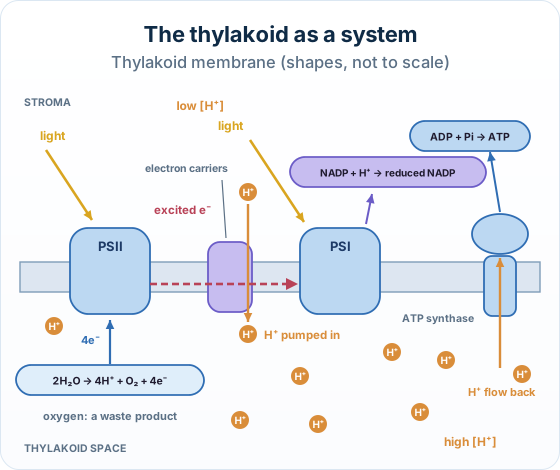
The points to remember
- Thylakoids are flattened membrane sacs, many stacked in grana.
- Their membranes hold photosystem II, carriers, photosystem I and ATP synthase.
- The thylakoid space is small, so the proton gradient builds up quickly.
- Products: ATP and reduced NADP (to the stroma), oxygen (a waste product).
- In electron micrographs, thylakoids are the stacked membranes inside the chloroplast.
Remember it as: Right parts, right order, small space.
Real example: electron micrographs of chloroplasts. Electron micrographs of leaf cells show chloroplasts packed with thylakoid membranes, stacked into grana and linked by single thylakoids, with the stroma around them.
Trap: The thylakoid space (lumen) is inside the thylakoid; the stroma is the fluid around the thylakoids.
How the structure fits the job:
| Feature of the thylakoid | How it helps |
|---|---|
| Large membrane area (many thylakoids, stacked in grana) | Room for many photosystems: more light absorbed |
| Photosystems, carriers and ATP synthase in order in the membrane | Electrons pass in sequence; protons are pumped one way |
| Small thylakoid space | A few protons quickly give a steep gradient |
| ATP synthase facing the stroma | ATP is made where the Calvin cycle uses it |
See how examiners mark answers
Answer exam-style questions with model answers. Learn exactly what earns marks and what doesn't.
Try Exam Vault FreeYour first topic is free to keep • No credit card required
How it is asked: Expect an Explain question on how thylakoid structure suits the light-dependent reactions, or an electron micrograph to label.
IB-style questionExplain[4 marks]
Explain how the structure of thylakoids allows them to carry out the light-dependent reactions.
Model answer plan
See the answer broken into clear points, with guidance on how each point earns marks.