Photolysis at Higher Level: An AHL statement in the light-dependent reactions: the source of the electrons and of the oxygen.
Practise this as you read
- Outline how oxygen is produced.
- State the role of photolysis.
Free preview
This is the free notes preview
You're reading the free notes. Aimnova Pro unlocks the full study experience — and you can try it with your first topic free to keep:
- FlashcardsLock in vocabulary and key terms with spaced repetition.
- Practice questionsAnswer exam-style questions and get instant AI marking.
- Mock exams & past-paper vaultSit full mocks and see exactly how examiners award marks.
- Personalised study planA daily plan built around your exam date and weak areas.
Start Studying Free Full access to Aimnova Pro · cancel anytime
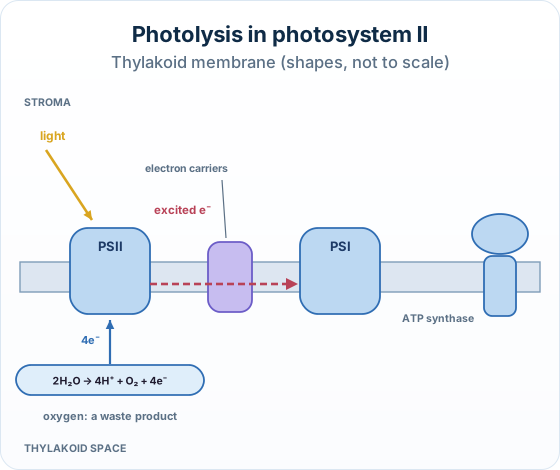
The big idea: Photosystem II emits excited electrons, so it needs replacements. It gets them by splitting water: photolysis. The electrons go back to photosystem II, the protons stay in the thylakoid space, and oxygen is released as a waste product.
The points to remember
- Photolysis happens at photosystem II, on the thylakoid space side of the membrane.
- 2H₂O → 4H⁺ + O₂ + 4e⁻, driven by the light energy absorbed.
- The electrons replace those emitted by photosystem II's reaction centre.
- The protons stay in the thylakoid space, adding to the proton gradient.
- Oxygen is a waste product; it diffuses out of the leaf.
Remember it as: Water gives electrons back; oxygen is the leftover.
Real example: the Great Oxidation Event. The oxygen in today's air comes from photolysis. When cyanobacteria began splitting water more than two billion years ago, oxygen built up in the atmosphere, making aerobic respiration, and animal life, possible.
Trap: The oxygen released comes from water, not from carbon dioxide.
Learn what examiners really want
See exactly what to write to score full marks. Our AI shows you model answers and the key phrases examiners look for.
Try AI Feedback FreeYour first topic is free to keep • No credit card required
How it is asked: Expect an Outline question on how oxygen is produced, or a multiple-choice statement about photosystem II.
IB-style questionOutline[4 marks]
Outline how oxygen is produced in the leaves of a water plant such as Elodea.
Model answer plan
See the answer broken into clear points, with guidance on how each point earns marks.