aımnova
DashboardMy LearningCrash CoursesStudy Plan

Aimnova site navigation

Stay in the loop

Get the latest study resources and updates

New features, study tips and exam insights — straight to your inbox.

IB Diploma

  • IB Past Papers
  • IB Study Notes
  • IB Question Bank
  • IB Mock Exams
  • IB Revision

IB Subjects

  • IB Math AA
  • IB Math AI
  • IB Economics
  • IB Business Management
  • IB Physics
  • IB Biology
  • View all IB subjects→

IB Past Papers

  • IB Math AA HL Past Papers
  • IB Math AA SL Past Papers
  • IB Math AI HL Past Papers
  • IB Math AI SL Past Papers
  • IB Economics HL Past Papers
  • IB Economics SL Past Papers
  • IB ESS Past Papers
  • View all past papers→

Study Resources

  • Study Notes
  • Question Bank
  • Mock Exams
  • Crash Courses
  • Flashcards
  • Revision Guide
  • Exam Skills
  • Command Terms
  • Grade Calculator
  • Exam Timetable 2026

Aimnova

  • Features
  • Pricing
  • For Teachers
  • For Schools
  • For Parents
  • About Us
  • Blog
  • Contact
aımnova

IB study, practice and feedback built around the real exam.

TermsPrivacyCookies·© 2026 Aimnova. All rights reserved.06bfe1b

Aimnova is not affiliated with or endorsed by the International Baccalaureate Organization (IB).

NotesBiology HLTopic 3.2Transfer of energy by reduced NAD to the electron transport chain in the mitochondrion
Back to Biology HL Topics
3.2.133 min read

Transfer of energy by reduced NAD to the electron transport chain in the mitochondrion (Biology HL)

IB Biology · Unit 3

Exam preparation

Practice the questions examiners actually ask

Our question bank mirrors real IB exam papers. Practice under timed conditions and track your progress across topics.

Start Practicing

Contents

  1. 1Reduced NAD and the chain: Higher Level only
  2. 2Reduced NAD and the electron transport chain
  3. 3Exam-style question (step by step)
Reduced NAD and the chain: Higher Level only: This statement is Higher Level only. It opens the last stage of aerobic respiration, continued in 3.2.14 to 3.2.16.

Practise this as you read

  • Outline how reduced NAD passes energy to the chain.
  • Predict the effects of blocking the chain.

Free preview

This is the free notes preview

You're reading the free notes. Aimnova Pro unlocks the full study experience — and you can try it with your first topic free to keep:

  • FlashcardsLock in vocabulary and key terms with spaced repetition.
  • Practice questionsAnswer exam-style questions and get instant AI marking.
  • Mock exams & past-paper vaultSit full mocks and see exactly how examiners award marks.
  • Personalised study planA daily plan built around your exam date and weak areas.
Start Studying Free Full access to Aimnova Pro · cancel anytime
The big idea: The energy from glucose now sits in reduced NAD (and reduced FAD). Reduced NAD hands a pair of electrons to the first carrier of the electron transport chain in the inner mitochondrial membrane. As the electrons pass from carrier to carrier, their energy is released in small steps.
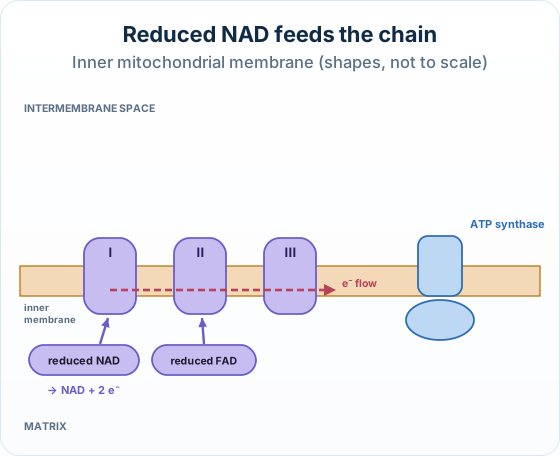
The inner mitochondrial membrane with three carrier proteins and ATP synthase; reduced NAD gives two electrons to carrier I and becomes NAD; the electrons pass along the carriers releasing energy; reduced FAD joins at carrier II
Reduced NAD feeds the chain, step by step.

The points to remember

  • The chain is a series of carrier proteins in the inner membrane (cristae).
  • Reduced NAD gives 2 electrons to the first carrier and becomes NAD again.
  • Electrons pass from carrier to carrier, releasing energy in steps.
  • Reduced FAD gives its electrons further along, so it yields less ATP than reduced NAD.
  • If the chain is blocked, reduced NAD builds up and ATP production falls.
Remember it as: Reduced NAD is a delivery van: it drops off electrons at the first carrier and goes back for more.

Real example: rotenone. Rotenone, a plant toxin once used to kill fish and insect pests, blocks the first carrier. Electrons from reduced NAD cannot enter the chain, so aerobic respiration slows dramatically.

Trap: Reduced NAD does not make ATP itself; it delivers electrons whose energy the chain uses.

Know your predicted grade

Take timed mock exams and get detailed feedback on every answer. See exactly where you're losing marks.

Try Mock Exams FreeYour first topic is free to keep • No credit card required
How it is asked: Expect an Outline of what happens when the chain is blocked by a toxin, or of how reduced NAD passes energy to the chain.
IB-style questionOutline[4 marks]

A toxin blocks the electron transport chain. Outline the consequences for cell respiration.

Model answer plan

See the answer broken into clear points, with guidance on how each point earns marks.

Claim your free topic

Try an IB Exam Question — Free AI Feedback

Test yourself on Transfer of energy by reduced NAD to the electron transport chain in the mitochondrion. Write your answer and get instant AI feedback — just like a real IB examiner.

the role of reduced NAD in the mitochondrion. [2 marks]

Related Biology HL Topics

Continue learning with these related topics from the same unit:

3.1.1Enzymes as catalysts3.1.2Role of enzymes in metabolism3.1.3Anabolic and catabolic reactions3.1.4Enzymes as globular proteins with an active site for catalysis
View all Biology HL topics
Improve your exam techniqueCommand terms, paper structure, and mark-scheme tips for Biology HL
Previous3.2.12Oxidation and decarboxylation of acetyl groups in the Krebs cycle with a yield of ATP and reduced NADNextGeneration of a proton gradient by flow of electrons along the electron transport chain3.2.14

7 exam-style questions ready for you

Students who practice on Aimnova improve their scores by 15% on average. Get instant feedback that shows exactly how to improve your answers.

Practice Now — FreeView All Biology HL Topics