The link reaction: Higher Level only: This statement is Higher Level only. It links glycolysis in the cytoplasm to the Krebs cycle in the matrix.
Practise this as you read
- Outline the link reaction.
- State its products per pyruvate.
Free preview
This is the free notes preview
You're reading the free notes. Aimnova Pro unlocks the full study experience — and you can try it with your first topic free to keep:
- FlashcardsLock in vocabulary and key terms with spaced repetition.
- Practice questionsAnswer exam-style questions and get instant AI marking.
- Mock exams & past-paper vaultSit full mocks and see exactly how examiners award marks.
- Personalised study planA daily plan built around your exam date and weak areas.
Start Studying Free Full access to Aimnova Pro · cancel anytime
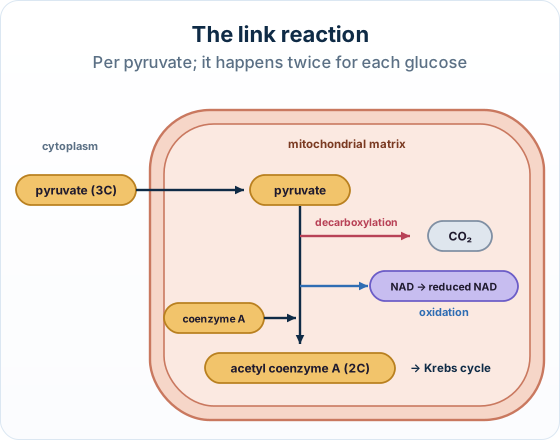
The big idea: If oxygen is available, pyruvate moves into the mitochondrial matrix. In the link reaction it is decarboxylated (carbon dioxide removed) and oxidized (hydrogen removed, NAD reduced). The acetyl group left is carried by coenzyme A into the Krebs cycle.
The points to remember
- Where: the matrix of the mitochondrion (pyruvate is moved in from the cytoplasm).
- Decarboxylation: one carbon leaves as carbon dioxide (3C → 2C).
- Oxidation: hydrogen removed; NAD → reduced NAD.
- The acetyl group joins coenzyme A: acetyl coenzyme A.
- Per glucose it happens twice: 2 CO₂, 2 reduced NAD, no ATP.
Remember it as: Link reaction: lose a carbon, lose some hydrogen, hitch a ride on coenzyme A.
Real example: why it needs oxygen. The link reaction does not use oxygen itself, but it stops without it: the reduced NAD it makes can only be oxidized by the electron transport chain, which needs oxygen at its end.
Trap: The link reaction makes no ATP. Its products are carbon dioxide, reduced NAD and acetyl coenzyme A.
Study smarter, not longer
Most students waste 40% of study time on topics they already know. Our AI tracks your progress and optimizes every minute.
Try Smart Study FreeYour first topic is free to keep • No credit card required
How it is asked: Expect an Outline of the link reaction, or a question on which stages of respiration release carbon dioxide or reduce NAD.
IB-style questionOutline[3 marks]
Outline the link reaction in aerobic respiration.
Model answer plan
See the answer broken into clear points, with guidance on how each point earns marks.