aımnova
DashboardMy LearningCrash CoursesStudy Plan

Aimnova site navigation

Stay in the loop

Get the latest study resources and updates

New features, study tips and exam insights — straight to your inbox.

IB Diploma

  • IB Past Papers
  • IB Study Notes
  • IB Question Bank
  • IB Mock Exams
  • IB Revision

IB Subjects

  • IB Math AA
  • IB Math AI
  • IB Economics
  • IB Business Management
  • IB Physics
  • IB Biology
  • View all IB subjects→

IB Past Papers

  • IB Math AA HL Past Papers
  • IB Math AA SL Past Papers
  • IB Math AI HL Past Papers
  • IB Math AI SL Past Papers
  • IB Economics HL Past Papers
  • IB Economics SL Past Papers
  • IB ESS Past Papers
  • View all past papers→

Study Resources

  • Study Notes
  • Question Bank
  • Mock Exams
  • Crash Courses
  • Flashcards
  • Revision Guide
  • Exam Skills
  • Command Terms
  • Grade Calculator
  • Exam Timetable 2026

Aimnova

  • Features
  • Pricing
  • For Teachers
  • For Schools
  • For Parents
  • About Us
  • Blog
  • Contact
aımnova

IB study, practice and feedback built around the real exam.

TermsPrivacyCookies·© 2026 Aimnova. All rights reserved.06bfe1b

Aimnova is not affiliated with or endorsed by the International Baccalaureate Organization (IB).

NotesBiology HLTopic 2.8Reasons for locomotion
Back to Biology HL Topics
2.8.93 min read

Reasons for locomotion (Biology HL)

IB Biology · Unit 2

IB exam ready

Study like the top scorers do

Access a smart study planner, AI tutor, and exam vault — everything you need to hit your target grade.

Start Free

Contents

  1. 1Why animals move from place to place
  2. 2Exam-style question (step by step)
The big idea: Locomotion is moving the whole body from place to place. Animals do it for four main reasons, each of which raises their chance of surviving and reproducing.
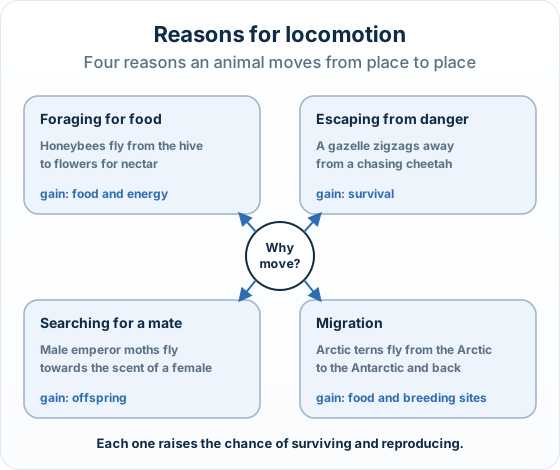
Four cards round the question 'why move?', revealed one by one: foraging (honeybees to flowers), escaping danger (a gazelle from a cheetah), searching for a mate (male emperor moths following a female's scent) and migration (Arctic terns between the Arctic and the Antarctic)
Four reasons for locomotion, one at a time.

The points to remember

  • Foraging: moving to find food, where it is not available where the animal is.
  • Escaping danger: moving away from predators or harmful conditions.
  • Searching for a mate: moving to find a partner for sexual reproduction.
  • Migration: regular, often seasonal, long journeys between feeding and breeding areas.
ReasonExampleWhat moving gains
ForagingHoneybees fly from the hive to flowers; wolves track herds of deerFood and energy
Escaping from dangerA gazelle zigzags away from a cheetah; a scallop claps its shell to swim from a starfishSurvival
Searching for a mateMale emperor moths follow a female's scent across moorlandOffspring
MigrationArctic terns fly between the Arctic and the Antarctic; wildebeest follow the rains across the SerengetiFood and breeding sites through the year
Remember it as: Food, flight, family, faraway.

Real example: the Arctic tern. It breeds in the Arctic summer and then flies to the Antarctic for the southern summer, so it lives in long daylight and plentiful food for most of the year.

Trap: Each reason needs a named example and what moving gains the animal. 'To survive' on its own is too vague.

Free preview

This is the free notes preview

You're reading the free notes. Aimnova Pro unlocks the full study experience — and you can try it with your first topic free to keep:

  • FlashcardsLock in vocabulary and key terms with spaced repetition.
  • Practice questionsAnswer exam-style questions and get instant AI marking.
  • Mock exams & past-paper vaultSit full mocks and see exactly how examiners award marks.
  • Personalised study planA daily plan built around your exam date and weak areas.
Start Studying Free Full access to Aimnova Pro · cancel anytime
How it is asked: Expect 'outline reasons for locomotion' or a question on one animal's journey, asking why it moves.
IB-style questionOutline[4 marks]

Outline four reasons for locomotion in animals, with a named example of each.

Model answer plan

See the answer broken into clear points, with guidance on how each point earns marks.

Claim your free topic

Try an IB Exam Question — Free AI Feedback

Test yourself on Reasons for locomotion. Write your answer and get instant AI feedback — just like a real IB examiner.

When a starfish touches a scallop, the scallop claps its two shells together and swims away.

why this locomotion increases the scallop's chance of reproducing.
[2 marks]

Related Biology HL Topics

Continue learning with these related topics from the same unit:

2.1.1Chemical properties of carbon that allow diverse compounds2.1.2Production of macromolecules by condensation reactions2.1.3Digestion of polymers into monomers by hydrolysis reactions2.1.4Form and function of monosaccharides
View all Biology HL topics
Improve your exam techniqueCommand terms, paper structure, and mark-scheme tips for Biology HL
Previous2.8.8Internal and external intercostal muscles as an example of antagonistic muscle action to facilitate internal body movementsNextAdaptations for swimming in marine mammals2.8.10

5 exam-style questions ready for you

Students who practice on Aimnova improve their scores by 15% on average. Get instant feedback that shows exactly how to improve your answers.

Practice Now — FreeView All Biology HL Topics