Coronary heart disease at Higher Level: The same statement as SL. HL papers add data skills: lines of best fit and comments on correlation coefficients. Systolic and diastolic pressure are taught again with the cardiac cycle.
Practise this as you read
- Draw a line of best fit and comment on a correlation coefficient.
- Outline the consequences of a blocked coronary artery.
Free preview
This is the free notes preview
You're reading the free notes. Aimnova Pro unlocks the full study experience — and you can try it with your first topic free to keep:
- FlashcardsLock in vocabulary and key terms with spaced repetition.
- Practice questionsAnswer exam-style questions and get instant AI marking.
- Mock exams & past-paper vaultSit full mocks and see exactly how examiners award marks.
- Personalised study planA daily plan built around your exam date and weak areas.
The big idea: Keeping the circulatory system healthy comes down to two big numbers: your blood pressure and your blood cholesterol.
Blood pressure
- The force the blood pushes on the artery walls
- Written as two numbers: a higher systolic pressure and a lower diastolic pressure
Cholesterol
- A lipid the body needs in small amounts
- Too much in the blood can build up inside arteries
- Carried around the blood by two kinds of particle: LDLs and HDLs
- Blood pressure
- The force that flowing blood exerts on the walls of the arteries. It is given as two numbers, e.g. 120/80.
- Systolic pressure
- The HIGHER blood-pressure number, measured when the ventricles contract and push blood into the arteries.
- Diastolic pressure
- The LOWER blood-pressure number, measured when the ventricles relax between beats and the heart refills.
- Cholesterol
- A lipid found in the blood. The body needs a little, but too much in the blood is a health risk.
- LDL (low-density lipoprotein)
- A particle that carries cholesterol from the liver to the tissues; excess is deposited in artery walls. The 'bad' carrier.
- HDL (high-density lipoprotein)
- A particle that carries excess cholesterol away from the tissues back to the liver for disposal. The 'good' carrier.
| Measurement | When it happens | Pressure |
|---|---|---|
| Systolic pressure | When the ventricles CONTRACT and push blood into the arteries | The HIGHER of the two numbers |
| Diastolic pressure | When the ventricles RELAX between beats and the heart refills | The LOWER of the two numbers |
Systolic vs diastolic — a quick fix: Systolic = Squeeze. The higher number is when the heart squeezes (ventricles contract).
Diastolic = Down-time. The lower number is when the heart relaxes between beats.
See how examiners mark answers
Answer exam-style questions with model answers. Learn exactly what earns marks and what doesn't.
Cholesterol becomes a problem when there is too much of it in the blood — especially too much carried by LDLs.
HDLs do the opposite: HDLs carry excess cholesterol away from the arteries and back to the liver, where it can be removed. So a healthy balance has low LDL and high HDL.
| Carrier | What it does | Nickname & why |
|---|---|---|
| LDL (low-density lipoprotein) | Carries cholesterol FROM the liver TO the body's tissues; excess is deposited in artery walls | 'Bad' cholesterol — it builds up in arteries |
| HDL (high-density lipoprotein) | Carries excess cholesterol AWAY from the tissues and artery walls BACK to the liver for disposal | 'Good' cholesterol — it removes cholesterol from arteries |
How high cholesterol damages arteries: When there is too much LDL cholesterol, it is deposited in the wall of an artery.
These deposits build into a fatty plaque — a process called atherosclerosis — which hardens the artery wall and narrows the space inside (the lumen).
A narrower artery lets less blood through, raising the risk of a blockage.
| Step | What happens |
|---|---|
| 1. Cholesterol deposits | Excess LDL cholesterol is deposited in the wall of an artery |
| 2. Plaque forms (atherosclerosis) | The deposits build into a fatty plaque that hardens the artery wall |
| 3. Artery narrows | The plaque narrows the lumen, so less blood can flow through |
| 4. Coronary arteries affected | If this happens in the coronary arteries, less blood reaches the heart muscle |
| 5. Reduced oxygen to heart | The heart muscle receives less oxygen, causing chest pain or, if a vessel is blocked, a heart attack |
Why this causes coronary heart disease: The coronary arteries are the small arteries that supply the heart muscle itself with oxygen.
If atherosclerosis narrows a coronary artery, the heart muscle gets less oxygen. This is coronary heart disease (CHD).
If a coronary artery becomes fully blocked, part of the heart muscle is starved of oxygen and dies — a heart attack.
What raises cholesterol — and blood pressure: High blood cholesterol can be caused by a diet high in saturated fat, smoking, a lack of exercise, obesity, or an inherited (genetic) tendency.
Separately, eating too much salt (sodium) raises blood pressure (hypertension), which also damages arteries and strains the heart.
Exercise lowers the risk: Regular exercise helps keep body mass, blood pressure and LDL cholesterol down, so plaques build up more slowly in the coronary arteries.
Raises your risk
- High LDL cholesterol (diet high in saturated fat)
- Smoking and obesity
- Too much salt (sodium) → high blood pressure
- A lack of exercise
Lowers your risk
- High HDL cholesterol (carries cholesterol away)
- Regular exercise
- A balanced diet, low in saturated fat and salt
- Not smoking
LDL vs HDL — an easy way to remember: LDL = Lousy (it Leaves cholesterol in your arteries). HDL = Healthy (it Hauls cholesterol back to the liver). You want low LDL and high HDL.
The big idea: When a coronary artery is blocked (occluded), the heart muscle it supplies is starved of oxygen and dies: a heart attack.
The points to remember
- Cause: a plaque narrows the artery; if it tears, a blood clot forms and blocks it.
- Consequence: heart muscle beyond the block gets no oxygen or glucose, so it cannot respire.
- The muscle stops contracting and dies: a heart attack (myocardial infarction).
- Risk factors: high LDL cholesterol, a diet high in saturated fat, high blood pressure, smoking, obesity, too little exercise, age and genes.
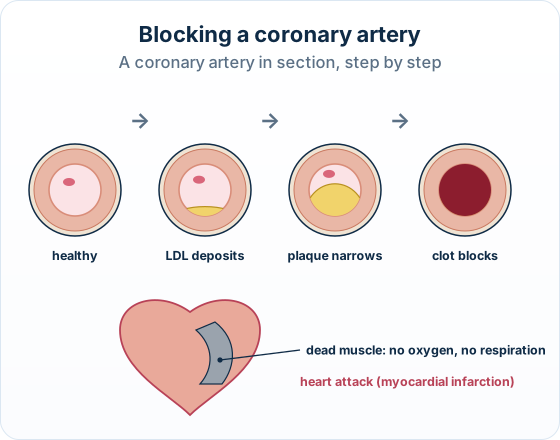
Remember it as: Deposit, plaque, clot, no oxygen, dead muscle.
Evidence for risk factors comes from epidemiology: studies of how often a disease occurs in large groups of people.
The points to remember
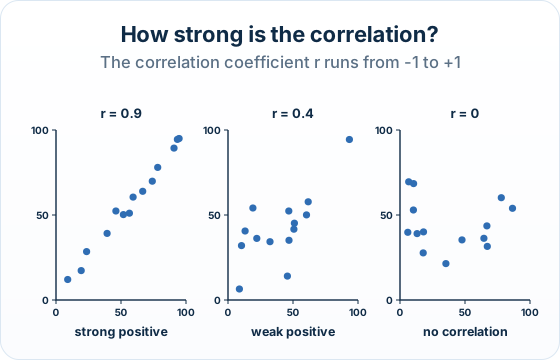
- The correlation coefficient r runs from -1 to +1: close to 1 is a strong positive correlation; close to 0 is no correlation.
- A low r, or none, is evidence against a hypothesis.
- Even a strong correlation does not prove cause: another factor may explain both.
- p < 0.05 means the correlation is unlikely to be due to chance.
Real example: the Framingham Heart Study. Since 1948, doctors have followed thousands of people in Framingham, Massachusetts. The study showed that high blood pressure, high cholesterol and smoking go with more coronary heart disease.
Trap: 'As fat intake rises, CHD rises' only describes. To evaluate, give the strength (r), the significance (p) and say that correlation is not causation.
Study smarter, not longer
Most students waste 40% of study time on topics they already know. Our AI tracks your progress and optimizes every minute.
How this is tested: Expect short questions on the chain from cholesterol to a heart attack, and on data about risk factors.
What the questions ask
- 1-mark Outline: how high blood cholesterol leads to coronary heart disease
- You need the cause→effect chain: cholesterol deposited → plaque / atherosclerosis → coronary artery narrows → heart muscle gets less oxygen
- Identify causes of high cholesterol (2 marks = two causes)
- State the role of HDLs
- Outline the consequences of a blood clot in a coronary artery, or deduce conclusions from correlation data
Exam-style question — high cholesterol and coronary heart disease
Outline how high blood cholesterol can contribute to coronary heart disease. [3]
How to score all three marks
- Start with the deposit. Excess (LDL) cholesterol is deposited in the wall of an artery.
- Name the build-up. The deposits form a fatty plaque (atherosclerosis), which narrows the artery and reduces blood flow.
- Link it to the heart. If this narrows a coronary artery, the heart muscle receives less oxygen, causing coronary heart disease.
Final answer
Excess cholesterol is deposited in the artery wall, forming a plaque (atherosclerosis) that narrows the coronary arteries, so the heart muscle receives less oxygen — coronary heart disease.
Why this scores full marks: It is a chain of causes, not a single statement: deposit → plaque → narrowed coronary artery → less oxygen to the heart.
A 3-mark Outline needs three linked steps, and the answer must reach the heart muscle / oxygen — the reason it counts as coronary heart disease.
| Step | What happens |
|---|---|
| 1. Cholesterol deposits | Excess LDL cholesterol is deposited in the wall of an artery |
| 2. Plaque forms (atherosclerosis) | The deposits build into a fatty plaque that hardens the artery wall |
| 3. Artery narrows | The plaque narrows the lumen, so less blood can flow through |
| 4. Coronary arteries affected | If this happens in the coronary arteries, less blood reaches the heart muscle |
| 5. Reduced oxygen to heart | The heart muscle receives less oxygen, causing chest pain or, if a vessel is blocked, a heart attack |
A 2-mark Comment, in the papers' style:
In a study, the correlation coefficient between systolic blood pressure and cholesterol level was 0.86. Comment on this value.
Model answer plan
See the answer broken into clear points, with guidance on how each point earns marks.