Capillaries at Higher Level: The same statement as SL. HL papers ask for the adaptation for very rapid exchange by name, and this page leads into tissue fluid at the next micros.
Practise this as you read
- State the adaptation in some capillaries for extremely rapid exchange.
- Explain how capillaries in a named tissue are adapted for exchange.
Free preview
This is the free notes preview
You're reading the free notes. Aimnova Pro unlocks the full study experience — and you can try it with your first topic free to keep:
- FlashcardsLock in vocabulary and key terms with spaced repetition.
- Practice questionsAnswer exam-style questions and get instant AI marking.
- Mock exams & past-paper vaultSit full mocks and see exactly how examiners award marks.
- Personalised study planA daily plan built around your exam date and weak areas.
Start Studying Free Full access to Aimnova Pro · cancel anytime
The big idea: Capillaries are where the blood exchanges materials with the cells. Every feature of them makes that exchange faster.
The points to remember
- Capillaries branch into huge networks: a large surface area for exchange.
- Their diameter is narrow, about one red blood cell, so they reach close to every cell.
- The wall is one cell thick (flat endothelial cells): a short diffusion distance.
- Oxygen and glucose leave the blood; carbon dioxide and wastes enter it.
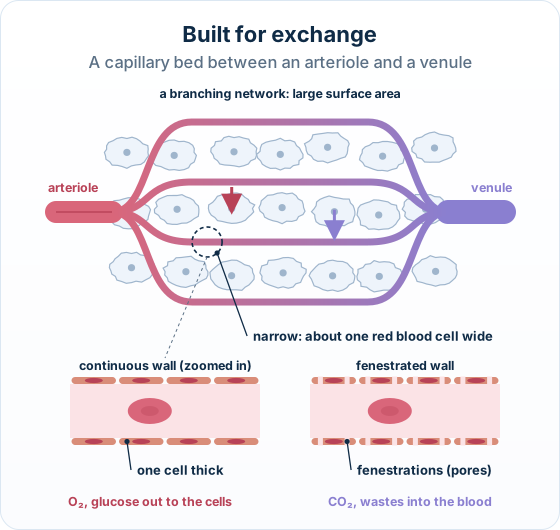
Remember it as: Branched, narrow, thin: area, closeness, short distance.
Real example: a villus. Each villus of the small intestine holds a dense network of fenestrated capillaries just under its surface, so absorbed glucose and amino acids enter the blood within moments.
Feeling unprepared for exams?
Get a clear study plan, practice with real questions, and know exactly where you stand before exam day. No more guessing.
Get Exam Ready FreeYour first topic is free to keep • No credit card required
Where exchange must be fastest: Some capillaries have fenestrations: small pores in the wall that let fluid and dissolved substances out and in very quickly.
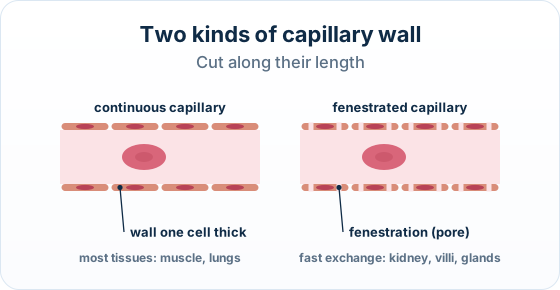
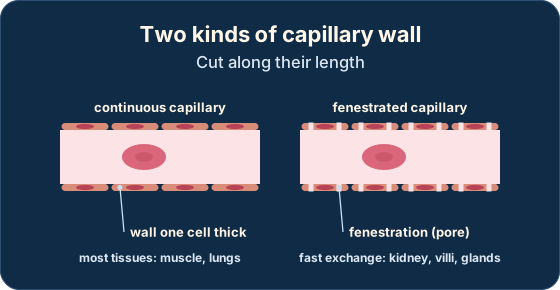
| Where | Why fenestrated capillaries are needed |
|---|---|
| Kidney (glomerulus) | Huge volumes of plasma are filtered every minute |
| Villi of the small intestine | Digested food is absorbed into the blood fast |
| Glands that release hormones | Hormones pass into the blood quickly |
The points to remember
- On a drawing, an arrow for oxygen or glucose goes from the capillary into the cell.
- An arrow for carbon dioxide or wastes goes from the cell into the capillary.
- Capillaries are too small to see at low power: a red blood cell barely fits inside one.
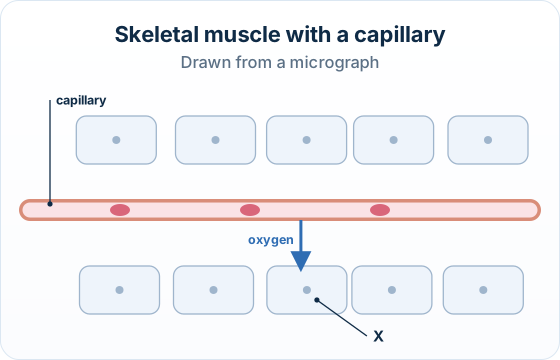
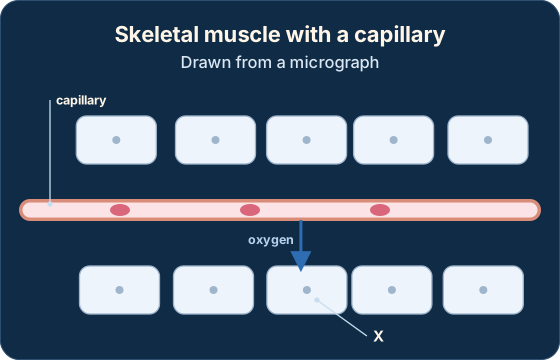
Two traps: Write that the wall is one cell thick, not that it is 'a thin membrane': the wall is made of cells.
An arrow must go through the capillary wall to or from the cell, never straight from an artery to the cell.
How it is asked: Expect 'describe or outline how capillaries are adapted for exchange', a one-mark 'state the adaptation', or an arrow to draw on a tissue diagram.
IB-style questionExplain[3 marks]
Explain how the capillaries in a villus are adapted for the rapid uptake of absorbed food.
Model answer plan
See the answer broken into clear points, with guidance on how each point earns marks.