The big idea: The egg is large and well stocked for the early embryo; the sperm is small and built to swim to the egg and get through its coats.
The points to remember
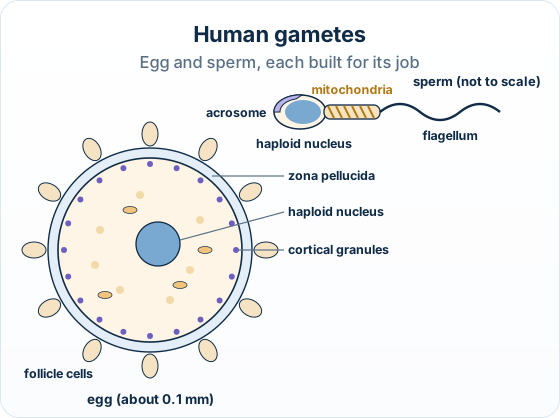
- Both gametes have a haploid nucleus: one set of 23 chromosomes.
- Egg: very large, with food reserves and many mitochondria in its cytoplasm.
- Egg: surrounded by the zona pellucida (glycoprotein) and follicle cells.
- Egg: cortical granules release enzymes after fertilization, so no second sperm can enter.
- Sperm: an acrosome of digestive enzymes that let it pass through the zona pellucida.
- Sperm: a mid-piece packed with mitochondria making ATP for the flagellum, which beats to swim.
Remember it as: Egg: stock it and guard it. Sperm: power it and pack the key.
Real example: fertility treatment: In ICSI, a form of IVF used when sperm swim poorly, a single sperm is injected straight into an egg, doing the job the flagellum and acrosome would normally do.
Free preview
This is the free notes preview
You're reading the free notes. Aimnova Pro unlocks the full study experience — and you can try it with your first topic free to keep:
- FlashcardsLock in vocabulary and key terms with spaced repetition.
- Practice questionsAnswer exam-style questions and get instant AI marking.
- Mock exams & past-paper vaultSit full mocks and see exactly how examiners award marks.
- Personalised study planA daily plan built around your exam date and weak areas.
Start Studying Free Full access to Aimnova Pro · cancel anytime
How it is asked: Expect a Paper 1A item matching a structure to its function, or a Paper 2 Compare and contrast or Outline on the adaptations of the gametes.
IB-style questionCompare and contrast[4 marks]
Compare and contrast the structure of human sperm and egg cells.
Model answer plan
See the answer broken into clear points, with guidance on how each point earns marks.