Pump proteins at Higher Level: The same statement as SL. At HL the sodium-potassium pump has its own page, as an exchange transporter, and its gradient powers the glucose cotransporters. Every pump works in the same basic way, step by step.
Practise this as you read
- Explain how a pump uses ATP to move particles against a gradient.
- Explain an ion-concentration table.
Free preview
This is the free notes preview
You're reading the free notes. Aimnova Pro unlocks the full study experience — and you can try it with your first topic free to keep:
- FlashcardsLock in vocabulary and key terms with spaced repetition.
- Practice questionsAnswer exam-style questions and get instant AI marking.
- Mock exams & past-paper vaultSit full mocks and see exactly how examiners award marks.
- Personalised study planA daily plan built around your exam date and weak areas.
The big idea: Active transport uses a pump protein and energy from ATP to force a particle against its concentration gradient.
**Passive** movement (most movement)
- Particles drift down their concentration gradient
- From where they are crowded to where they are sparse
- No energy is needed
**Active transport**
- Moves a substance the wrong way — against its gradient, from low concentration to high
- That cannot happen on its own
- A pump protein in the membrane uses energy from ATP
The four ways substances cross a membrane. The active-transport panel is this micro: a pump protein drives a particle AGAINST its concentration gradient, powered by ATP.
Interactive diagram
Explore the labelled diagram, charts and maps for this topic in full study mode.
- Active transport
- The movement of a substance across a membrane AGAINST its concentration gradient, using energy from ATP.
- Concentration gradient
- The difference in concentration of a substance between two regions. 'Down' the gradient means high → low; 'against' it means low → high.
- Pump protein
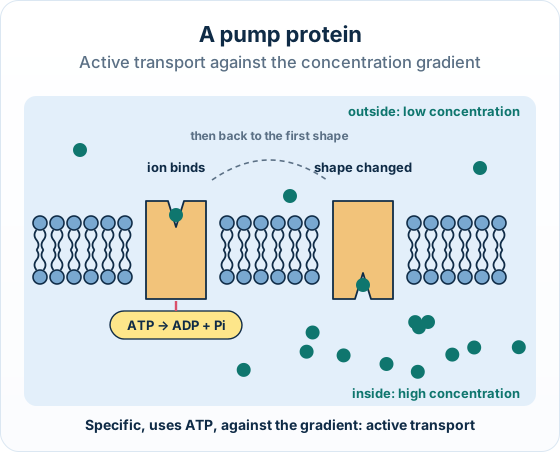
- A membrane protein that uses ATP to move a specific particle against its gradient by changing shape.
- ATP
- The molecule cells use as their energy currency; active transport spends ATP to power the pump.
- Passive transport
- Movement DOWN a concentration gradient (e.g. diffusion, osmosis) that needs no ATP.
Two words tell you it's active: If a question says a particle moves AGAINST the gradient, or that the process uses ATP, it is active transport.
Either word on its own is the giveaway — passive transport does neither.
Stop wasting time on topics you know
Our AI identifies your weak areas and focuses your study time where it matters. No more overstudying easy topics.
The big idea: A pump protein can move particles against their concentration gradient, because it uses energy from ATP.
The points to remember
- Pump proteins are integral proteins that move specific particles across the membrane.
- They use energy from ATP: ATP is split into ADP and phosphate.
- So they can move particles against the concentration gradient, from low to high concentration.
- The particle binds on one side; the energy changes the pump's shape, and it is released on the other.
- This is active transport. Without ATP, pumps stop, and the differences they keep slowly disappear.
Remember it as: Pump: ATP in, particle up the gradient.
Real example: the stomach's proton pump: Cells lining the stomach pump hydrogen ions into it, making the stomach about a million times more acidic than the cells. The drug omeprazole blocks this pump to treat acid reflux.
How this is tested: Active transport is tested as a 1-mark Identify, a data question on ion gradients, and a Paper 2 Describe.
| Question | What you are asked | What scores |
|---|---|---|
| 1-mark Identify | Name 'the protein that uses ATP to move particles against a concentration gradient' | A pump protein (active transport) |
| Paper 1B / data, a favourite | An ion-concentration table (K⁺ high inside, Na⁺ high outside): how does the cell maintain those gradients? | Active transport by the Na⁺/K⁺ pump, using ATP |
| Paper 2, 3-mark Describe | The three processes by which molecules cross the bilayer | Simple diffusion, facilitated diffusion and active transport, making the passive-vs-active contrast clear |
Exam-style question — describe how molecules cross the membrane
Describe three different processes by which molecules cross the phospholipid bilayer of a cell membrane. [3]
How to score all three marks
- Simple diffusion. Small, non-polar molecules pass straight through the bilayer, moving down the concentration gradient, using no ATP (passive).
- Facilitated diffusion. Ions and large polar molecules pass through a channel or carrier protein, still moving down the gradient and using no ATP (passive).
- Active transport. A pump protein moves a particle against the gradient, using ATP (active). (Award 1 mark for each correctly described process, up to 3.)
Final answer
Simple diffusion (small molecules through the bilayer, down the gradient, no ATP); facilitated diffusion (ions/large molecules through a protein, down the gradient, no ATP); active transport (a pump moves particles against the gradient, using ATP).
Why this scores full marks: Each line is a distinct process and states two scoring facts — what crosses and the gradient/ATP status.
A 3-mark 'describe' needs three separate processes, with the passive-vs-active difference made obvious — not the same idea three times.
| Process | How the particle crosses | Gradient & ATP |
|---|---|---|
| Simple diffusion | Small, non-polar molecules slip straight through the phospholipid bilayer | Down the gradient · no ATP (passive) |
| Facilitated diffusion | Ions and large polar molecules pass through a channel or carrier protein | Down the gradient · no ATP (passive) |
| Active transport | A pump protein moves the particle through, changing shape as it works | Against the gradient · uses ATP (active) |
A two-mark Explain on data:
Cells of the alga Nitella hold about 1,000 times more potassium than the pond water around them. Explain how this difference is maintained.
Model answer plan
See the answer broken into clear points, with guidance on how each point earns marks.