Energy-storage polysaccharides at Higher Level: The same statement as SL. HL papers ask for it at seven marks: explain the structure of starch or glycogen, including the 1,4 and 1,6 links and amylose and amylopectin, and why each feature suits storage.
Practise this as you read
- Outline three features that make starch and glycogen good stores.
- Explain the structure of starch or glycogen and how it suits storage.
- Match alpha-glucose to starch and glycogen, beta-glucose to cellulose.
Free preview
This is the free notes preview
You're reading the free notes. Aimnova Pro unlocks the full study experience — and you can try it with your first topic free to keep:
- FlashcardsLock in vocabulary and key terms with spaced repetition.
- Practice questionsAnswer exam-style questions and get instant AI marking.
- Mock exams & past-paper vaultSit full mocks and see exactly how examiners award marks.
- Personalised study planA daily plan built around your exam date and weak areas.
The big idea: A polysaccharide is a giant molecule built from many monosaccharides (single sugars) joined together.
Same building block, different jobs: The three you must know — starch, glycogen and cellulose — are all made of the same single sugar, glucose (C₆H₁₂O₆).
Yet they do completely different jobs. The secret is how the glucose units are joined and arranged — same building block, different structure, different function.
- Monosaccharide
- A single sugar unit — the monomer of a carbohydrate (for example glucose).
- Polysaccharide
- A polymer (large molecule) made of many monosaccharides joined together.
- Monomer
- The small repeating unit that a polymer is built from. The monomer of all three polysaccharides here is glucose.
- Condensation reaction
- The reaction that joins two sugars and releases a molecule of water (H₂O). It is how a polysaccharide is built up.
How they are built and broken: Glucose units are linked one at a time by condensation — each new link releases one water molecule (H₂O).
To get the glucose back (for example to release energy), the chain is broken by hydrolysis — adding water splits the links again.
Three polysaccharides, all made of glucose: starch (alpha-glucose, coiled + lightly branched), glycogen (alpha-glucose, highly branched) and cellulose (beta-glucose, straight chains bundled into strong fibres).
Interactive diagram
Explore the labelled diagram, charts and maps for this topic in full study mode.
Memorize terms 3x faster
Smart flashcards show you cards right before you forget them. Perfect for definitions and key concepts.
All three are glucose chains, but two features change everything: which form of glucose is used (alpha or beta), and how the chains are shaped (coiled and branched, or straight and unbranched).
- Starch
- The energy-storage polysaccharide of plants. Made of alpha-glucose; coiled into a helix with some branching.
- Glycogen
- The energy-storage polysaccharide of animals (stored in liver and muscle). Made of alpha-glucose; highly branched.
- Cellulose
- The structural polysaccharide of plant cell walls. Made of beta-glucose; long, straight, unbranched chains.
- Branching
- Side chains coming off the main chain. More branches mean more free ends where glucose can be added or removed quickly.
| Polysaccharide | Monomer | Shape | Where | Job |
|---|---|---|---|---|
| Starch | alpha-glucose | Coiled (helix) + some branching | Plant cells | Energy storage in plants |
| Glycogen | alpha-glucose | Highly branched | Animal cells (liver, muscle) | Energy storage in animals |
| Cellulose | beta-glucose | Long, straight, unbranched chains | Plant cell walls | Structural support |
Storage polysaccharides (starch & glycogen)
- Built from alpha-glucose
- Chains are coiled / branched — compact and bushy
- Branching gives many ends to add or release glucose fast
- Insoluble, so they store energy without disturbing water balance
- Starch = plants; glycogen = animals (even more branched)
Structural polysaccharide (cellulose)
- Built from beta-glucose
- Chains are straight and unbranched
- Straight chains lie side by side and hydrogen-bond into strong fibres
- Fibres give the plant cell wall its strength and support
- Cannot be digested by humans — it is dietary fibre
Why structure decides function: Alpha-glucose chains coil and branch easily, making a compact, quick-release energy store (starch, glycogen).
So the same sugar gives a soft store OR a strong wall, depending only on the bonds and shape.
Why cellulose stays straight: Beta-glucose units sit in alternating flipped positions, so the chain stays straight.
Straight chains pack tightly and hydrogen-bond into tough fibres — perfect for the support job of a plant cell wall (cellulose).
An easy way to remember: Alpha → Around (coils, branches) → Available energy (starch, glycogen).
Beta → Bars (straight) → Building material (cellulose).
The big idea: Starch and glycogen are built to store a lot of glucose in a small space, without upsetting the cell, and to give it back quickly.
The points to remember
- Starch (plants) and glycogen (animals) are polymers of alpha-glucose.
- Compact: amylose coils into a helix and amylopectin and glycogen branch, so much glucose fits in a small space.
- Insoluble because the molecules are so large: they do not draw water in by osmosis, and they stay inside the cell.
- Easy to add or remove glucose at the chain ends: condensation to store, hydrolysis to release.
- Chains are joined by 1,4 links; each branch point is a 1,6 link.
- Glycogen branches most, so it has the most ends and releases glucose fastest.
Remember it as: Coiled and branched: compact. Huge: insoluble. Many ends: fast.
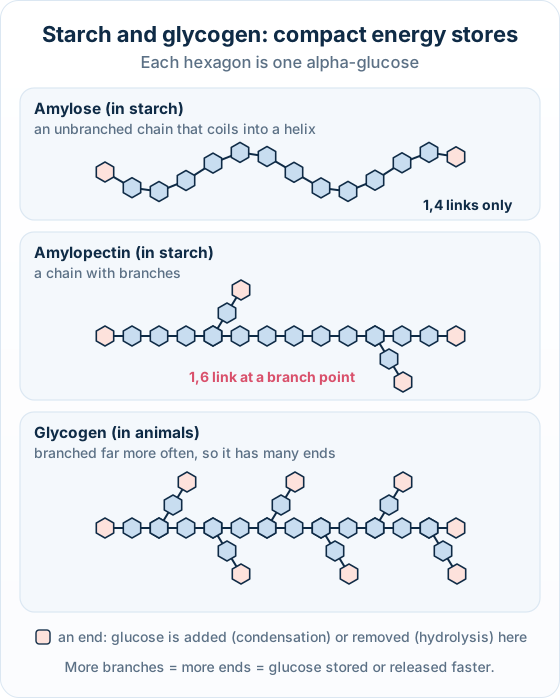
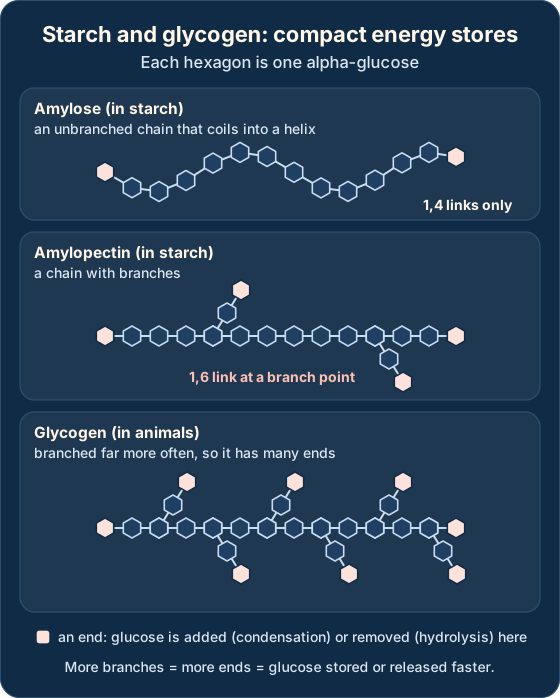
Real example: glycogen in your liver: An adult liver holds about 100 g of glycogen. Between meals it is hydrolysed from its many ends to keep the blood glucose level steady.
Know your predicted grade
Take timed mock exams and get detailed feedback on every answer. See exactly where you're losing marks.
How this is tested: Polysaccharides come up on Paper 1A and Paper 2. The Paper 2 items reward a clear structure→function chain.
What you may be asked
- Paper 1A: identify a polysaccharide (or its monomer) from a structural diagram.
- Paper 1A: pick the correct description of cellulose (straight chains, beta-glucose) or state its role (support in the plant cell wall).
- Paper 2, Outline: the features that make polysaccharides good energy stores.
- Paper 2, Explain: how the structure of cellulose relates to its function.
Exam-style question — features that suit energy storage
Outline three features of polysaccharides such as starch and glycogen that make them efficient energy-storage molecules. [3]
How to score all three marks
- Compact / many units in one molecule. They are large polymers of glucose, so a single molecule stores a lot of energy in a small space (the helix coils it up tightly).
- Insoluble. Being insoluble, they do not dissolve in the cytoplasm, so they do not affect the cell's water balance (osmosis) and stay put as a store.
- Branched → quick release. Branching creates many free ends, so glucose can be added or removed rapidly by hydrolysis when energy is needed. (Any three distinct features score the three marks.)
Final answer
Large/compact glucose polymer (lots of energy stored); insoluble (no effect on osmosis / water balance); branched, giving many ends for fast release of glucose.
Three features that score: Pick any three distinct points:
1. Big glucose polymer → lots of energy stored compactly.
2. Insoluble → no effect on osmosis / water balance.
3. Branched → many ends → glucose added/removed fast.
(Do not repeat the same idea twice — each must be a different feature.)
| Polysaccharide | Monomer | Shape | Where | Job |
|---|---|---|---|---|
| Starch | alpha-glucose | Coiled (helix) + some branching | Plant cells | Energy storage in plants |
| Glycogen | alpha-glucose | Highly branched | Animal cells (liver, muscle) | Energy storage in animals |
| Cellulose | beta-glucose | Long, straight, unbranched chains | Plant cell walls | Structural support |
A four-mark Paper 2 version asks for structure and function together:
Outline how the structure of starch and cellulose relate to their function.
Model answer plan
See the answer broken into clear points, with guidance on how each point earns marks.