Steroids at Higher Level: The same statement as SL. HL papers draw a steroid and ask for its type, its polarity and whether it crosses the bilayer, all in one table: practise all three from one diagram.
Practise this as you read
- Identify a steroid from its four-ring core.
- Explain why a steroid crosses a membrane freely.
- Contrast a steroid with polar molecules that need proteins.
Free preview
This is the free notes preview
You're reading the free notes. Aimnova Pro unlocks the full study experience — and you can try it with your first topic free to keep:
- FlashcardsLock in vocabulary and key terms with spaced repetition.
- Practice questionsAnswer exam-style questions and get instant AI marking.
- Mock exams & past-paper vaultSit full mocks and see exactly how examiners award marks.
- Personalised study planA daily plan built around your exam date and weak areas.
The big idea: A steroid is a lipid with a core of four joined rings. Spot the rings and you have spotted a steroid.
The points to remember
- Steroids are lipids.
- Every steroid has the same core: four joined rings, three with six corners and one with five.
- Testosterone and oestradiol are steroid hormones; cholesterol is a steroid too.
- Steroids differ only in the small groups on the rings (=O, -OH, CH₃) and any side chain.
- To identify a steroid in a diagram, look for the 6-6-6-5 rings.
Remember it as: Six, six, six, five: a steroid.
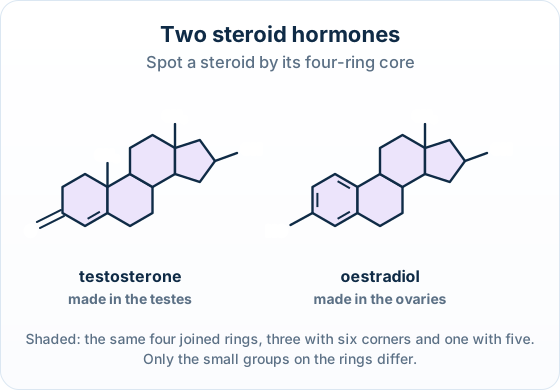
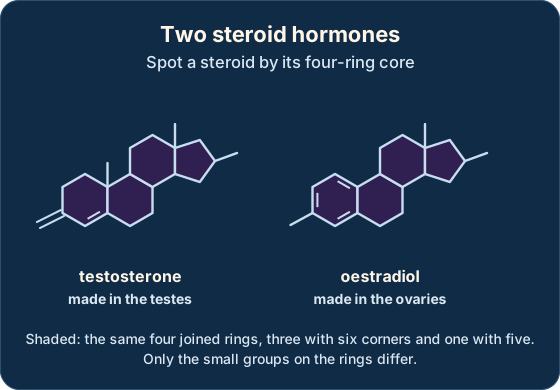
Real example: the contraceptive pill: Most contraceptive pills contain steroids made to work like oestradiol and progesterone. They are swallowed, absorbed and carried to target cells, which they enter through the bilayer.
Learn what examiners really want
See exactly what to write to score full marks. Our AI shows you model answers and the key phrases examiners look for.
The big idea: Steroids are non-polar, so they dissolve through the hydrophobic core of a membrane and need no protein to cross it.
The points to remember
- Steroids are almost entirely carbon and hydrogen, so they are non-polar.
- Non-polar molecules dissolve in the hydrophobic core of the phospholipid bilayer.
- So steroids pass freely between the phospholipids, with no protein needed.
- Polar molecules such as glucose and ions are stopped by the core and need proteins.
- Steroid hormones can therefore act inside their target cells.
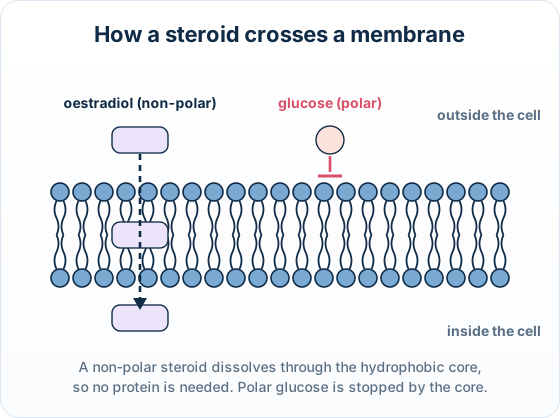
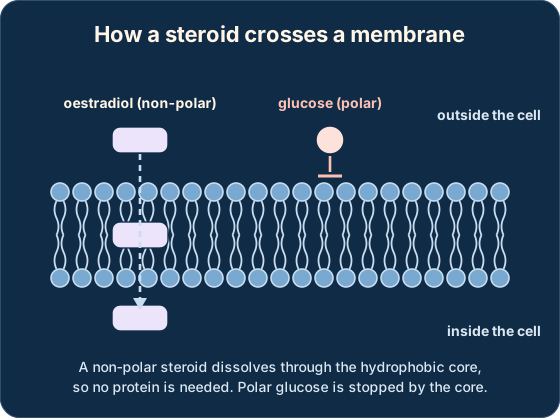
Steroids (non-polar)
- Oestradiol, testosterone
- Dissolve in the hydrophobic core
- Pass freely, no protein
Polar molecules
- Glucose, ions, amino acids
- Repelled by the core
- Need channel or carrier proteins
Not amphipathic, not through channels: A steroid crosses between the phospholipids because it is non-polar. It does not need a channel protein, and it is not amphipathic like a phospholipid.
How it is asked: Multiple-choice items: a steroid drawn as a diagram to identify and describe, how oestradiol crosses a membrane, and which molecule passes through which part of the membrane.
Oestradiol is a steroid hormone. How does oestradiol cross plasma membranes?
Model answer plan
See the answer broken into clear points, with guidance on how each point earns marks.
And a diagram item:
A simplified diagram of a molecule with four joined rings, OH groups and two CH₃ groups is shown. What describes the molecule?
Model answer plan
See the answer broken into clear points, with guidance on how each point earns marks.