This section explains what psychologists mean by personality, so you can define it and say where it comes from.
Personality: Personality is the way one person differs from another in their usual patterns of thinking, feeling and behaving.
It comes from genetic traits interacting with the environment.
Our example: Lina is 16 and plays goal shooter for her netball club. Her coach says she is "always the same Lina": chatty, organised and calm. That sameness is her personality.
See it drawn, step by step
In My Learning, handwritten diagrams build one step at a time. Play, pause and replay each explanation until it clicks. Create your free account to try it.
Thinking
- What Lina expects before a game
- "We can win this."
Feeling
- How she feels when she misses
- Disappointed, but not upset for long
Behaving
- What she does next
- Calls for the ball again straight away
Free preview
This is the free notes preview
You're reading the free notes. Aimnova Pro unlocks the full study experience — and you can try it with your first topic free to keep:
- FlashcardsLock in vocabulary and key terms with spaced repetition.
- Practice questionsAnswer exam-style questions and get instant AI marking.
- Mock exams & past-paper vaultSit full mocks and see exactly how examiners award marks.
- Personalised study planA daily plan built around your exam date and weak areas.
This section shows the trait approach: describing personality as a set of traits, and measuring them with a questionnaire.
The trait approach: A trait is a characteristic that is relatively enduring and stable: it shows across many situations and over a long time.
Traits are measured with validated self-report questionnaires.
What those words mean
Self-report
The athlete answers the questions about themselves, for example rating "I like meeting new people" from 1 to 5.
Questionnaire
The same fixed questions for everyone, so scores can be compared.
Validated
Tested by researchers to show it really measures the trait it claims to measure.
Strengths
- Quick and cheap to give to a whole team
- Gives a number, so athletes can be compared
- Asks the person who knows their own thoughts best
Limitations
- Self-report bias: people may answer to look good
- Mood or tiredness on the day can change answers
- Other variables (fitness, skill, team-mates) also affect performance, so a trait cannot be shown to cause a result
Memorize terms 3x faster
Smart flashcards show you cards right before you forget them. Perfect for definitions and key concepts.
This section teaches the big five, the most common way to describe traits. In the exam you name the trait from a description of a player.
Remember it as OCEAN: Openness, Conscientiousness, Extraversion, Agreeableness, Neuroticism. Each one is a scale: a person can be high, low or in between.
| Trait | What it describes | What you see in a player |
|---|---|---|
| Openness to experience | Willing to try new things, open to feeling unsure, thinks in original ways | Happy to try a new position or tactic; takes on new coaching ideas instead of resisting them |
| Conscientiousness | Controls impulses, follows the rules, works towards goals | Organised, on time, sticks to the training plan, gives the same steady effort every session |
| Extraversion (or introversion) | Gets energy from being with other people (or finds it tiring) | Talkative and sociable in the changing room |
| Agreeableness | Gets on with others and acts to keep relationships good | Supportive, cooperative, avoids arguments with team-mates |
| Neuroticism (or emotional stability) | Sees situations as upsetting, or keeps an emotional balance | High: easily upset after a mistake. Low: stays calm |
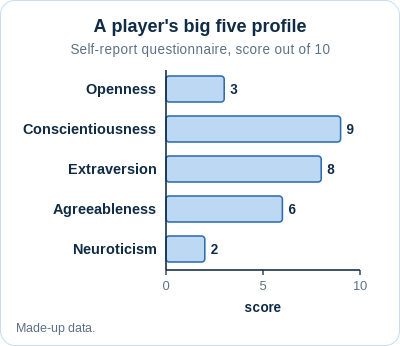
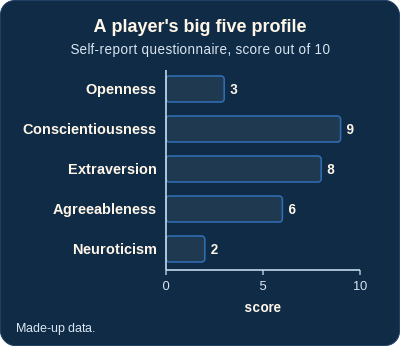
Reading Lina's profile: Organised (conscientiousness 9) and chatty (extraversion 8). Her low neuroticism (2) means she is emotionally stable: she stays calm.
How this is tested — naming a big five trait from a description of a person, and saying what each trait means. It comes up two ways:
Paper 1 — recall and data
- Paper 1A describes a player and asks which trait or pair of traits it shows
- Match each clue in the description to one trait
Paper 2 — explain and evaluate
- Paper 2 asks you to outline a trait or describe how traits are assessed
- Link each trait to something the athlete does
Two traits, two scales: Extraversion runs to introversion and neuroticism runs to emotional stability. A calm player is low in neuroticism, not low in extraversion.
A coach describes a rugby player: "He is always early, follows his gym plan exactly and never panics when we are losing." Describe two big five personality traits this player shows.
Model answer plan
See the answer broken into clear points, with guidance on how each point earns marks.
Exam tips
- A trait named with no link to the description earns only half the credit: always add the clue.
- Use the trait names exactly: conscientiousness, extraversion, agreeableness, openness, neuroticism.
- Paper 1A often gives two clues for two traits: sociable points to extraversion, self-disciplined to conscientiousness.
- If asked how traits are assessed, write validated self-report questionnaire, not just a test.
- Papers may spell it extroversion: the same trait as extraversion.