This section explains mental toughness and the five things it is made of, so you can define it and list its parts.
Mental toughness: Mental toughness is a part of personality that helps explain how a person copes with difficult, high-pressure situations. It helps athletes perform consistently when the pressure is highest.
Appraisal and commitment
- Appraisal of challenges: sees a hard moment as a challenge, not a threat
- Commitment: sticks to the goal and the plan
Confidence and control
- Confidence: believes in their own skill
- Perceived control: feels able to influence what happens
Resilience
- Bounces back after a mistake or a defeat
- Keeps going when things go wrong
See it drawn, step by step
In My Learning, handwritten diagrams build one step at a time. Play, pause and replay each explanation until it clicks. Create your free account to try it.
What it looks like from outside: Determination, persistence, staying focused, keeping emotions under control and handling pressure. Any of these words describes a mentally tough athlete.
Free preview
This is the free notes preview
You're reading the free notes. Aimnova Pro unlocks the full study experience — and you can try it with your first topic free to keep:
- FlashcardsLock in vocabulary and key terms with spaced repetition.
- Practice questionsAnswer exam-style questions and get instant AI marking.
- Mock exams & past-paper vaultSit full mocks and see exactly how examiners award marks.
- Personalised study planA daily plan built around your exam date and weak areas.
This section shows where mental toughness comes from and how an athlete can build more of it.
A malleable trait: Mental toughness is partly genetic: genes shape personality traits, and those traits shape mental toughness. But it is malleable: it can change, and studies suggest training develops it.
Ways Dev can train it
Mindfulness
Paying attention to the present moment. He worries less about the last point or the score, notices his body, and controls his emotions.
Practice under pressure
His coach adds a forfeit to practice points, so pressure becomes normal and he learns to cope with it.
Routines and habits
The same steps before every serve, every day. Routines help concentration and build commitment.
Positive self-talk
Swapping "don't miss" for "smooth and deep" builds confidence and a sense of control.
Why it is worth building before a big event
- A more consistent approach to every training session, even on hard days
- More confidence going into the event
- Bounces back from setbacks in the build-up, such as a poor result
- Handles high-pressure moments, such as selection trials
Why mindfulness helps: Staying in the present stops worry about the past or the future. That improves emotional control and coping with stress, which makes him tougher under pressure.
Feeling unprepared for exams?
Get a clear study plan, practice with real questions, and know exactly where you stand before exam day. No more guessing.
This section explains why mental toughness is hard to measure, and the strengths and limits of the usual method.
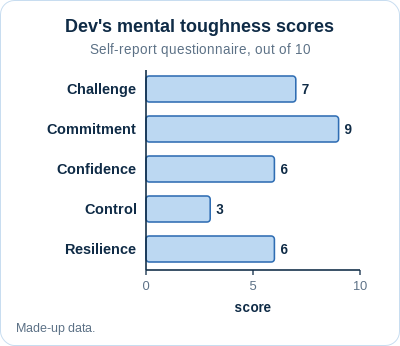
Hard to observe: You cannot see mental toughness directly: two players can look the same on court but think very differently. So it is assessed by self-report: the athlete answers a questionnaire about themselves.
Strengths of self-report
- Direct insight into how the athlete thinks and feels
- Cheap, quick and easy to record
- Can be personal and detailed
Limitations
- Subjective: athletes may answer to look good
- Mood or tiredness on the day changes answers
- Researchers do not fully agree on what mental toughness is, so it is hard to measure
How this is tested — defining mental toughness, listing its parts, training it and evaluating how it is measured. It comes up two ways:
Paper 1 — recall and data
- Paper 1A describes an athlete who stays consistent under pressure and asks what quality it is
- The answer is mental toughness
Paper 2 — explain and evaluate
- Paper 2 asks you to list its parts, describe a way to develop it, or evaluate self-report measures
- One clear point per mark
Describe means how, not just what: "Mindfulness helps" scores nothing. Say what it changes: staying in the present, so the athlete controls emotions and copes with stress.
Describe how mindfulness training could help a swimmer develop mental toughness.
Model answer plan
See the answer broken into clear points, with guidance on how each point earns marks.
Exam tips
- A list question gives one mark per attribute: confidence, determination, resilience, handling pressure, focus, persistence, emotional control. Single words are enough.
- For Describe, link the method to its effect: present moment, so better emotional control.
- Evaluate needs both sides: a list of strengths alone is capped.
- Benefits in preparation: a consistent approach to training, more confidence, resilience after setbacks, coping with high pressure.