The big idea: Progesterone, oestrogen and testosterone are the reproductive hormones. Everybody makes all three — just in very different amounts.
They also change
- How hot you get
- How you sleep
- Which fuel you burn
- How loose your joints are
- How much oxygen your blood can carry
Our example: Amara rows 2 km on the machine every Tuesday morning. Same machine, same time, same warm-up. Her time is usually 7:48.
Some Tuesdays it is 7:56 and the effort feels worse, and nothing about her training has changed.
Her hormone levels are not the same every week, and that is enough to move the number. You do not need the cycle itself here — that comes later. You need what each hormone does.
Each hormone and the body systems it acts on. These are the exact effects the guide names, so this is the list to know.
Interactive diagram
Explore the labelled diagram, charts and maps for this topic in full study mode.
Free preview
This is the free notes preview
You're reading the free notes. Aimnova Pro unlocks the full study experience — and you can try it with your first topic free to keep:
- FlashcardsLock in vocabulary and key terms with spaced repetition.
- Practice questionsAnswer exam-style questions and get instant AI marking.
- Mock exams & past-paper vaultSit full mocks and see exactly how examiners award marks.
- Personalised study planA daily plan built around your exam date and weak areas.
Progesterone is thermogenic, which just means it raises body temperature. Not by much — a few tenths of a degree at rest — but Amara starts her 2 km already warmer than usual.
What progesterone does
Thermoregulation — she starts warmer
Her resting temperature sits higher, so she has less room to heat up before she is too hot. In a warm gym the same pace feels harder.
Sleep quality — she wakes more
Progesterone changes how well she sleeps, and a warmer body is a worse body for sleeping. Broken sleep on Monday night shows up in Tuesday's time.
Fuel availability — less is ready
It also leaves less stored carbohydrate ready to burn. For a hard 2 km, carbohydrate is the fuel she wants, so having less of it available costs her.
See it drawn, step by step
In My Learning, handwritten diagrams build one step at a time. Play, pause and replay each explanation until it clicks. Create your free account to try it.
Follicular phase (before ovulation)
- Progesterone low
- Core temperature at its usual level
- Heat is lost more easily
Luteal phase (after ovulation)
- Progesterone high
- Core temperature a few tenths higher
- Less blood to the skin, so heat leaves less easily
- Harder to lose heat: drink more and plan for the heat
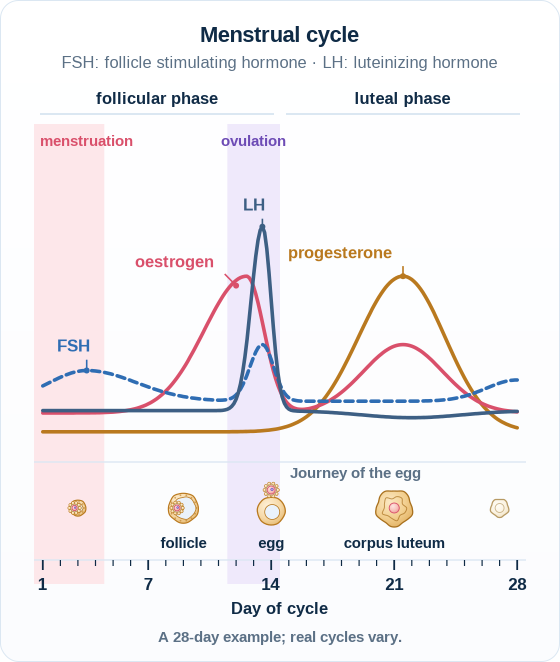
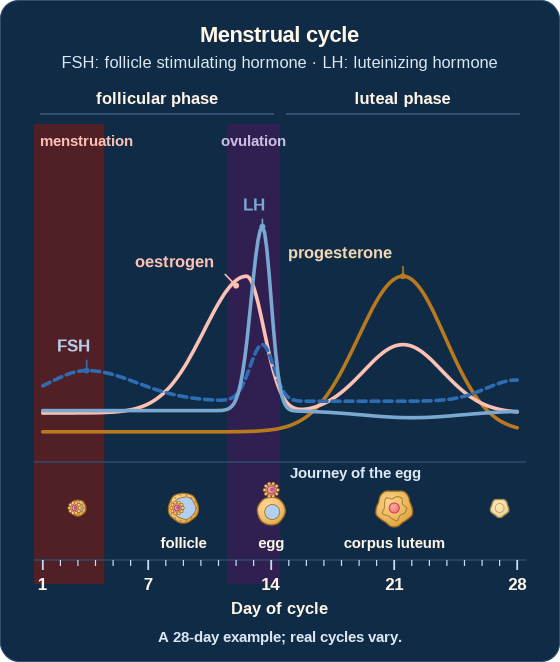
Hot day or cold water: In the heat, the luteal phase makes thermoregulation harder and fluid needs higher. In cold water it helps a little: a warmer core means less energy spent keeping warm.
Small temperature change, real effect: Half a degree sounds like nothing. But her body loses heat by the difference between her and the air, so starting warmer means she reaches her limit sooner.
On a hot day that is the difference between holding pace and slowing.
Study smarter, not longer
Most students waste 40% of study time on topics they already know. Our AI tracks your progress and optimizes every minute.
Glycogen is the body's stored carbohydrate, kept in the muscles and the liver. It is the fuel for hard work, and there is only so much of it.
Oestrogen spares it.
Sparing glycogen
- Pushes the body to burn more fat instead
- So the stored carbohydrate lasts longer
- Helps most in long work — Amara's 90-minute row
- Sparing means using it slower, not making more of it
Joint stiffness
- Makes the tissue around a joint less stiff
- The joint moves further but is held less tightly
- More range of movement, less support
- A looser knee is an easier knee to injure
The two hormones pull opposite ways on fuel: Oestrogen makes stored carbohydrate last longer. Progesterone leaves less of it ready to use.
They act on the same thing — fuel availability — from opposite sides. These two are the pair most often swapped round.
Amara makes testosterone too. Her training partner Theo makes far more of it, and that is one reason the same training block builds more muscle on him.
Three effects, one direction: Its three named effects all point the same way: a body that rebuilds stronger and carries more oxygen.
What testosterone does
Bone formation — stronger bone
It drives new bone being laid down, so bones get denser and harder to break. Low testosterone over months means weaker bone and more stress fractures.
Protein synthesis — more muscle built
Protein synthesis means building new protein. In muscle, that is repairing the damage from training and adding to it, so Amara comes back stronger than she was.
Erythropoietin — more red blood cells
Erythropoietin is the signal that tells the body to make more red blood cells. More red cells means more oxygen delivered, which is exactly what a 2 km row runs on.
Bones, women and men: Oestrogen helps keep bone dense. After the menopause it falls, and bone is lost faster. With less testosterone as well, women carry a higher risk of weak bones later in life, and heavy training with too little food when young adds to it.
Why this one matters: Build bone, build muscle, carry more oxygen. That is a list of everything an endurance or strength athlete trains for.
It is also why anything that lowers testosterone — under-eating for months, for example — shows up as weaker bone and stalled progress.
Practice with exam-style questions
Answer exam-style questions and get AI feedback that shows you exactly what examiners want to see in a full-marks response.
How this is tested — you name a reproductive hormone, state one of its named effects, and link that effect to what happens in a sport situation. It comes up two ways:
Paper 1 — recall and data
- Multiple choice matching a hormone to an effect
- State one effect of oestrogen on fuel use
- One mark, no working — the effect has to be the named one
Paper 2 — explain and evaluate
- Explain how a hormone changes performance in given conditions
- Outline why an athlete with low testosterone breaks bones
- Marks for the effect AND the consequence for the athlete
The trap: oestrogen and progesterone get swapped: Writing oestrogen raises body temperature loses the mark — that is progesterone, and thermogenic means raising temperature.
Same the other way: oestrogen is the one that spares glycogen.
A distance runner trains outdoors on a hot afternoon at a time when her progesterone level is high. Explain how this could affect her performance. [3]
Model answer plan
See the answer broken into clear points, with guidance on how each point earns marks.
Where marks are lost: Progesterone makes her hot gets one mark at most. The question says explain, so the answer has to go from the hormone, to the effect, to what the athlete has to do about it.
Exam tips
- Progesterone: give the effect (higher core temperature in the luteal phase) and the impact (heat is harder to manage, so more fluid is needed).
- In cold water the luteal phase helps: a warmer core means less energy spent keeping warm; in warm water the reverse.
- Weak bones: women have less testosterone and oestrogen falls with age; give one reason per point.
- Testosterone raises bone density, protein synthesis and EPO; all three go up.