aımnova
DashboardMy LearningCrash CoursesStudy Plan

Aimnova site navigation

Stay in the loop

Get the latest study resources and updates

New features, study tips and exam insights — straight to your inbox.

IB Diploma

  • IB Past Papers
  • IB Study Notes
  • IB Question Bank
  • IB Mock Exams
  • IB Revision

IB Subjects

  • IB Math AA
  • IB Math AI
  • IB Economics
  • IB Business Management
  • IB Physics
  • IB Biology
  • View all IB subjects→

IB Past Papers

  • IB Math AA HL Past Papers
  • IB Math AA SL Past Papers
  • IB Math AI HL Past Papers
  • IB Math AI SL Past Papers
  • IB Economics HL Past Papers
  • IB Economics SL Past Papers
  • IB ESS Past Papers
  • View all past papers→

Study Resources

  • Study Notes
  • Question Bank
  • Mock Exams
  • Crash Courses
  • Flashcards
  • Revision Guide
  • Exam Skills
  • Command Terms
  • Grade Calculator
  • Exam Timetable 2027

Aimnova

  • Features
  • Pricing
  • For Teachers
  • For Schools
  • For Parents
  • About Us
  • Blog
  • Contact
aımnova

IB study, practice and feedback built around the real exam.

TermsPrivacyCookies·© 2026 Aimnova. All rights reserved.d9e1c61

Aimnova is not affiliated with or endorsed by the International Baccalaureate Organization (IB).

NotesSports, Exercise and Health Science HLTopic 8.1
Unit 8 · Motor learning · Topic 8.1

IB Sports, Exercise and Health Science HL — Motor learning processes

Motor learning processes

Higher Level students should use this topic hub as a map: start with the shared sub-topics, then follow the HL-only extensions and exam-skill links where this topic asks for deeper analysis.

Exam technique guidePractice questions

Key concepts in Motor learning processes

Start here: Most questions on this topic contrast non-linear and linear pedagogy, then transfer and the psychological refractory period. In a contrast, every point must name both sides.

1. Learning and models

  • Learning: a relatively permanent change from experience. Performance: temporary, fluctuating.
  • Learning is inferred from performance over time and checked with a retention test.
  • Information processing model (schema theory) v ecological model (ecological dynamics).

2. Two pedagogies

  • Non-linear: the learner explores and self-organizes; ecological systems and dynamical systems theory.
  • Ideas: variability, degrees of freedom, perception-action coupling; the constraints-led approach.
  • Linear: step by step to one technique; open and closed loop, schema, motor patterns.
  • Phases: cognitive, associative, autonomous.

3. PRP and transfer

  • PRP: a second stimulus arriving while the first is processed gets a slower response.
  • Players use a quick, unpredictable fake to win time.
  • Transfer: past experience helps (positive) or hinders (negative) a new skill.
  • Six types: skill to skill, practice to performance, abilities, bilateral, stage, principles.

Constraints, a coach's change, and the learner self-organizing.
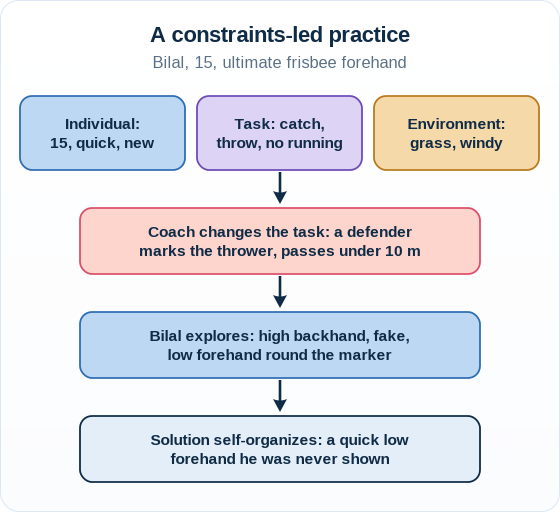
Three constraints, a changed task, exploring, and a self-organized throw
Recap: the constraints-led approach.

The psychological refractory period on a timeline.
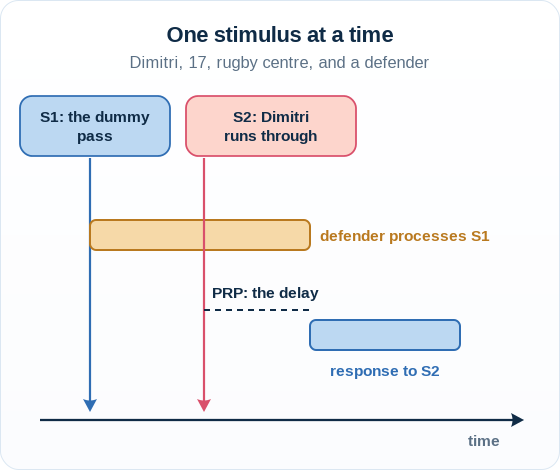
Timeline of a dummy pass, the defender's processing, the real run and the delayed response
Recap: S1, S2, the delay.

Inside My Learning

Turn these notes into practice

Try each question, reveal a clear model answer, and learn how to build your response.

  • 1.Distinguish between learning and performance. [2]
  • 2.Contrast non-linear and linear pedagogy in a football session. [3]
  • 3.Explain how a basketball player uses the PRP with a head fake. [3]
Claim your free topic

Key terms, one line each:

TermIn one line
Learninga relatively permanent change in behaviour from experience
Retention testa test after a break to check learning
Constraints-led approachchanging task, performer or environment constraints
Self-organizationthe learner finding a movement solution
Psychological refractory periodthe delay caused by a second stimulus
Autonomous phaseskill is automatic; attention free for tactics

Inside My Learning

Turn these notes into practice

Try each question, reveal a clear model answer, and learn how to build your response.

  • 1.Schema theory goes with which model?
  • 2.Is safety a difference between the pedagogies?
  • 3.Thinking through each step, many errors: which phase?
Claim your free topic
IB-style questionDiscuss[4 marks]

Discuss the use of the constraints-led approach to coach young hockey players.

Model answer plan

See the mark-by-mark plan — for / against / judgement, with marking guidance — in study mode.

Claim your free topic →

Exam tips

  • Every contrast point must name both approaches.
  • Use relatively permanent for learning, temporary for performance.
  • Pair the models: information processing with schema theory, ecological with ecological dynamics.
  • Use S1 and S2 in PRP answers, and end with the advantage in the sport.
  • Name the transfer type and whether it is positive or negative.

What you'll learn in Topic 8.1

  • 8.1.1 Learning versus performance
  • 8.1.2 Two models of motor learning
  • 8.1.3 Non-linear pedagogy
  • 8.1.4 Linear pedagogy
  • 8.1.5 Psychological refractory
  • 8.1.6 Transfer of learning
Suggested study order: Read the notes for each sub-topic below → test yourself with flashcards → attempt practice questions → review exam technique.

Study resources — 8.1 Motor learning processes

8.1.1

Learning versus performance

Notes
8.1.2

Two models of motor learning

Notes
8.1.3

Non-linear pedagogy

Notes
8.1.4

Linear pedagogy

Notes
8.1.5

Psychological refractory

Notes
8.1.6

Transfer of learning

Notes

Ready to study Motor learning processes?

Get expert practice questions with instant AI feedback, and a study planner tailored to your IB Sports, Exercise and Health Science HL exam date.

Start studying free

Topic 8.1 Motor learning processes forms a core part of Unit 8: Motor learning in IB Sports, Exercise and Health Science HL. Mastering these concepts will strengthen your understanding of connected topics across the syllabus and prepare you for exam questions that require analysis, evaluation, and real-world application.

Previous topic
7.2 Mental toughness
Next topic
8.2 Attentional control
All Sports, Exercise and Health Science HL topics
Exam technique

Ready to practice?

Get AI-graded practice questions, mock exams, flashcards, and a personalised study plan — all aligned to your IB syllabus.

Start Studying Free

No credit card required · No time limit