aımnova
DashboardMy LearningCrash CoursesStudy Plan

Aimnova site navigation

Stay in the loop

Get the latest study resources and updates

New features, study tips and exam insights — straight to your inbox.

IB Diploma

  • IB Past Papers
  • IB Study Notes
  • IB Question Bank
  • IB Mock Exams
  • IB Revision

IB Subjects

  • IB Math AA
  • IB Math AI
  • IB Economics
  • IB Business Management
  • IB Physics
  • IB Biology
  • View all IB subjects→

IB Past Papers

  • IB Math AA HL Past Papers
  • IB Math AA SL Past Papers
  • IB Math AI HL Past Papers
  • IB Math AI SL Past Papers
  • IB Economics HL Past Papers
  • IB Economics SL Past Papers
  • IB ESS Past Papers
  • View all past papers→

Study Resources

  • Study Notes
  • Question Bank
  • Mock Exams
  • Crash Courses
  • Flashcards
  • Revision Guide
  • Exam Skills
  • Command Terms
  • Grade Calculator
  • Exam Timetable 2027

Aimnova

  • Features
  • Pricing
  • For Teachers
  • For Schools
  • For Parents
  • About Us
  • Blog
  • Contact
aımnova

IB study, practice and feedback built around the real exam.

TermsPrivacyCookies·© 2026 Aimnova. All rights reserved.d9e1c61

Aimnova is not affiliated with or endorsed by the International Baccalaureate Organization (IB).

NotesSports, Exercise and Health Science HLTopic 6.1
Unit 6 · Injury · Topic 6.1

IB Sports, Exercise and Health Science HL — Causes of injury

Causes of injury

Higher Level students should use this topic hub as a map: start with the shared sub-topics, then follow the HL-only extensions and exam-skill links where this topic asks for deeper analysis.

Exam technique guidePractice questions

Key concepts in Causes of injury

Start here: Questions on this topic ask you to sort risk factors, classify trauma and correct a faulty technique. Name the maladaptation, how it is found and how it is fixed.

1. Risk factors

  • A risk factor predisposes; it is never the cause.
  • Internal: previous injury, age, sex differences, pregnancy, fitness.
  • External: surface, equipment, position played, weather.
  • Factors interact: they multiply rather than add.

2. Acute and cumulative trauma

  • Acute: one sudden, excessive or wrongly directed force.
  • Cumulative: the same force repeated until the tissue fails.
  • Both affect connective tissue, muscle, bone, skin and the brain.
  • Sprain = ligament; strain = muscle or tendon. Concussion is a brain injury.

3. Overuse and technique (HL)

  • Many overuse injuries come from a biomechanical maladaptation repeated many times.
  • Find it with video analysis or observation.
  • Fix it: correct the technique, strength training for imbalances, fitted equipment, orthotics.
  • Shin splints: orthotics that support the arch.

One big force or many small ones.
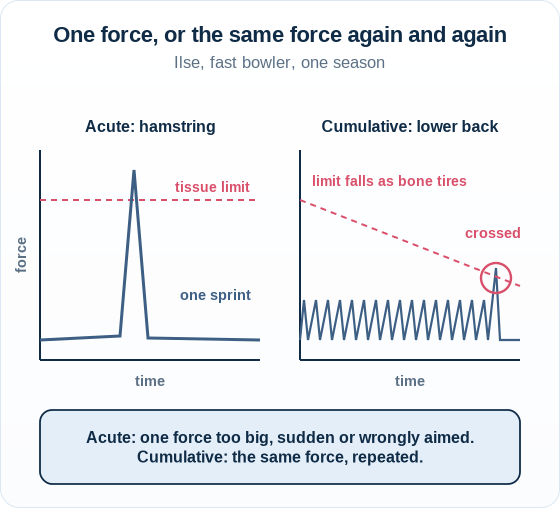
Two force-time panels: one spike past the limit, and repeated spikes with a falling limit
Recap: one force or many.

A faulty backhand, and the corrected one.
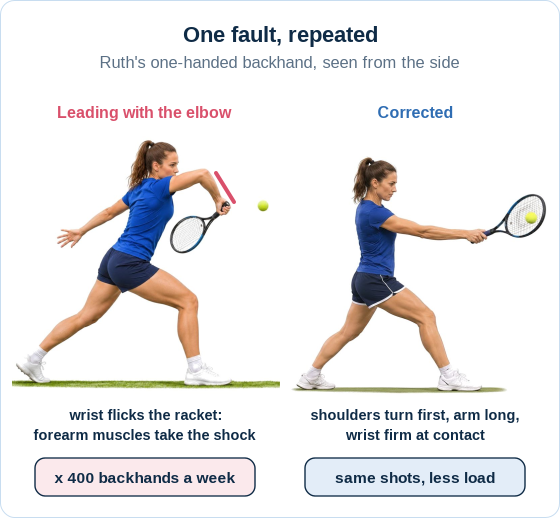
Two arm sketches: an elbow-led backhand and a corrected one with the shoulders turning first
Recap: one fault, corrected.

Inside My Learning

Turn these notes into practice

Try each question, reveal a clear model answer, and learn how to build your response.

  • 1.Classify previous injury and playing surface as internal or external risk factors. [2]
  • 2.Outline two injury risks for an athlete returning to sport after giving birth. [2]
  • 3.Distinguish between acute and cumulative trauma. [2]
Claim your free topic

Key terms, one line each:

TermIn one line
Risk factorsomething that predisposes a person to injury
Internal risk factora variable of the individual
External risk factora variable of the environment or sport
Acute traumainjury from one sudden force
Cumulative traumainjury from repeated force
Maladaptationa faulty movement pattern that raises injury risk

Inside My Learning

Turn these notes into practice

Try each question, reveal a clear model answer, and learn how to build your response.

  • 1.Is age internal or external?
  • 2.A stress fracture in a runner: acute or cumulative?
  • 3.Is weakened bone alone accepted for pregnancy risk?
Claim your free topic
IB-style questionExplain[3 marks]

Explain why a netball player with a previous ankle sprain is at higher risk on a wet outdoor court.

Model answer plan

See the mark-by-mark plan — for / against / judgement, with marking guidance — in study mode.

Claim your free topic →

Exam tips

  • Write predispose or susceptible: a risk factor is never the cause.
  • Previous injury, age, sex and pregnancy are internal; surfaces and equipment are external.
  • Give each pregnancy or postpartum risk its own reason.
  • Use video analysis to find and correct a maladaptation.
  • Targeted strength training removes muscle imbalances before load rises.

What you'll learn in Topic 6.1

  • 6.1.1 Risk factors for injury
  • 6.1.2 Acute and cumulative trauma
  • 6.1.3 Overuse injury and technique
Suggested study order: Read the notes for each sub-topic below → test yourself with flashcards → attempt practice questions → review exam technique.

Study resources — 6.1 Causes of injury

6.1.1

Risk factors for injury

Notes
6.1.2

Acute and cumulative trauma

Notes
6.1.3

Overuse injury and technique

Notes

Ready to study Causes of injury?

Get expert practice questions with instant AI feedback, and a study planner tailored to your IB Sports, Exercise and Health Science HL exam date.

Start studying free

Topic 6.1 Causes of injury forms a core part of Unit 6: Injury in IB Sports, Exercise and Health Science HL. Mastering these concepts will strengthen your understanding of connected topics across the syllabus and prepare you for exam questions that require analysis, evaluation, and real-world application.

Previous topic
5.3 Movement analysis
Next topic
6.2 Injury interventions
All Sports, Exercise and Health Science HL topics
Exam technique

Ready to practice?

Get AI-graded practice questions, mock exams, flashcards, and a personalised study plan — all aligned to your IB syllabus.

Start Studying Free

No credit card required · No time limit