aımnova
DashboardMy LearningCrash CoursesStudy Plan

Aimnova site navigation

Stay in the loop

Get the latest study resources and updates

New features, study tips and exam insights — straight to your inbox.

IB Diploma

  • IB Past Papers
  • IB Study Notes
  • IB Question Bank
  • IB Mock Exams
  • IB Revision

IB Subjects

  • IB Math AA
  • IB Math AI
  • IB Economics
  • IB Business Management
  • IB Physics
  • IB Biology
  • View all IB subjects→

IB Past Papers

  • IB Math AA HL Past Papers
  • IB Math AA SL Past Papers
  • IB Math AI HL Past Papers
  • IB Math AI SL Past Papers
  • IB Economics HL Past Papers
  • IB Economics SL Past Papers
  • IB ESS Past Papers
  • View all past papers→

Study Resources

  • Study Notes
  • Question Bank
  • Mock Exams
  • Crash Courses
  • Flashcards
  • Revision Guide
  • Exam Skills
  • Command Terms
  • Grade Calculator
  • Exam Timetable 2027

Aimnova

  • Features
  • Pricing
  • For Teachers
  • For Schools
  • For Parents
  • About Us
  • Blog
  • Contact
aımnova

IB study, practice and feedback built around the real exam.

TermsPrivacyCookies·© 2026 Aimnova. All rights reserved.d9e1c61

Aimnova is not affiliated with or endorsed by the International Baccalaureate Organization (IB).

NotesSports, Exercise and Health Science HLTopic 4.3
Unit 4 · Generating movement in the body · Topic 4.3

IB Sports, Exercise and Health Science HL — Muscular function

Muscular function

Higher Level students should use this topic hub as a map: start with the shared sub-topics, then follow the HL-only extensions and exam-skill links where this topic asks for deeper analysis.

Exam technique guidePractice questions

Key concepts in Muscular function

Start here: Most questions on this topic are on sliding filament theory, then motor units and contraction types. Give the steps of a cross-bridge in order and say what calcium and ATP each do.

1. Motor units

  • A motor unit = one motor neuron plus the fibres it supplies.
  • Acetylcholine crosses to the muscle; ATP pays for contraction.
  • All or none: one motor unit, never the whole muscle.
  • More force: recruit more units, type I first, then IIa, then IIx.

2. Contraction types

  • A contraction is a muscle producing force, whatever its length does.
  • Isotonic concentric (shortening), isotonic eccentric (lengthening under control).
  • Isometric: force with no change in length. Isokinetic: constant speed, set by a machine.
  • Agonist contracts, antagonist relaxes: reciprocal inhibition.

3. Sliding filaments (HL)

  • Nerve signal: calcium released from the sarcoplasmic reticulum.
  • Calcium binds troponin; tropomyosin moves off actin's binding sites.
  • Myosin heads attach and the power stroke pulls actin to the centre of the sarcomere.
  • ATP binds to detach the head; splitting it re-cocks the head. Filaments slide, they do not shorten.

Motor units recruited as more force is needed.
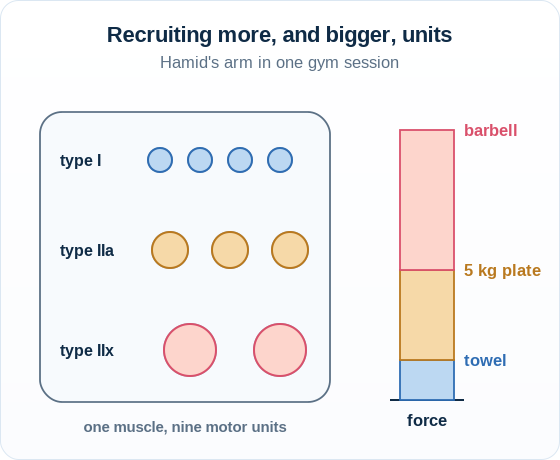
Motor units of three sizes all switched on beside a force bar rising in three steps
Recap: more and bigger units.

The sarcomere, before and after the filaments slide.
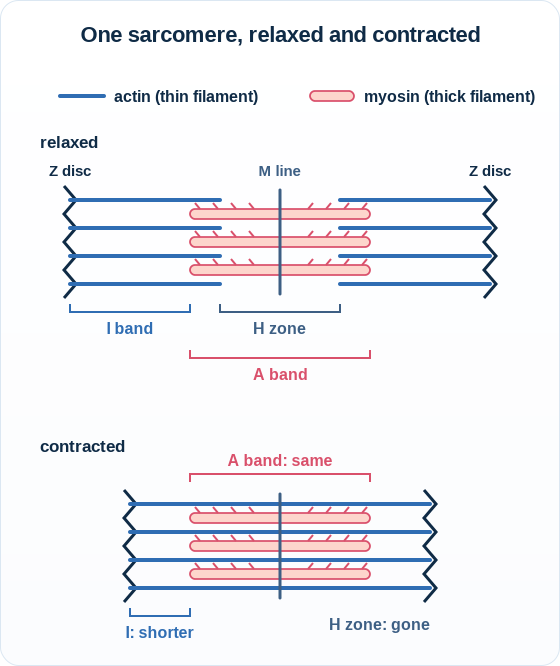
A relaxed and a contracted sarcomere with the Z discs, M line, actin (thin) and myosin (thick) filaments, and the A band, I band and H zone marked
Recap: sliding shortens the sarcomere.

Inside My Learning

Turn these notes into practice

Try each question, reveal a clear model answer, and learn how to build your response.

  • 1.Explain the role of calcium in muscle contraction. [3]
  • 2.Outline the role of ATP in the cross-bridge cycle. [2]
  • 3.Identify the contraction type of the quadriceps femoris while lowering into a squat. [1]
Claim your free topic

Key terms, one line each:

TermIn one line
Motor unita motor neuron and the fibres it supplies
Eccentriclengthening under control while producing force
Sarcomerethe contractile unit between two Z discs
Troponinbinds calcium and moves tropomyosin
Tropomyosincovers actin's binding sites at rest
Cross-bridgea myosin head attached to actin

Inside My Learning

Turn these notes into practice

Try each question, reveal a clear model answer, and learn how to build your response.

  • 1.Where is calcium stored?
  • 2.Do the filaments shorten?
  • 3.What does low calcium do?
Claim your free topic
IB-style questionExplain[4 marks]

Explain how a muscle fibre shortens after a nerve impulse arrives.

Model answer plan

See the mark-by-mark plan — for / against / judgement, with marking guidance — in study mode.

Claim your free topic →

Exam tips

  • Calcium binds troponin, then tropomyosin shifts: keep the order.
  • Tropomyosin moves off the sites; it is not destroyed or rebuilt.
  • ATP detaches the head; its splitting re-cocks it.
  • The filaments slide; they do not shorten.
  • Contraction type needs both words: isotonic concentric or eccentric.

What you'll learn in Topic 4.3

  • 4.3.1 Motor units and contraction
  • 4.3.2 Types of contraction
  • 4.3.3 Sliding filament theory
Suggested study order: Read the notes for each sub-topic below → test yourself with flashcards → attempt practice questions → review exam technique.

Study resources — 4.3 Muscular function

4.3.1

Motor units and contraction

Notes
4.3.2

Types of contraction

Notes
4.3.3

Sliding filament theory

Notes

Ready to study Muscular function?

Get expert practice questions with instant AI feedback, and a study planner tailored to your IB Sports, Exercise and Health Science HL exam date.

Start studying free

Topic 4.3 Muscular function forms a core part of Unit 4: Generating movement in the body in IB Sports, Exercise and Health Science HL. Mastering these concepts will strengthen your understanding of connected topics across the syllabus and prepare you for exam questions that require analysis, evaluation, and real-world application.

Previous topic
4.2 Connective tissues and joints
Next topic
4.4 Levers in movement and sport
All Sports, Exercise and Health Science HL topics
Exam technique

Ready to practice?

Get AI-graded practice questions, mock exams, flashcards, and a personalised study plan — all aligned to your IB syllabus.

Start Studying Free

No credit card required · No time limit