This page explains how a muscle actually shortens: thin and thick protein filaments sliding past each other, switched on by calcium and powered by ATP.
Our example: Ines is a 100 m sprinter. As she drives out of the blocks her quadriceps must contract hard in a fraction of a second. Everything on this page happens millions of times inside those muscles in that moment.
From muscle to filament
Muscle
Made of bundles of long muscle fibres (cells).
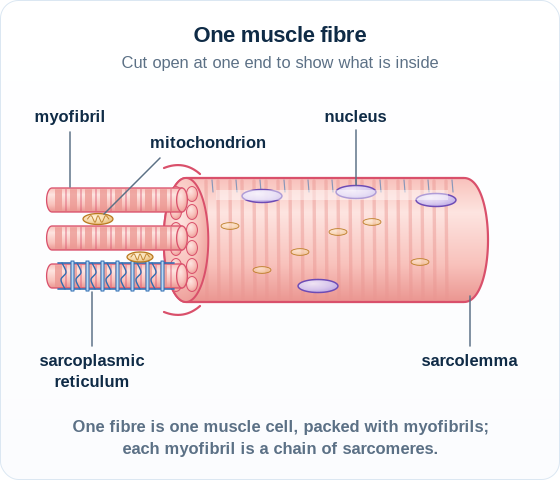
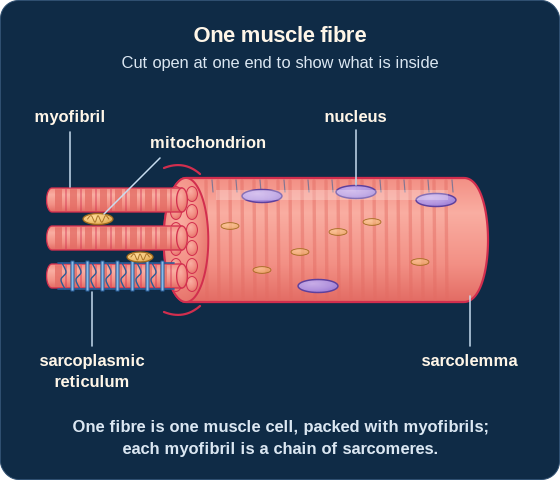
Muscle fibre
Packed with myofibrils. Each myofibril is wrapped in a network of sarcoplasmic reticulum, the fibre's calcium store.
Myofibril
A chain of repeating units called sarcomeres, end to end.
Sarcomere
The unit that shortens: from one Z disc (also called the Z line) to the next, with actin and myosin filaments inside.
See it drawn, step by step
In My Learning, handwritten diagrams build one step at a time. Play, pause and replay each explanation until it clicks. Create your free account to try it.
Sliding, not shrinking: The filaments do not get shorter. Actin slides over myosin towards the centre, so each sarcomere shortens, and so does the whole muscle.
Free preview
This is the free notes preview
You're reading the free notes. Aimnova Pro unlocks the full study experience — and you can try it with your first topic free to keep:
- FlashcardsLock in vocabulary and key terms with spaced repetition.
- Practice questionsAnswer exam-style questions and get instant AI marking.
- Mock exams & past-paper vaultSit full mocks and see exactly how examiners award marks.
- Personalised study planA daily plan built around your exam date and weak areas.
Myosin is ready to grab actin at any moment, but at rest the binding sites are covered. Calcium uncovers them.
See it drawn, step by step
In My Learning, handwritten diagrams build one step at a time. Play, pause and replay each explanation until it clicks. Create your free account to try it.
Who does what
| Molecule | Role |
|---|---|
| Calcium ions | Released from the sarcoplasmic reticulum; bind to troponin |
| Troponin | Changes shape when calcium binds, moving tropomyosin |
| Tropomyosin | Covers actin's binding sites at rest |
| Actin | Thin filament with the binding sites |
| Myosin | Thick filament whose heads form cross-bridges |
Low calcium, weak contraction: With too little calcium, fewer binding sites are exposed, so fewer cross-bridges form and the force is low.
Get feedback like a real examiner
Submit your answers and get instant feedback — what you did well, what's missing, and exactly what to write to score full marks.
Once the sites are open, each myosin head works like a rower's oar: grab, pull, let go, reach forward, again.
See it drawn, step by step
In My Learning, handwritten diagrams build one step at a time. Play, pause and replay each explanation until it clicks. Create your free account to try it.
Two jobs for ATP: ATP binding detaches the myosin head from actin. Splitting ATP re-cocks the head for the next stroke. Without ATP the heads stay stuck on actin.
Stopping: When the nerve signal stops, calcium is pumped back into the sarcoplasmic reticulum, tropomyosin covers the sites again, and the muscle relaxes.
How this is tested — you put the steps of contraction in order, or give the role of one molecule. It comes up two ways:
Paper 1 — recall and data
- Paper 1A: the role of ATP or of calcium
- What low calcium does to cross-bridges and force
Paper 2 — explain and evaluate
- Paper 2 asks you to outline calcium's role or explain the whole process
- One mark per step, in the right order
Right word, wrong molecule: Calcium binds to troponin, not to tropomyosin or myosin. ATP detaches the head; it does not expose the binding sites.
Ines holds her drive phase for the first 30 m of a race. Explain why her muscle fibres can keep shortening only while ATP is available.
Model answer plan
See the answer broken into clear points, with guidance on how each point earns marks.
Exam tips
- Calcium binds troponin; troponin changes shape; tropomyosin shifts off the binding sites; cross-bridges can form.
- Say tropomyosin moves or is released from the sites; it is not rebuilt or destroyed.
- ATP: binds to the myosin head and detaches it from actin; its splitting re-cocks the head.
- Low calcium: fewer exposed sites, fewer or weaker cross-bridges, lower force.
- The power stroke pulls actin towards the centre of the sarcomere; filaments slide, they do not shorten.