aımnova
DashboardMy LearningCrash CoursesStudy Plan

Aimnova site navigation

Stay in the loop

Get the latest study resources and updates

New features, study tips and exam insights — straight to your inbox.

IB Diploma

  • IB Past Papers
  • IB Study Notes
  • IB Question Bank
  • IB Mock Exams
  • IB Revision

IB Subjects

  • IB Math AA
  • IB Math AI
  • IB Economics
  • IB Business Management
  • IB Physics
  • IB Biology
  • View all IB subjects→

IB Past Papers

  • IB Math AA HL Past Papers
  • IB Math AA SL Past Papers
  • IB Math AI HL Past Papers
  • IB Math AI SL Past Papers
  • IB Economics HL Past Papers
  • IB Economics SL Past Papers
  • IB ESS Past Papers
  • View all past papers→

Study Resources

  • Study Notes
  • Question Bank
  • Mock Exams
  • Crash Courses
  • Flashcards
  • Revision Guide
  • Exam Skills
  • Command Terms
  • Grade Calculator
  • Exam Timetable 2027

Aimnova

  • Features
  • Pricing
  • For Teachers
  • For Schools
  • For Parents
  • About Us
  • Blog
  • Contact
aımnova

IB study, practice and feedback built around the real exam.

TermsPrivacyCookies·© 2026 Aimnova. All rights reserved.d9e1c61

Aimnova is not affiliated with or endorsed by the International Baccalaureate Organization (IB).

NotesSports, Exercise and Health Science HLTopic 3.2
Unit 3 · Response · Topic 3.2

IB Sports, Exercise and Health Science HL — Benefits of being active

Benefits to health of being active

Higher Level students should use this topic hub as a map: start with the shared sub-topics, then follow the HL-only extensions and exam-skill links where this topic asks for deeper analysis.

Exam technique guidePractice questions

Key concepts in Benefits of being active

Start here: Questions on this topic ask for the health benefits of activity and how to prescribe it safely for a named group. Fit every choice to the person: children, older adults or pregnancy.

1. How much, and energy balance

  • A healthy amount of activity varies with age and sex.
  • Energy balance: intake, consumption, and storage, which takes the difference.
  • More intake than use: storage rises; less: it falls.

2. Muscle, bone and immunity

  • Load bearing makes denser bone; muscles and connective tissue get stronger.
  • Moderate activity strengthens the immune system; very heavy load weakens it (the J-curve).
  • Inactivity works the other way: muscle and bone are lost.

3. Lower risk

  • Regular activity reduces the risk of heart disease, type 2 diabetes, obesity, osteoporosis and some cancers.
  • Type 2 diabetes: more muscle to take up glucose and cells more sensitive to insulin.
  • Write reduces the risk, never prevents.

4. Prescribing exercise (HL)

  • Screen, measure a baseline, set frequency, intensity, time and type, progress, monitor.
  • Children: varied, supervised, technique-first strength work; care in heat.
  • Older adults: low-impact aerobic work plus resistance and balance training.
  • Pregnancy: medical clearance, moderate intensity, no contact or fall risk, no overheating.

The J-shaped curve of training load and illness risk.
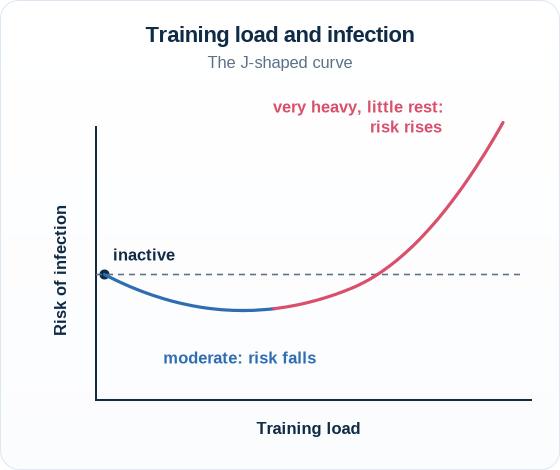
Infection risk falling with moderate load and rising with very heavy load
Recap: the J-shaped curve.

Five steps from screening to monitoring.
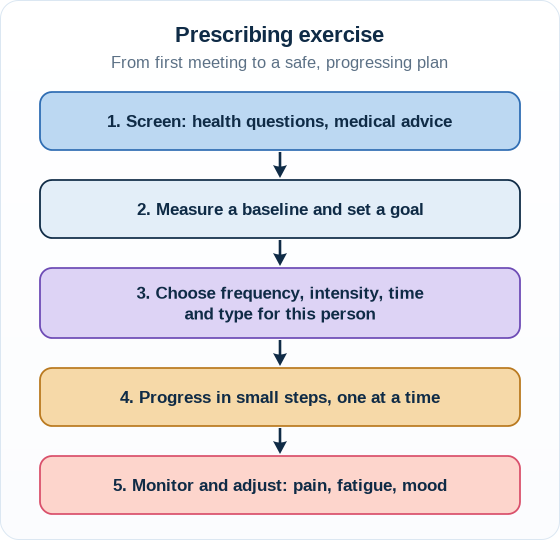
Five steps from screening to monitoring
Recap: how a prescription is built.

Inside My Learning

Turn these notes into practice

Try each question, reveal a clear model answer, and learn how to build your response.

  • 1.Outline two musculoskeletal benefits of regular activity. [2]
  • 2.Suggest a suitable programme for a 70-year-old beginner. [3]
  • 3.Outline two guidelines for exercise during pregnancy. [2]
Claim your free topic

Key terms, one line each:

TermIn one line
Energy balanceintake minus consumption, shown in storage
J-curveillness risk against training load
FITTfrequency, intensity, time, type of exercise
Screeninghealth checks before a programme starts
Insulin sensitivityhow strongly cells respond to insulin

Inside My Learning

Turn these notes into practice

Try each question, reveal a clear model answer, and learn how to build your response.

  • 1.Should older adults avoid resistance training?
  • 2.How should a prescription progress?
  • 3.What must come before a pregnant woman starts?
Claim your free topic
IB-style questionDesign[4 marks]

Design an exercise prescription for a 12-year-old who wants to start strength training.

Model answer plan

See the mark-by-mark plan — for / against / judgement, with marking guidance — in study mode.

Claim your free topic →

Exam tips

  • Older beginners: low-impact aerobic work plus resistance and balance training.
  • Never write that older adults should avoid resistance training.
  • Children: supervised, light, technique-first strength work and varied activity.
  • Progress one variable at a time to lower injury risk.
  • Write reduces the risk, never prevents.

What you'll learn in Topic 3.2

  • 3.2.1 Active lifestyle and health
  • 3.2.2 Prescribing exercise
Suggested study order: Read the notes for each sub-topic below → test yourself with flashcards → attempt practice questions → review exam technique.

Study resources — 3.2 Benefits of being active

3.2.1

Active lifestyle and health

Notes
3.2.2

Prescribing exercise

Notes

Ready to study Benefits of being active?

Get expert practice questions with instant AI feedback, and a study planner tailored to your IB Sports, Exercise and Health Science HL exam date.

Start studying free

Topic 3.2 Benefits of being active forms a core part of Unit 3: Response in IB Sports, Exercise and Health Science HL. Mastering these concepts will strengthen your understanding of connected topics across the syllabus and prepare you for exam questions that require analysis, evaluation, and real-world application.

Previous topic
3.1 Qualities of training
Next topic
3.3 Fatigue and recovery
All Sports, Exercise and Health Science HL topics
Exam technique

Ready to practice?

Get AI-graded practice questions, mock exams, flashcards, and a personalised study plan — all aligned to your IB syllabus.

Start Studying Free

No credit card required · No time limit