aımnova
DashboardMy LearningCrash CoursesStudy Plan

Aimnova site navigation

Stay in the loop

Get the latest study resources and updates

New features, study tips and exam insights — straight to your inbox.

IB Diploma

  • IB Past Papers
  • IB Study Notes
  • IB Question Bank
  • IB Mock Exams
  • IB Revision

IB Subjects

  • IB Math AA
  • IB Math AI
  • IB Economics
  • IB Business Management
  • IB Physics
  • IB Biology
  • View all IB subjects→

IB Past Papers

  • IB Math AA HL Past Papers
  • IB Math AA SL Past Papers
  • IB Math AI HL Past Papers
  • IB Math AI SL Past Papers
  • IB Economics HL Past Papers
  • IB Economics SL Past Papers
  • IB ESS Past Papers
  • View all past papers→

Study Resources

  • Study Notes
  • Question Bank
  • Mock Exams
  • Crash Courses
  • Flashcards
  • Revision Guide
  • Exam Skills
  • Command Terms
  • Grade Calculator
  • Exam Timetable 2027

Aimnova

  • Features
  • Pricing
  • For Teachers
  • For Schools
  • For Parents
  • About Us
  • Blog
  • Contact
aımnova

IB study, practice and feedback built around the real exam.

TermsPrivacyCookies·© 2026 Aimnova. All rights reserved.d9e1c61

Aimnova is not affiliated with or endorsed by the International Baccalaureate Organization (IB).

NotesSports, Exercise and Health Science HLTopic 3.1
Unit 3 · Response · Topic 3.1

IB Sports, Exercise and Health Science HL — Qualities of training

Qualities of training

Higher Level students should use this topic hub as a map: start with the shared sub-topics, then follow the HL-only extensions and exam-skill links where this topic asks for deeper analysis.

Exam technique guidePractice questions

Key concepts in Qualities of training

Start here: Most questions on this topic are about the training principles, applied to the athlete in the question. A list of principle names scores little: say what each one means for this person.

1. Training principles

  • Test a baseline first, so you can tell whether the programme worked.
  • Specificity: train the energy system, muscles and movements of the event.
  • Progressive overload: raise load, reps or sets step by step.
  • Recovery is when adaptation happens; reversibility: stop and fitness is lost.
  • Variety keeps motivation up and lowers overuse injury risk.

2. Periodization

  • Macrocycle (often a year), mesocycles (weeks), microcycles (usually a week).
  • The year: preparation, competition, then a transition period for recovery.
  • Transition = active rest and strengthening injury-prone muscles, not peak work.
  • Aerobic methods raise endurance; anaerobic methods raise speed and power.

3. The individual

  • Before planning check medical history, baseline fitness, age, facilities and motivation.
  • Responders and non-responders differ mainly through genetics.
  • Plan around the menstrual cycle: name the phase, the hormone, and what changes.
  • Overreaching is short-term; overtraining lasts: performance falls, fatigue, higher resting heart rate.

Progressive overload: the load steps up and fitness follows.
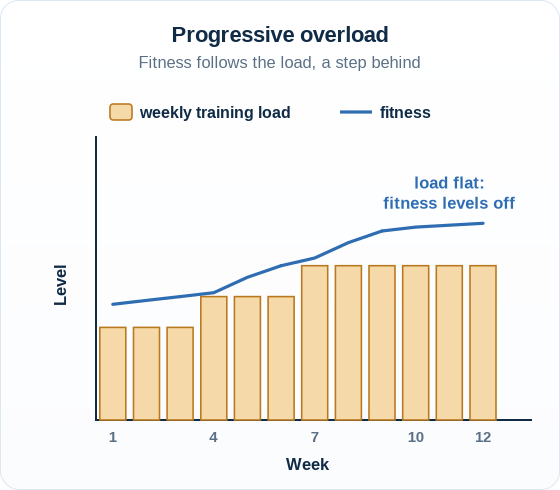
Weekly load rising in steps with fitness following
Recap: fitness follows the load.

The training year at four zoom levels.

The same training year at four zoom levels. Watch how each row is one piece of the row above it.

Interactive diagram

Explore the labelled diagram, charts and maps for this topic in study mode.

Claim your free topic →

Inside My Learning

Turn these notes into practice

Try each question, reveal a clear model answer, and learn how to build your response.

  • 1.Explain how progressive overload could be applied by a weightlifter. [2]
  • 2.Outline the purpose of the transition period. [2]
  • 3.Outline two signs of overtraining. [2]
Claim your free topic

Key terms, one line each:

TermIn one line
Specificitytraining matched to the demands of the event
Progressive overloada gradual rise in training load
Reversibilityfitness lost when training stops
Macrocyclethe whole training period, often a year
Microcycleone short block, usually a week
Overtraininglong-term decline from too much load and too little recovery

Inside My Learning

Turn these notes into practice

Try each question, reveal a clear model answer, and learn how to build your response.

  • 1.Which cycle is usually one week?
  • 2.More rest or less resistance: is that overload?
  • 3.What is the transition period for?
Claim your free topic
IB-style questionDesign[4 marks]

Design a six-week training block for a 200 m swimmer, using four training principles.

Model answer plan

See the mark-by-mark plan — for / against / judgement, with marking guidance — in study mode.

Claim your free topic →

Exam tips

  • Apply every principle to the athlete in the question.
  • Overload means more load, reps or sets: more rest or less resistance is not overload.
  • Variety scores for two reasons: motivation and less overuse injury.
  • Know the order and length of the cycles: macro, meso, micro.
  • Signs of overtraining must be long-term, not one bad session.

What you'll learn in Topic 3.1

  • 3.1.1 Training principles
  • 3.1.2 Periodization cycles
  • 3.1.3 Designing for the individual
Suggested study order: Read the notes for each sub-topic below → test yourself with flashcards → attempt practice questions → review exam technique.

Study resources — 3.1 Qualities of training

3.1.1

Training principles

Notes
3.1.2

Periodization cycles

Notes
3.1.3

Designing for the individual

Notes

Ready to study Qualities of training?

Get expert practice questions with instant AI feedback, and a study planner tailored to your IB Sports, Exercise and Health Science HL exam date.

Start studying free

Topic 3.1 Qualities of training forms a core part of Unit 3: Response in IB Sports, Exercise and Health Science HL. Mastering these concepts will strengthen your understanding of connected topics across the syllabus and prepare you for exam questions that require analysis, evaluation, and real-world application.

Previous topic
2.3 Energy systems
Next topic
3.2 Benefits of being active
All Sports, Exercise and Health Science HL topics
Exam technique

Ready to practice?

Get AI-graded practice questions, mock exams, flashcards, and a personalised study plan — all aligned to your IB syllabus.

Start Studying Free

No credit card required · No time limit