aımnova
DashboardMy LearningCrash CoursesStudy Plan

Aimnova site navigation

Stay in the loop

Get the latest study resources and updates

New features, study tips and exam insights — straight to your inbox.

IB Diploma

  • IB Past Papers
  • IB Study Notes
  • IB Question Bank
  • IB Mock Exams
  • IB Revision

IB Subjects

  • IB Math AA
  • IB Math AI
  • IB Economics
  • IB Business Management
  • IB Physics
  • IB Biology
  • View all IB subjects→

IB Past Papers

  • IB Math AA HL Past Papers
  • IB Math AA SL Past Papers
  • IB Math AI HL Past Papers
  • IB Math AI SL Past Papers
  • IB Economics HL Past Papers
  • IB Economics SL Past Papers
  • IB ESS Past Papers
  • View all past papers→

Study Resources

  • Study Notes
  • Question Bank
  • Mock Exams
  • Crash Courses
  • Flashcards
  • Revision Guide
  • Exam Skills
  • Command Terms
  • Grade Calculator
  • Exam Timetable 2027

Aimnova

  • Features
  • Pricing
  • For Teachers
  • For Schools
  • For Parents
  • About Us
  • Blog
  • Contact
aımnova

IB study, practice and feedback built around the real exam.

TermsPrivacyCookies·© 2026 Aimnova. All rights reserved.d9e1c61

Aimnova is not affiliated with or endorsed by the International Baccalaureate Organization (IB).

NotesSports, Exercise and Health Science HLTopic 11.1
Unit 11 · Psychological skills · Topic 11.1

IB Sports, Exercise and Health Science HL — Goal setting

Goal setting

Higher Level students should use this topic hub as a map: start with the shared sub-topics, then follow the HL-only extensions and exam-skill links where this topic asks for deeper analysis.

Exam technique guidePractice questions

Key concepts in Goal setting

Start here: Questions on this topic ask you to classify goals and weigh up goal setting, including its paradox. Give limitations as well as benefits.

1. Goal types

  • Goals direct attention and raise motivation.
  • Outcome: a result against others (winning, selection): norm-referenced.
  • Performance: a measurable number about yourself (a time, a weight).
  • Process: the technique or strategy; performance and process are self-referenced.

2. Choosing the right goal

  • Match the goal to the athlete's achievement motivation.
  • Anxious failure avoiders: process goals, which are in their control.
  • Task-oriented high achievers: challenging performance goals.
  • Confident ego-oriented athletes: outcome goals can motivate.

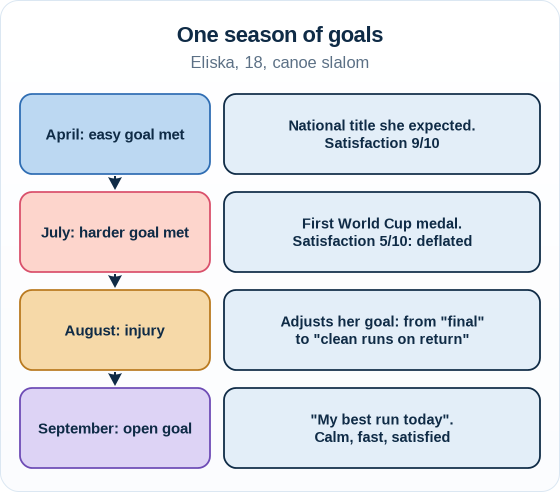
3. The goal-setting paradox (HL)

  • Reaching a higher goal can bring less satisfaction than an easier one.
  • Goal adjustment matters more than goal setting.
  • Disengaging from an unreachable goal protects well-being.
  • Some athletes do best with open or do-your-best goals.

Outcome, performance and process goals as a ladder.
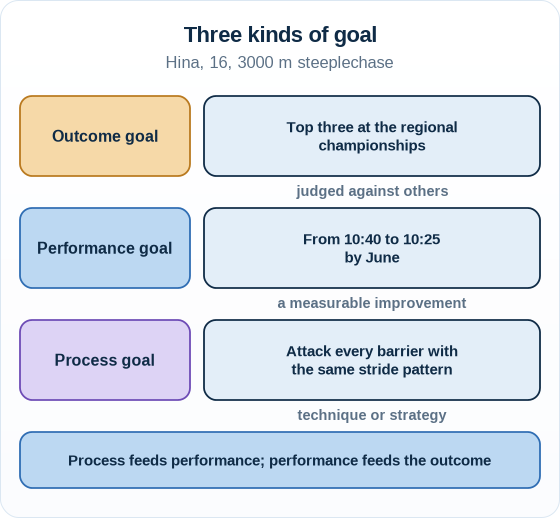
Outcome, performance and process goals for a steeplechaser
Recap: three kinds of goal.

The goal-setting paradox.

Four stages of a canoe slalom season of goals
Recap: Eliska's season.

Inside My Learning

Turn these notes into practice

Try each question, reveal a clear model answer, and learn how to build your response.

  • 1.Contrast outcome goals and performance goals. [2]
  • 2.Identify the goal type: *keep my elbow high on the catch*. [1]
  • 3.Explain why process goals suit an anxious swimmer. [2]
Claim your free topic

Key terms, one line each:

TermIn one line
Outcome goala result judged against others
Performance goala measurable improvement on yourself
Process goala technique or strategy to carry out
Norm-referencedjudged against other people
Goal adjustmentchanging a goal as circumstances change

Inside My Learning

Turn these notes into practice

Try each question, reveal a clear model answer, and learn how to build your response.

  • 1.Lift 80 kg: which goal?
  • 2.Make the team: which goal?
  • 3.Which goals are in the athlete's control?
Claim your free topic
IB-style questionSuggest[3 marks]

A nervous 15-year-old runner fears failure. Suggest suitable goals for her first season.

Model answer plan

See the mark-by-mark plan — for / against / judgement, with marking guidance — in study mode.

Claim your free topic →

Exam tips

  • In a contrast, mention both goal types in each point.
  • Performance goal = a measurable number about yourself.
  • Outcome goals depend on other people.
  • Goal adjustment builds an adaptable approach to progress.
  • Give limitations too: the paradox, rigid goals, open goals for some.

What you'll learn in Topic 11.1

  • 11.1.1 Outcome and learning goals
  • 11.1.2 Choosing the right goal
  • 11.1.3 The goal-setting paradox
Suggested study order: Read the notes for each sub-topic below → test yourself with flashcards → attempt practice questions → review exam technique.

Study resources — 11.1 Goal setting

11.1.1

Outcome and learning goals

Notes
11.1.2

Choosing the right goal

Notes
11.1.3

The goal-setting paradox

Notes

Ready to study Goal setting?

Get expert practice questions with instant AI feedback, and a study planner tailored to your IB Sports, Exercise and Health Science HL exam date.

Start studying free

Topic 11.1 Goal setting forms a core part of Unit 11: Psychological skills in IB Sports, Exercise and Health Science HL. Mastering these concepts will strengthen your understanding of connected topics across the syllabus and prepare you for exam questions that require analysis, evaluation, and real-world application.

Previous topic
10.2 Coping
Next topic
11.2 Imagery
All Sports, Exercise and Health Science HL topics
Exam technique

Ready to practice?

Get AI-graded practice questions, mock exams, flashcards, and a personalised study plan — all aligned to your IB syllabus.

Start Studying Free

No credit card required · No time limit