Start here: Questions on this topic ask for the purpose of an image and how to make imagery work. Classify with Paivio's four functions, and apply PETTLEP one element per point.
1. What imagery is
- Imagery mimics real experience using several senses, without actual perception.
- It can lower anxiety and heart rate.
- During injury it keeps skills practised and confidence up.
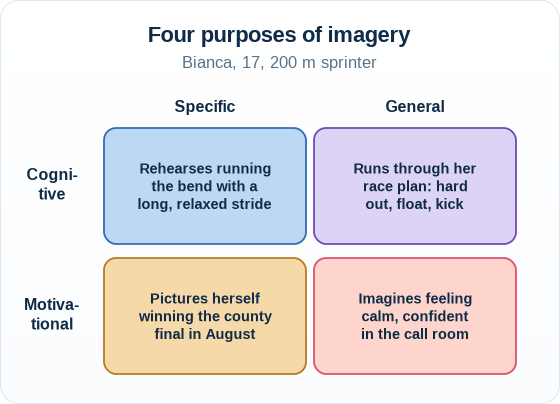
2. Paivio's framework
- Cognitive specific: a single skill, such as a perfect serve.
- Cognitive general: a strategy or game plan.
- Motivational specific (a goal) and motivational general (arousal, confidence).
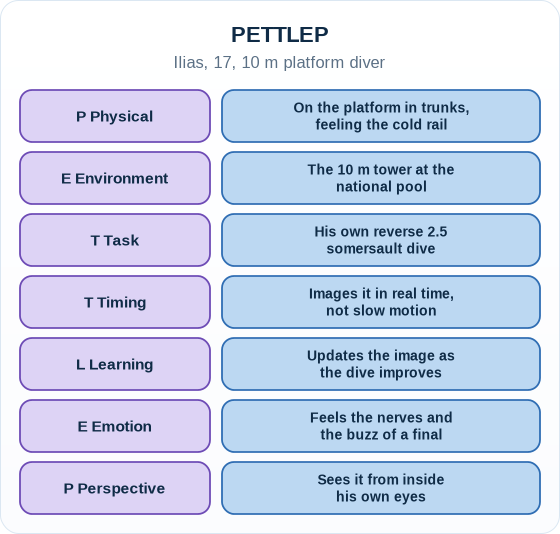
3. PETTLEP
- Physical, Environment, Task, Timing, Learning, Emotion, Perspective.
- Aim: imagery as functionally equivalent to the real thing as possible.
- An easy, different setting is not equivalent.
Four purposes of imagery.
PETTLEP applied to a diver.
Key terms, one line each:
| Term | In one line |
|---|---|
| Imagery | creating or re-creating an experience in the mind |
| Functional equivalence | imagery that matches the real task closely |
| Cognitive general | imagery of strategies and game plans |
| Motivational general | imagery of arousal, confidence and coping |
IB-style questionExplain[4 marks]
Explain how a sprinter could use PETTLEP imagery before a final.
Model answer plan
See the mark-by-mark plan — for / against / judgement, with marking guidance — in study mode.
Exam tips
- Rehearsing a single perfect skill is cognitive specific; a strategy is cognitive general.
- PETTLEP answers: one element per mark, applied to the named athlete.
- Emotion: replicate competition feelings and rehearse managing them.
- To reduce anxiety: relaxed body, familiar setting, rehearsed task, real-time timing.