Start here: Most questions on this topic are on self-talk from a study's data, then matching coping to the stressor. Ask first whether the stressor can be controlled.
1. Coping strategies
- A stressor causes strain, positive or negative.
- Problem-focused: change the stressor (problem solving, seeking information).
- Emotion-focused: calm the reaction (relaxation, emotional support, self-talk).
- Avoidance-focused: get away from it (ignoring, quitting).
2. Self-talk and relaxation
- Self-talk can be problem- or emotion-focused; unintentional self-talk positive or negative.
- Mechanisms: recall good experiences, acronyms, cue words.
- Negative self-talk narrows attention.
- Relaxation training gives more control of heart rate.
3. Matching and effectiveness (HL)
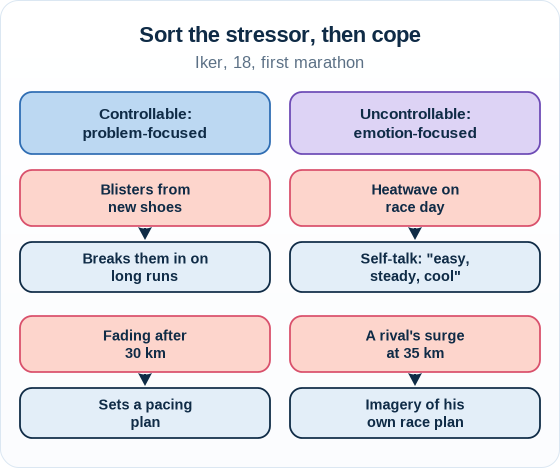
- Controllable stressor: problem-focused. Uncontrollable (weather, opponents): emotion-focused.
- Seeking support is the most effective type for athletes.
- Also effective: logical analysis, relaxation, imagery, thought control, effort expenditure.
- Distraction helps only short term; withdrawal, venting and self-blame are maladaptive.
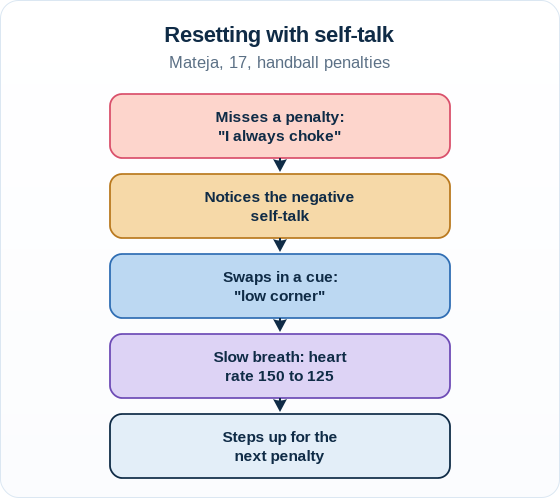
Resetting with self-talk.
Sorting stressors: controllable or not.
Key terms, one line each:
| Term | In one line |
|---|---|
| Stressor | a demand that causes strain |
| Problem-focused coping | acting on the stressor itself |
| Emotion-focused coping | managing the emotional reaction |
| Controllable stressor | a stressor the athlete can change |
| Maladaptive coping | a strategy that makes things worse |
IB-style questionDiscuss[4 marks]
A study finds that a self-talk group improved its free-throw score more than a control group. Discuss whether this supports the hypothesis that self-talk improves shooting.
Model answer plan
See the mark-by-mark plan — for / against / judgement, with marking guidance — in study mode.
Exam tips
- Controllable stressor: problem-focused; uncontrollable: emotion-focused.
- Apply the strategy to the athlete in the question.
- Effectiveness depends on the person and the situation.
- Show the subtraction as well as the answer.
- Discuss a hypothesis with evidence for and against.